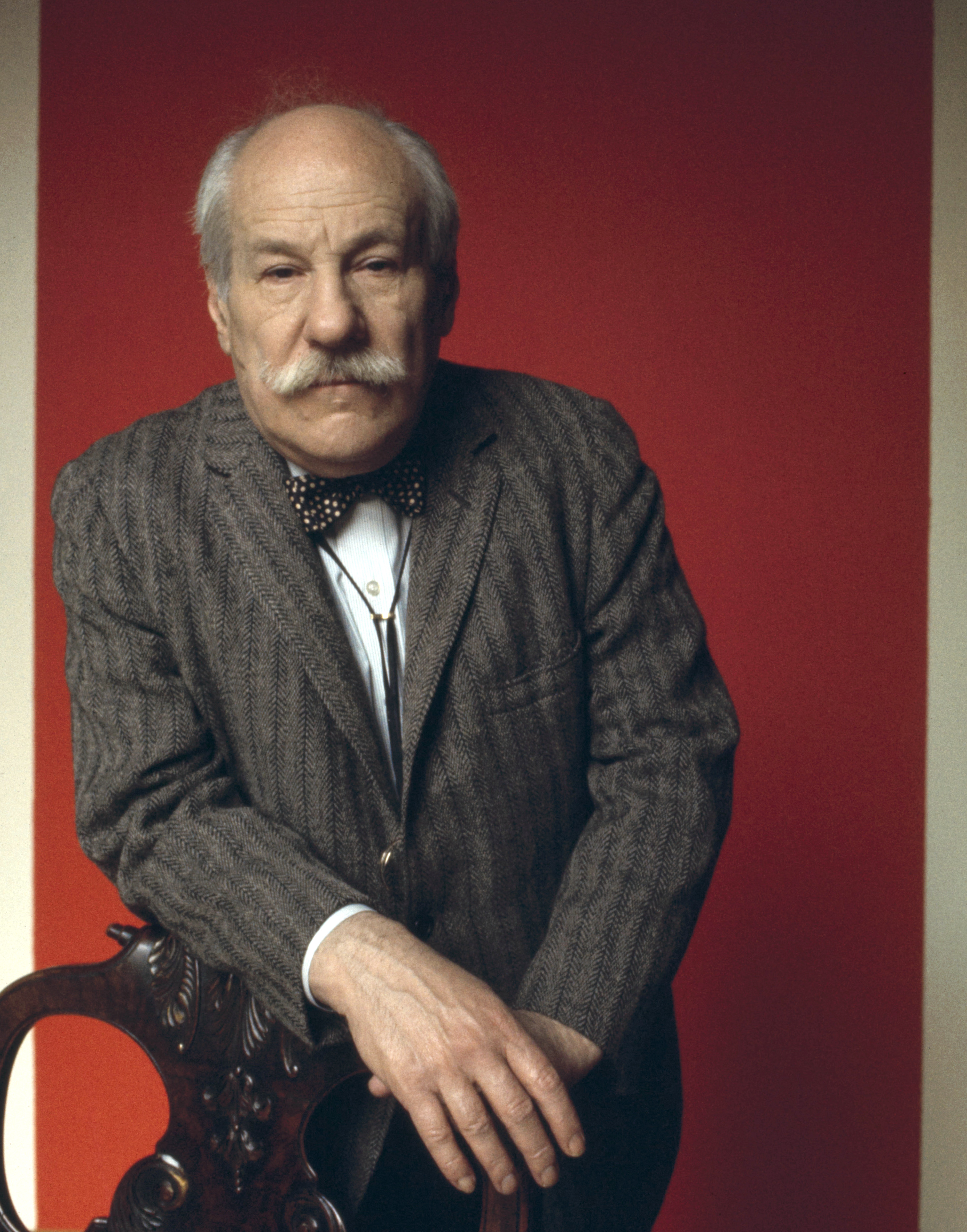
Why Barnett Newman matters
Barnett Newman is one of the foundational figures of postwar American art, the Abstract Expressionist who reduced painting to a single vertical line of color and, in doing so, helped invent both color field painting and the conceptual ground that Minimalism would later build on. For a collector, he is a study in scarcity at the very top of the market: an artist with a small, fully catalogued body of work, deep museum entrenchment, and a record of eight-figure and nine-figure results when a major canvas does come to sale.
- Born
- 1905-01-29, New York City, USA
- Nationality
- American
- Media
- Painting, Sculpture, Printmaking
- Movement
- Abstract Expressionism, Color Field painting
- Education
- City College of New York, philosophy; studied at the Art Students League of New York
- Signature motifs
- The zip, Color field, The sublime
- Representation
- Estate represented by The Barnett Newman Foundation
By the numbers
- USD 84.2MAuction highBlack Fire I, Christie's New York, 2014
- Abstract ExpressionismMovementcolor field painting; the zip
- Published 2004Catalogue raisonneThe Barnett Newman Foundation
- The Barnett Newman FoundationEstate
Selected works
Click any work to view it full screen.
Biography
Barnett Newman was born in New York City on 29 January 1905 to immigrant parents and studied philosophy at City College of New York while taking classes at the Art Students League. He spent much of the 1930s and 1940s writing, teaching, and helping organize exhibitions before he settled into the work for which he is known. His mature style arrived with the Onement series, begun in 1948, built around what he called the zip: a thin vertical band that divides and activates a field of color rather than describing any object within it.
Newman pursued an idea of the sublime rather than beauty, treating the canvas as a space the viewer stands before and inside of rather than simply looks at. Major works followed across the 1950s and 1960s, among them Vir Heroicus Sublimis, the fourteen-canvas cycle The Stations of the Cross: Lema Sabachthani, the Who's Afraid of Red, Yellow and Blue series, and the steel sculpture Broken Obelisk.
For much of his career Newman was dismissed or misread, and several of his paintings were later slashed or defaced by viewers who rejected them. Critical recognition arrived late, accelerated by a 1959 solo exhibition at French & Company organized with Clement Greenberg. Newman died in New York City on 4 July 1970. In 1979 his widow, Annalee Newman, established The Barnett Newman Foundation, which published the catalogue raisonne of his work in 2004.
Critical reception
The critical history of Newman is a story of reversal. For years he was treated as a marginal or eccentric figure, and the critic Thomas B. Hess, an early and influential champion, captured the speed of his rehabilitation from marginal figure to a father figure for younger painters. Clement Greenberg's championing helped cement his standing within Abstract Expressionism, while a younger generation read the zip paintings as a bridge toward Minimalism and Color Field abstraction, a lineage Newman himself resisted. Critics and historians have centered on his ambition for the sublime, the idea that a stripped down field of color and a single vertical band could produce an experience of scale and presence rather than depict a subject. Later scholarship, anchored by the 2002 retrospective at the Philadelphia Museum of Art and Tate Modern and by the National Gallery of Art's stewardship of The Stations of the Cross, has treated him as one of the most intellectually rigorous painters of his era. The enduring debate is less about quality than about how much philosophical and religious weight the work can carry.
Watch
Market
Newman's market is defined by scarcity and concentration at the high end. His auction high is Black Fire I (1961), which sold for USD 84,165,000 at Christie's New York on 13 May 2014. Onement VI (1953) sold for USD 43,845,000 at Sotheby's New York in May 2013. Because so few canvases are in private hands and a full catalogue raisonne fixes the corpus, individual results reflect the specific work and the moment of sale far more than any steady trend line.
Top auction results
| Work | Price | Sale |
|---|---|---|
| Black Fire I (1961) | USD 84,165,000 (USD 84,165,000) | Christie's, New York, 2014-05-13 |
| Onement VI (1953) | USD 43,845,000 (USD 43,845,000) | Sotheby's, New York, 2013-05-14 |
Selected exhibitions
| Years | Exhibition | Venues |
|---|---|---|
| 1958 to 1966 | The Stations of the Cross: Lema Sabachthani | National Gallery of Art, Washington, D.C. |
| 1959 | Barnett Newman | French & Company, New York (organized with Clement Greenberg) |
| 2002 | Barnett Newman | Philadelphia Museum of Art; Tate Modern, London |
Museum collections
- Museum of Modern Art, New York
- Metropolitan Museum of Art, New York
- National Gallery of Art, Washington, D.C.
- Tate, London
- San Francisco Museum of Modern Art
- Stedelijk Museum, Amsterdam
Awards and honors
- Honorary doctorate, University of Akron (1968)
Authentication and provenance
Catalogue raisonne published.
A full catalogue raisonne of paintings and works on paper was published in 2004 by The Barnett Newman Foundation. The Foundation, established by Annalee Newman, is the primary authority on the artist's estate and archive.
Primary reference: http://www.barnettnewman.org/
What collectors should know
Newman's appeal at the very top of the market is inseparable from how little there is to buy. The body of work is small and fully documented through the 2004 catalogue raisonne, and most of the strongest paintings sit in museum collections, which means major canvases reach the market rarely and command exceptional prices when they do. Authentication runs through The Barnett Newman Foundation and the catalogue raisonne, so provenance and inclusion in the published record matter more than for artists with looser documentation. For a collector, the durability signal is unusually strong, anchored by deep institutional holdings, while the practical constraint is supply: a handful of public sales over many years means any single price should be read as a point, not a trend.
Further reading and resources
Data current as of 2026-06-20.

