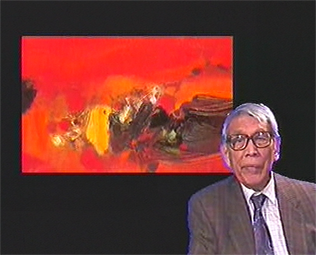
Why Chu Teh-Chun matters
Chu Teh-Chun is a foundational name in the market for Chinese modern art, and a clear case study in how cross-cultural artists are repriced once a region's collector base matures. For decades his work was admired but thinly traded; the rise of Asian buying power has since pushed his best canvases to eight-figure results, almost entirely in the Hong Kong salerooms. For a collector, Chu represents the convergence of two stories that the market rewards: a blue-chip European abstraction lineage and a deep, still-expanding Asian demand base. His top results cluster around a specific, scarce body of work, which makes period and series the central questions in any acquisition.
- Born
- 1920-10-24, Baitou Town, Jiangsu Province, China
- Nationality
- Chinese-French
- Media
- Painting, Drawing
- Movement
- Lyrical Abstraction, Modernism
- Education
- National Academy of Fine Arts, Hangzhou, 1941
- Signature motifs
- Lyrical abstraction, Calligraphic gesture, Snow scenes, Light and landscape
- Representation
- Waddington Custot, Opera Gallery
- In the Masterworks collection
- 3 works
By the numbers
- USD 29.5MAuction highHarmonie hivernale, Sotheby's Hong Kong, 2021
- HKD 229,568,000Record price local
- 98Documented repeat salesMar 1999 to Nov 2025
- Hong KongPrimary market
Selected works
Click any work to view it full screen.
Biography
Chu Teh-Chun was born in 1920 to a wealthy, art-collecting family in Jiangsu Province, China, and was taught calligraphy and classical Chinese poetry as a child. In 1935 he was admitted to the National Academy of Fine Arts in Hangzhou, where he studied alongside Zao Wou-Ki and Wu Guanzhong under Lin Fengmian. Formally trained in both Chinese and Western techniques, the three became informally known as the Three Musketeers of Chinese Modernism. Chu graduated in 1941 and then taught, first at the National Academy and later, after moving to Taiwan in 1949, at the National Taiwan Normal University.
His first solo exhibition, at the Sun Yat-sen Memorial Hall in Taipei in 1954, sold out and funded his move to France. Chu settled in Paris in 1955. A Nicolas de Staal retrospective he saw in 1956 pushed him decisively toward abstraction, and by the late 1950s he had developed the lyrical, gestural style that fused the brushwork of Chinese calligraphy with the color and light of postwar European abstraction. He exhibited across France, Germany, and Switzerland through the following decade, returned to calligraphy and classical Chinese literature for inspiration in the late 1960s, and represented China at the Tenth Sao Paulo Biennale in 1969.
Chu became a French citizen in 1980 and, in 1997, the first Chinese-born member of l'Institut de France, Academie des Beaux-Arts. France awarded him both the Chevalier de l'Ordre des Palmes Academiques and the Chevalier de la Legion d'Honneur in 2001. His later snow-scene series, begun after a 1985 journey through an Alpine snowstorm, produced the works that now anchor the top of his market. Chu died in 2014. In 2017 his family founded the Fondation Chu Teh-Chun in Geneva to preserve his legacy, and his estate is represented by Waddington Custot.
Critical reception
Critics and institutions have long positioned Chu as one of the principal figures of postwar lyrical abstraction, routinely paired with his friend and classmate Zao Wou-Ki as the artists who carried a Chinese sensibility into the language of the School of Paris. The consensus reading praises his fusion of calligraphic gesture and the spatial logic of Song dynasty landscape with the color and light of European abstraction, a synthesis that critics credit with giving his canvases their sense of atmosphere and depth. That standing was formalized in 1997, when he became the first Chinese-born member of the Academie des Beaux-Arts at the Institut de France, a level of establishment recognition rarely extended to an artist working between two traditions. The later snow-scene paintings, begun after a 1985 Alpine journey, are generally treated as the summit of his achievement. The critical caution most often noted is the same one the market reflects: his reputation, like his prices, rests heavily on a relatively narrow band of his strongest mature work.
Watch
Market
Chu's market is concentrated and Asia-led. His auction high stands at HKD 229,568,000, roughly USD 29.5M, set when the snow-scene triptych Harmonie hivernale sold at Sotheby's Hong Kong in 2021, surpassing his prior record of about USD 14.7M for the pentaptych Les elements confederes a year earlier. Both records belong to the large-format, multi-panel abstractions of his mature period, which are the scarcest and most contested part of his output.
The repeat-sale record runs deep for a postwar name, with 98 documented pairs spanning 1999 to 2025, and the salerooms that drive his top prices are almost entirely in Hong Kong. That concentration is the defining feature of his market: demand is real and sustained, but it is regionally specific and weighted toward a narrow band of his best work.
Top auction results
| Work | Price | Sale |
|---|---|---|
| Harmonie hivernale (1990) | USD 29,540,810 (HKD 229,568,000) | Sotheby's, Hong Kong, 2021-04-18 |
| Les elements confederes (1983) | USD 14,700,000 (HKD 113,700,000) | Sotheby's, Hong Kong, 2020-07-08 |
Selected exhibitions
| Years | Exhibition | Venues |
|---|---|---|
| 2010 | Chu Teh-Chun: Retrospective | National Art Museum of China, Beijing |
| 2013 | Colors/Forms: Chu Teh-Chun | National Taiwan Museum of Fine Arts, Taichung |
| 2015 | Chu Teh-Chun: Amours Oceanes | Fondation Monticelli, Marseille |
| 2017 | Chu Teh-Chun: Nature Lives with Me | Waddington Custot, London |
| 2021 | Chu Teh-Chun's Symphony | Alisan Fine Arts, Hong Kong |
Museum collections
- Bibliotheque Nationale de France, Paris
- National Art Museum of China, Beijing
- Guangdong Museum of Art, Guangzhou
- Taipei Fine Arts Museum, Taipei
- Macau Museum of Art, Macau
Awards and honors
- Member, l'Institut de France, Academie des Beaux-Arts (first Chinese-born member) (1997)
- Chevalier de l'Ordre des Palmes Academiques (France) (2001)
- Chevalier de la Legion d'Honneur (France) (2001)
Authentication and provenance
No catalogue raisonne.
Certificate of authenticity issued by the Fondation Chu Teh-Chun in Geneva (email [email protected] with cataloguing details and high-resolution images). The Foundation is compiling the catalogue raisonne; publication date is to be confirmed, and a free online archive lists many known works. Confirming an existing certificate is free; issuing a new certificate carries a fee.
Primary reference: https://chu-teh-chun.org/en/home
What collectors should know
With Chu, period and format are the value. The mature snow scenes and large polyptychs occupy a different tier from his smaller and earlier canvases, and the gap between tiers is wide. Authentication runs through the Fondation Chu Teh-Chun in Geneva, which issues certificates and is compiling the catalogue raisonne; confirming an existing certificate is free, while issuing a new one carries a fee, and the Foundation maintains a free online archive of known works. Because the catalogue raisonne is still forthcoming, provenance and Foundation confirmation carry extra weight on any acquisition. And because the market is so heavily Hong Kong-centric, liquidity is strongest when a work is offered into that specific demand base.
Further reading and resources
Data current as of 2026-06-18.

