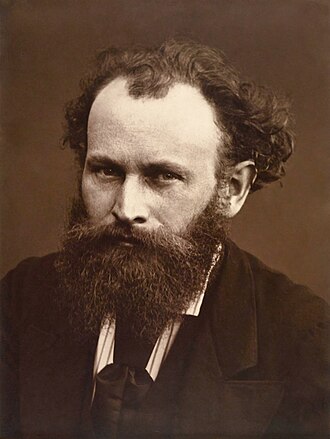
Why Edouard Manet matters
Edouard Manet is one of the foundational figures of modern painting, the artist most art historians credit with breaking the academic tradition and opening the path that the Impressionists would follow. For a collector, he is a blue-chip name in the deepest sense: a long-deceased master with a fixed and finite body of work, a complete catalogue raisonne, and the bulk of his greatest paintings permanently held in museums. That combination makes the few works that do reach the open market scarce, expensive, and closely watched.
- Born
- 1832-01-23, Paris, France
- Nationality
- French
- Media
- Painting, Pastel
- Movement
- Realism, Impressionism
- Education
- Studio of Thomas Couture, Paris, 1850 to 1856
- Signature motifs
- Modern Parisian life, Flat tonal painting, Reworked old-master compositions
- Representation
- Estate (no active estate or single-artist foundation)
By the numbers
- USD 65.1MAuction highLe Printemps, Christie's New York, 2014
- Rouart and Wildenstein, 1975Catalogue raisonne
- 1832 to 1883Lifespan
- Realism, precursor to ImpressionismMovement
Selected works
Click any work to view it full screen.
Biography
Manet was born in Paris on 23 January 1832 into a well-off family. After twice failing the entrance examination for the naval college, he entered the studio of the academic painter Thomas Couture in 1850 and trained there until 1856. He did not follow the conventional Ecole des Beaux-Arts path, and his independence from academic doctrine shaped everything that came after.
His career was defined by scandal at the official Salon. Le Dejeuner sur l'herbe, rejected by the 1863 Salon jury, was shown at the Salon des Refuses and drew public outrage for placing a nude woman among clothed men in a contemporary setting. Olympia, painted in 1863 and exhibited in 1865, provoked an even sharper reaction for its frank depiction of a modern courtesan. Both works are now in the Musee d'Orsay in Paris. Manet painted modern Parisian life with flat, broadly brushed tones and frequently reworked old-master compositions into contemporary scenes.
Though he was a generation older than Claude Monet and Pierre-Auguste Renoir and never exhibited in the Impressionist group shows, Manet was a central influence on them, and his late work absorbed their brighter palette. His final masterpiece, A Bar at the Folies-Bergere, was completed in 1882 and is now in The Courtauld Gallery in London. He died in Paris on 30 April 1883 and is buried in Passy Cemetery.
Critical reception
The scholarly consensus treats Manet as the pivot between the academic nineteenth century and modern art. Art historian Beatrice Farwell described him as a father of modernism, and the formalist critic Clement Greenberg positioned him as effectively the first modern painter for asserting the flatness of the picture plane rather than disguising it. The art historian T. J. Clark, in The Painting of Modern Life (1984), read Olympia as a social document that exposed the economics of modern Paris and punctured the Salon's idealized image of the courtesan. The philosopher Michel Foucault credited Manet with changing the basic techniques of pictorial representation in ways that made Impressionism and later movements possible. In his own time his most prominent public defender was the novelist Emile Zola, who argued in print for the seriousness of work the Salon audience dismissed as crude. The durable debate is less about whether Manet matters than about how to read the social content of paintings such as Olympia.
Watch
Market
Manet's market is the market of a scarce historical master rather than a steady producer. His auction high is Le Printemps (Jeanne), an 1881 portrait of the actress Jeanne Demarsy, which sold for USD 65,125,000 at Christie's New York on 5 November 2014. It nearly doubled his previous record of about USD 33.2 million, set in 2010 at Sotheby's London for Self-Portrait with a Palette, and it remains his auction record. Le Printemps was acquired by The J. Paul Getty Museum in Los Angeles. Because so many of his major paintings are held permanently by museums, top results turn on the rare appearance of an important work rather than a continuous flow of supply.
Top auction results
| Work | Price | Sale |
|---|---|---|
| Le Printemps (Jeanne) (1881) | USD 65,125,000 (USD 65,125,000) | Christie's, New York, 2014-11-05 |
| Self-Portrait with a Palette (1879) | USD 33,162,481 (GBP 22,441,250) | Sotheby's, London, 2010-06-22 |
Selected exhibitions
| Years | Exhibition | Venues |
|---|---|---|
| 2023 to 2024 | Manet/Degas | Musee d'Orsay, Paris; The Metropolitan Museum of Art, New York |
| 2012 to 2013 | Manet: Portraying Life | Toledo Museum of Art; Royal Academy of Arts, London |
| 2003 to 2004 | Manet and the Sea | Art Institute of Chicago; Philadelphia Museum of Art; Van Gogh Museum, Amsterdam |
| 1983 | Manet, 1832 to 1883 | Galeries nationales du Grand Palais, Paris; The Metropolitan Museum of Art, New York |
Museum collections
- Musee d'Orsay, Paris
- The Courtauld Gallery, London
- The Metropolitan Museum of Art, New York
- National Gallery, London
- National Gallery of Art, Washington, D.C.
- The Art Institute of Chicago
- The J. Paul Getty Museum, Los Angeles
Authentication and provenance
Catalogue raisonne published.
No living artist or foundation authenticates the work. Attribution rests on provenance, connoisseurship, technical analysis, and inclusion in the standard catalogue raisonne by Denis Rouart and Daniel Wildenstein (1975).
Primary reference: https://www.musee-orsay.fr/en/artworks/olympia-712
What collectors should know
Manet sits at the most stable end of the art market, but stability here means scarcity rather than liquidity. The standard catalogue raisonne, compiled by Denis Rouart and Daniel Wildenstein in 1975, fixes the accepted body of work, and because there is no living artist or foundation to authenticate, attribution depends on provenance, connoisseurship, technical analysis, and inclusion in that literature. The strongest works rarely trade, so a single great picture can reset price expectations, as Le Printemps did in 2014, while lesser works and the flower still lifes of his final years form a more active middle market. For a collector, the durability of his museum standing is the central signal, and the thinness of supply at the top is the main reason any single result should be read in context.
Further reading and resources
Data current as of 2026-06-20.

