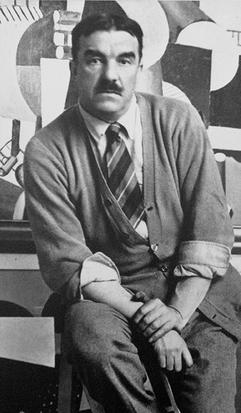
Why Fernand Léger matters
Fernand Léger is one of the canonical figures of European modernism, the painter who took Cubism out of the muted studio still life and pushed it toward the bright, mechanical, mass-produced world of the twentieth century. For a collector he sits in a reassuring part of the market: a fully catalogued, museum-anchored blue-chip name whose best canvases are scarce and expensive, while his prints, ceramics, and later figurative works trade across a wide range of price points. His market is deep, long-established, and unusually well documented, which is exactly what a buyer of historical material wants to see.
- Born
- 1881-02-04, Argentan, Orne, France
- Nationality
- French
- Media
- Painting, Film, Ceramics, Mosaic
- Movement
- Cubism, Tubism, Modernism
- Education
- Apprenticed as an architectural draughtsman in Caen, 1897 to 1899; studied in Paris at the Ecole des Arts Decoratifs and the Academie Julian after 1900 (refused entry to the Ecole des Beaux-Arts)
- Signature motifs
- Cylindrical "tubist" forms, Machine-age abstraction, The modern city and the common worker
- Representation
- Musee national Fernand Leger, Biot (estate and largest public holding)
By the numbers
- USD 70.1MAuction highContraste de formes (1913), Christie's New York, 2017
- Cubism, TubismMovement
- Musee national Fernand Leger, BiotEstate museum
- Full (paintings)Catalogue raisonne
Selected works
Click any work to view it full screen.
Biography
Fernand Léger was born on 4 February 1881 in Argentan, in Normandy, the son of a cattle farmer. He trained first as an architectural draughtsman in Caen before moving to Paris in 1900. After being refused admission to the Ecole des Beaux-Arts, he studied independently and at the Academie Julian, supporting himself with architectural and photographic retouching work.
By 1909 to 1911 he had absorbed Cezanne and fallen in with the Cubist circle around Picasso, Braque, Robert Delaunay, and the Section d'Or group. His early breakthrough, Nudes in the Forest, reduced the figure to cylinders and cones, a treatment critics nicknamed Tubism. Service in the First World War was decisive: dazzled by the form of artillery and machinery at the front, Léger emerged committed to a bold, machine-age art of contrasting colors and forms, populated by workers, cyclists, acrobats, and the modern city. The City (1919), now in Philadelphia, is the monument of this period.
Léger's ambitions ran beyond painting. He made the pioneering non-narrative film Ballet Mécanique in 1924, taught widely, designed sets and murals, and in his later years produced mosaics, stained glass, and ceramics. He spent the Second World War in the United States, then returned to France, where his work grew more openly populist and political. He died on 17 August 1955 at Gif-sur-Yvette. The Musee national Fernand Léger in Biot, opened in 1960, holds the largest public collection of his work.
Critical reception
Léger's social conscience was not that of a fierce Marxist, but of a passionate humanist.
Charlotta Kotik, art historian
The critical standing of Fernand Léger is settled: he is treated as a primary architect of modernism rather than a follower of Cubism, the artist who married avant-garde form to the imagery of industry and everyday labor. Art historian Charlotta Kotik has framed his lifelong commitment to depicting and creating for the common man as humanist rather than doctrinaire, a reading that recurs across the literature. Scholarship since the major retrospectives, the Museum of Modern Art survey of 1998 and the Tate Liverpool exhibition of 2018 among them, has emphasized his range beyond the easel painting: the experimental cinema of Ballet Mécanique, his mural and architectural collaborations, and his ceramics and mosaics. Critics tend to single out the Cubist and machine-age canvases of roughly 1913 to 1921 as his most radical achievement, while debate continues over the late, flatter, more populist work, which some read as a democratic culmination and others as a softening of his early invention. What is not in dispute is his influence on Purism, on graphic and industrial design, and on later abstraction.
Watch
Market
Léger's market is mature, liquid by Modern-master standards, and anchored by museum-grade Cubist material. His auction high is Contraste de formes (1913), an oil on burlap from his most sought-after period, which sold for USD 70,062,500 at Christie's New York on 13 November 2017, then the fifth most expensive work of any artist sold at auction that year. Strong results cluster around the 1913 to 1921 Cubist and machine-age canvases, while later figurative compositions, works on paper, and his prolific print and ceramic output give the market breadth at lower entry points.
Top auction results
| Work | Price | Sale |
|---|---|---|
| Contraste de formes (1913) | USD 70,062,500 (USD 70,062,500) | Christie's, New York, 2017-11-13 |
Selected exhibitions
| Years | Exhibition | Venues |
|---|---|---|
| 1998 | Fernand Léger | Museum of Modern Art, New York (organized with Centre Pompidou) |
| 2013 to 2014 | Léger: Modern Art and the Metropolis | Philadelphia Museum of Art |
| 2017 | Le Beau est partout (Beauty is Everywhere) | Centre Pompidou-Metz |
| 2018 | Fernand Léger: New Times, New Pleasures | Tate Liverpool |
Museum collections
- Museum of Modern Art, New York
- Solomon R. Guggenheim Museum, New York
- The Metropolitan Museum of Art, New York
- Philadelphia Museum of Art
- Centre Pompidou, Paris
- Tate, London
- Musee national Fernand Leger, Biot
Authentication and provenance
Catalogue raisonne published.
A catalogue raisonne of the paintings exists (Georges Bauquier and successors). Works are typically authenticated through the catalogue raisonne, the estate and archive, and the Comite Leger, with provenance and prior certificates carrying weight given the long history of forgeries.
Primary reference: https://www.guggenheim.org/artwork/artist/fernand-leger
What collectors should know
Léger is a documented, institutionally validated market, which lowers several of the risks that attach to thinner or newer names. A catalogue raisonne of the paintings exists, the estate and the Comite Léger support authentication, and the long auction history gives real price discovery. That history also means forgeries and questionable attributions exist, so provenance and prior certification matter. Value is heavily period-dependent: the 1913 to 1921 Cubist and machine-age works carry the strongest demand and the highest prices, while later figurative paintings, drawings, prints, and ceramics span a much wider and more accessible range. As with any historical master, condition, rarity, and provenance drive results more than headline names alone.
Further reading and resources
Data current as of 2026-06-19.

