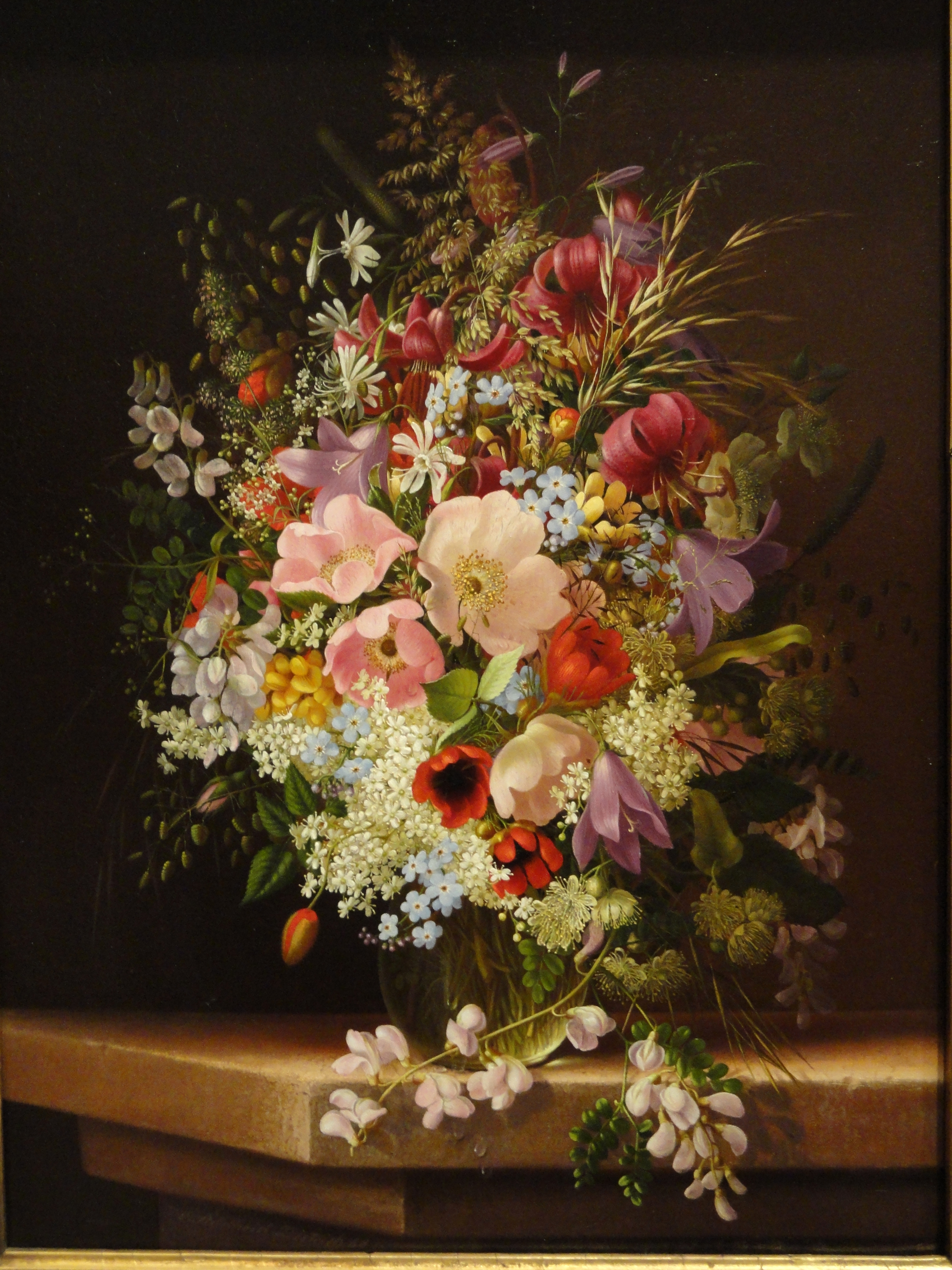
Why Adelheid Dietrich matters
Adelheid Dietrich is one of a small number of women who built sustained, publicly exhibited painting careers in nineteenth-century Germany, and she did it with an exacting, almost microscopic style of flower and fruit painting that critics of her own era compared directly to seventeenth-century Dutch still-life masters. Her work now sits in the National Gallery of Art's John Wilmerding Collection, yet only about fifty of her paintings are known to survive and she has no catalogue raisonne. For a collector, she is a case study in a historical, museum-validated woman artist whose market is thin, whose late biography is only partly documented, and whose authentication depends heavily on specialist expertise rather than a settled scholarly record.
- Born
- 1827-10-13, Wittenberg, Kingdom of Prussia (present-day Germany)
- Nationality
- German
- Media
- Painting
- Movement
- 19th-century German still-life painting
- Education
- No academy enrollment or degree is documented. Trained privately by her father, the painter Eduard Dietrich (1803 to 1877).
- Signature motifs
- Hyperrealistic flower still lifes, Fruit and flower compositions in the manner of 17th-century Dutch still-life painting
- Representation
- "Hirschl & Adler, New York (secondary market)", "Galerie Paffrath, Dusseldorf (secondary market)"
By the numbers
- About 50 paintingsKnown worksConsistent figure across Wikipedia, Godel & Co., and Questroyal Fine Art
- National Gallery of ArtMuseum collectionJohn Wilmerding Collection, Washington, D.C.
- 1847 to 1893Exhibition spanDresden debut to last documented exhibition catalogue reference, San Francisco
- Hirschl & Adler; Galerie PaffrathSecondary-market dealersNo formal estate representation is documented
Selected works
Click any work to view it full screen.
Biography
Adelheid Dietrich was born in 1827 in Wittenberg, in the Kingdom of Prussia. German-language reference sources give her birth date as 13 October 1827, though this specific day is repeated in secondary art-historical sources rather than traced to a primary civil or church record. She was the daughter and pupil of the landscape and architecture painter Eduard Dietrich (1803 to 1877), and her training appears to have been entirely private and familial. No source consulted places her in a formal art academy, and none records a degree; a Van Ham auction catalogue essay states plainly that little is documented about her life and training, and treats her father's home instruction as an assumption rather than a proven fact.
She made her exhibiting debut with fruit and flower pieces at the Dresden art exhibition in 1847 and 1848, and for roughly three decades showed regularly at major German venues, including Berlin, Dresden, Bremen, Kassel, Munich, Cologne, Wurzburg, Vienna, and Solothurn. Her exhibition record then continues in the United States: the Brooklyn Art Association from 1866 to 1873, and expositions in Chicago, Louisville, and San Francisco through the 1870s and 1880s. One American dealer's listing accordingly describes her as "American, born 1827," a market categorization based on this later U.S. activity rather than on her birthplace or training, which remained German.
Her death is usually given as 1891 in Erfurt, Germany, a year and city repeated across German auction-house, gallery, and institutional biographies, and this profile treats that as the best-supported account. The exact date most often cited, 2 April 1891, is less secure: a Russian-language reference source lists an alternate death year of 1870 in its infobox, though its own narrative text resolves to 1891 in Erfurt, and the New York gallery Hirschl & Adler states directly that it is not presently known where or when the artist died, pointing instead to an 1893 San Francisco exhibition catalogue as the last contemporary reference to her. Readers should treat 1891, Erfurt as the working consensus and the precise day and month as less certain.
Critical reception
Dietrich's contemporaries repeatedly framed her against the seventeenth-century Dutch still-life tradition, praising a precision that bordered on the microscopic. Later reference works from the turn of the century listed her among the leading still-life painters of her field, and her inclusion in standard artist lexica such as Thieme-Becker, Benezit, and Boetticher has kept her name in circulation among specialists even as broader public recognition faded. Her most concrete modern rehabilitation came in 2004 to 2005, when the Angermuseum in Erfurt mounted a cabinet exhibition pairing her with fellow Erfurt flower painter Ernestine Wendel, explicitly framed as a recovery of two nearly forgotten nineteenth-century women painters.
Market
Public auction activity for Dietrich is sparse, and no single result in the available record can be confirmed, with a full title and exact sale date, as a definitive all-time high. The highest documented figure found is EUR 25,800 including buyer's premium for a still life sold at Van Ham Kunstauktionen, Cologne, though the specific lot title and calendar sale date are not given in the source consulted. Kunsthaus Lempertz has sold a flower still life titled Blumenstillleben for EUR 11,210 including premium, also without a visible calendar date. Auktionshaus Stahl's public archive separately shows one completed result of EUR 7,600 for a work by Dietrich, without a recorded title or sale date. A Sotheby's listing for a work titled Morning Glories (1867) carried a pre-sale estimate of USD 25,000 to 35,000, but no realized price is documented in the listing itself, and Galerie Paffrath has offered a small oil, Blumen- und Fruechtestillleben (1856), at a retail asking price of EUR 8,500, which is a gallery price rather than an auction result. Taken together, these figures point to a modest, occasional market in the low five figures, consistent with an artist of roughly fifty known works and no catalogue raisonne.
Selected exhibitions
| Years | Exhibition | Venues |
|---|---|---|
| 1847 to 1848 | Kunstausstellung Dresden | Dresden art exhibition (debut, fruit and flower pieces) |
| 1850 to 1870 | German academy exhibitions | Berlin, Dresden, Bremen, Kassel, Munich, Cologne, Wurzburg, Vienna, Solothurn |
| 1866 to 1873 | Brooklyn Art Association exhibitions | Brooklyn, New York |
| 1870s to 1880s | U.S. expositions | Chicago, Louisville, San Francisco |
| 1893 | San Francisco exhibition catalogue | San Francisco (last known contemporary reference to the artist) |
| 2004 to 2005 | Rose, Mohn und Silberdistel: Ernestine Wendel und Adelheid Dietrich, Zwei Erfurter Blumenmalerinnen des 19. Jahrhunderts | Angermuseum, Erfurt |
Museum collections
- National Gallery of Art, Washington, D.C. (John Wilmerding Collection)
- Angermuseum, Erfurt
- Bundeskanzleramt, Berlin (Federal Chancellery collection)
Authentication and provenance
No catalogue raisonne.
No catalogue raisonne exists for Dietrich. Germany's federal art administration, the Kunstverwaltung des Bundes, has stated that her oeuvre, of which roughly fifty paintings are known today, is not systematically documented in the literature. Attribution rests on her inclusion in period artist lexica such as Thieme-Becker, Benezit, and Boetticher, and on the expertise of specialist dealers and auction houses who handle her work.
Primary reference: https://de.wikipedia.org/wiki/Adelheid_Dietrich
What collectors should know
Dietrich's work is rare, museum-validated through the National Gallery of Art, and priced modestly relative to major nineteenth-century names, but the market is thin enough that any single sale should be read in context rather than as a benchmark. There is no catalogue raisonne, and Germany's own federal art administration has acknowledged that her oeuvre is not comprehensively documented in the scholarly literature, so provenance and attribution depend on the judgment of specialist dealers and auction houses experienced with her hand. Her late biography, including the exact date and circumstances of her death, is not fully settled even among specialist sources, which is a useful reminder that a modest and well-attributed nineteenth-century oeuvre can still carry real gaps in the documentary record.
Further reading and resources
Data current as of 2026-07-13.

