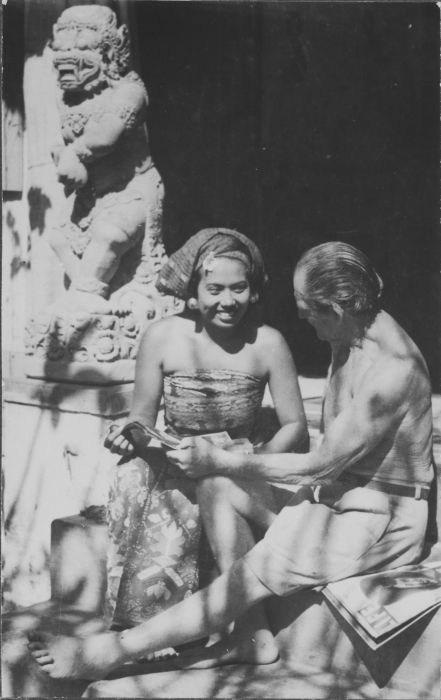
Why Adrien-Jean le Mayeur matters
Adrien-Jean le Mayeur, commonly cataloged as Adrien-Jean Le Mayeur de Merprès and known in his own time simply as Jean Le Mayeur, is one of the clearest bridges between European Impressionism and the art of colonial-era Southeast Asia. Trained in Brussels and largely self-directed after formal engineering study, he spent the latter half of his life in Bali, where his light-filled paintings of dancers, gardens, and domestic life became central to how Western collectors first saw the island. For a collector, he is a case study in a small, geographically split market: a European academic pedigree paired with an auction record now driven almost entirely from Southeast Asia.
- Born
- 1880-02-09, Ixelles, Brussels, Belgium
- Nationality
- Belgian
- Media
- Painting
- Movement
- Belgian Impressionism
- Education
- Polytechnic College, Universite Libre de Bruxelles (architecture and civil engineering; exact years and degree completion undocumented). Painting studied under his father and Ernest Blanc-Garin; possible further study at the Academie Royale des Beaux-Arts, Brussels, though this is not consistently documented.
- Signature motifs
- Balinese dancers and temple scenes, Tropical garden light, Domestic scenes featuring his wife and model Ni Pollok
By the numbers
- USD 1.2MAuction highWeavers (1953), Sotheby's Singapore, 25 January 2026
- 1880 to 1958LifespanBorn Ixelles, Belgium; died Brussels, Belgium, aged 78
- Museum Le Mayeur, Sanur, BaliMuseumAdministered by the Government of Indonesia; established after Ni Pollok's death in 1985 (exact opening date undocumented)
Selected works
Click any work to view it full screen.
Biography
Adrien-Jean le Mayeur de Merprès was born on 9 February 1880 in Ixelles, a municipality of Brussels, Belgium. At his father's insistence he first studied architecture and civil engineering at the Polytechnic College of the Universite Libre de Bruxelles before turning fully to painting; sources differ on whether he completed a formal engineering degree. His early artistic education came from his father, the marine painter Andrien Le Mayeur de Merprès, and from the painter Ernest Blanc-Garin; some sources also place him briefly at the Academie Royale des Beaux-Arts in Brussels, though this is not consistently documented.
Le Mayeur traveled extensively through Europe and North Africa before settling, from the early 1930s, in Sanur, on the island of Bali. There he met and married the dancer Ni Nyoman Pollok, known as Ni Pollok, who became his central model and the subject of many of his best-known paintings of Balinese dancers, temple ceremonies, and garden interiors. His work gained regional recognition through a series of exhibitions beginning at the YMCA in Singapore in 1933 and continuing through 1937 and 1941, with related shows in Kuala Lumpur; further exhibitions in Jakarta and Kuala Lumpur followed after the Second World War, though exact dates for these later shows are not consistently documented.
In 1958, suffering from ear cancer, Le Mayeur returned to Belgium for treatment. He died in Brussels on 31 May 1958, at the age of 78, and was buried in Ixelles, the district where he had been born. Ni Pollok continued to live in the Sanur house until her own death in 1985, after which the house and roughly one hundred of the couple's paintings were donated to the Government of Indonesia and preserved as the Museum Le Mayeur.
Critical reception
Art historians describe Le Mayeur as an exponent of late European Impressionism, noting his gentle, earthy palette of yellow, brown, beige, and soft blue set against accents of red, pink, orange, and purple, a style he carried from Belgium into his Bali subjects. Sotheby's has framed him as occupying a special place in the history of Southeast Asian art, a status reinforced by the endurance of the Museum Le Mayeur in Sanur as a living record of his output. Critical attention today centers less on stylistic innovation than on his role as a European painter whose reputation and market are now sustained primarily by institutions and collectors in the region where he made his home.
Market
Le Mayeur's auction market is thin in volume but has produced strong individual results, concentrated almost entirely at Southeast Asian sales of Sotheby's, Christie's, and Bonhams. His current auction high is Weavers, a 1953 painting that sold for USD 1.2 million at Sotheby's Singapore on 25 January 2026. General market commentary describes typical realized prices for his paintings ranging from the low thousands of euros to figures approaching seven figures for his strongest Bali-period canvases, so any single result should be read against a small and uneven sample of public sales.
Top auction results
| Work | Price | Sale |
|---|---|---|
| Weavers (1953) | USD 1,200,000 | Sotheby's, Singapore, 2026-01-25 |
Selected exhibitions
| Years | Exhibition | Venues |
|---|---|---|
| 1933 | First major Southeast Asian exhibition | YMCA, Singapore |
| 1937 | Singapore exhibition | Singapore |
| 1941 | Singapore and Kuala Lumpur exhibitions | Singapore and Kuala Lumpur |
| 1945 to 1957 | Postwar exhibitions | Jakarta and Kuala Lumpur (exact dates undocumented) |
Museum collections
- Museum Le Mayeur, Sanur, Bali (Government of Indonesia)
Authentication and provenance
No catalogue raisonne.
No published catalogue raisonne has been confirmed for this artist. The primary institutional reference is the Museum Le Mayeur in Sanur, Bali, which preserves the artist's former residence and a large body of his work donated to the Indonesian government. Individual works are typically verified through provenance research and auction house specialists rather than a certificate program.
Primary reference: https://en.wikipedia.org/wiki/Adrien-Jean_Le_Mayeur
What collectors should know
There is no confirmed catalogue raisonne for Le Mayeur, and no gallery or estate currently represents his work; acquisitions move almost exclusively through the secondary market at major auction houses. The Museum Le Mayeur in Sanur, Bali, holds the largest single body of his paintings and is the most useful institutional reference point for provenance research, but it functions as a public collection rather than an authentication body. Given the small number of public sales and the geographic concentration of demand in Southeast Asia, collectors should treat any individual auction result, including the current record, as a data point from a thin and still-developing market rather than a stable benchmark.
Further reading and resources
Data current as of 2026-07-09.

