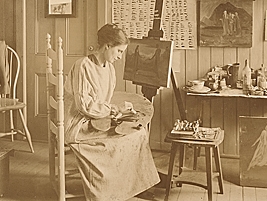
Why Agnes Pelton matters
Agnes Pelton is a central figure in the history of American spiritual abstraction, a painter who spent much of her career working in near isolation in the California desert and who has, decades after her death, been reclaimed by major museums as a foundational modernist. Her 2019 to 2020 traveling retrospective, Agnes Pelton: Desert Transcendentalist, moved her from a footnote in regional art history into the permanent collections of the Whitney Museum of American Art and other leading institutions, and her auction market has followed, with prices rising as scholarship and museum attention have caught up to the work.
- Born
- 1881-08-22, Stuttgart, Germany
- Nationality
- American
- Media
- Painting
- Movement
- Symbolist abstraction, Transcendental Painting Group, American modernism
- Education
- Pratt Institute, Brooklyn, general art course, 1895 to 1900; life drawing study, British Academy of Arts, Rome, 1910
- Signature motifs
- Desert landscapes, Luminous nature-based abstraction, Spiritual symbolism
By the numbers
- USD 525,000Auction highPurple Star Icon, Heritage Auctions, 15 May 2024 (house record for the artist)
- 5 major institutionsMuseum collectionsWhitney, Crystal Bridges, Oakland Museum, Palm Springs Art Museum, New Mexico Museum of Art
- Agnes Pelton: Desert TranscendentalistLandmark retrospectiveTraveling museum survey, 2019 to 2020
- Founding memberMovement roleTranscendental Painting Group
Selected works
Click any work to view it full screen.
Biography
Agnes Pelton was born on August 22, 1881, in Stuttgart, Germany, to American parents, and was raised in Brooklyn, New York. She enrolled in the general art course at the Pratt Institute in Brooklyn in 1895, studying with Arthur Wesley Dow, and graduated in 1900 alongside classmate Max Weber; one source gives a later graduation year of 1906, but the weight of museum and gallery sources supports 1900. After graduating she worked as an assistant teacher at Dow's Ipswich Summer School of Art in Massachusetts, took summer classes with William Langson Lathrop in 1907, and spent 1910 studying life drawing at the British Academy of Arts in Rome. In 1913 she participated in the Armory Show in New York, one of the era's defining showcases of modern art.
Pelton exhibited in New York galleries through the 1910s and 1920s and lived in Water Mill, Long Island, from 1921 to 1932. In 1932 she moved to Cathedral City, California, near Palm Springs, where she would live and paint for the rest of her life. During the 1930s and 1940s she was given one-person exhibitions at major California museums, including the San Francisco Museum of Modern Art, the Santa Barbara Museum of Art, the Laguna Art Museum, and the San Diego Museum of Art. She was a founding member of the Transcendental Painting Group, a circle of New Mexico-based abstractionists devoted to spiritually oriented, nature-derived abstraction, the mode most associated with her mature work.
Pelton's later years were marked by declining health and financial hardship. She died on March 13, 1961, in Cathedral City, California, in relative poverty; she was cremated, and her ashes were buried in the San Jacinto Mountains.
Critical reception
Pelton was a serious presence in her own time, exhibiting at the Armory Show in 1913 and later at nearly every major California museum, but broader recognition receded after her death and only resumed with scholarly attention beginning in the 1980s. Her inclusion in the Los Angeles County Museum of Art's 1986 survey The Spiritual in Art: Abstract Painting 1890 to 1985 placed her within the larger story of spiritual abstraction alongside better-known figures, and the art historian Michael Zakian's writing and curatorial work through the 1990s helped rebuild her critical standing. The 2019 to 2020 Desert Transcendentalist retrospective, organized by the Phoenix Art Museum and traveling to the New Mexico Museum of Art, the Whitney Museum of American Art, and the Palm Springs Art Museum, was widely covered by major outlets and is generally credited with cementing her current reputation as one of the more significant, if long overlooked, American modernists working in an abstract, spiritually inflected idiom.
Market
Pelton's auction market was thin for decades and has strengthened since renewed museum attention began with the 2019 to 2020 Desert Transcendentalist retrospective. Her best-documented auction result is Purple Star Icon, a newly surfaced transcendental abstraction that sold for USD 525,000 at Heritage Auctions' American Art Signature Auction on May 15, 2024, a house record for the artist. Some market databases report a higher figure, up to USD 3,438,000, for a Pelton painting, but the specific work, auction house, and sale date behind that figure could not be independently confirmed, so it is noted here only as a reported, unverified data point rather than as her confirmed record. Because so few works come to auction in any given year, individual results can move the picture of her market substantially, and each new sale should be read against the small overall sample rather than as part of a long, smooth price series.
Top auction results
| Work | Price | Sale |
|---|---|---|
| Purple Star Icon (2024) | USD 525,000 (USD 525,000) | Heritage Auctions, 2024-05-15 |
Selected exhibitions
| Years | Exhibition | Venues |
|---|---|---|
| 2019 to 2020 | Agnes Pelton: Desert Transcendentalist | Phoenix Art Museum; New Mexico Museum of Art, Santa Fe; Whitney Museum of American Art, New York; Palm Springs Art Museum |
| 1995 to 1996 | Agnes Pelton: Poet of Nature | Palm Springs Desert Museum (traveling) |
| 1986 | The Spiritual in Art: Abstract Painting 1890 to 1985 | Los Angeles County Museum of Art |
| 1930s to 1940s | One-person museum exhibitions | San Francisco Museum of Modern Art; Santa Barbara Museum of Art; Laguna Art Museum; San Diego Museum of Art |
| 1913 | International Exhibition of Modern Art (The Armory Show) | 69th Regiment Armory, New York |
| 1989 | Agnes Pelton | Ohlone College, Fremont, California |
| 2020s | Pelton and Jonson | University of New Mexico Art Museum, Albuquerque |
Museum collections
- Whitney Museum of American Art, New York
- Crystal Bridges Museum of American Art, Bentonville
- Oakland Museum of California, Oakland
- Palm Springs Art Museum, Palm Springs
- New Mexico Museum of Art, Santa Fe
Authentication and provenance
No catalogue raisonne.
No published catalogue raisonne has been identified for Pelton. Attribution rests on museum scholarship, most notably the research of art historian Michael Zakian, and on the documented exhibition record; no gallery or foundation-run authentication program has been located.
Primary reference: https://whitney.org/exhibitions/agnes-pelton
What collectors should know
Pelton has no published catalogue raisonne, and her estate does not appear to be represented by a current commercial gallery, so provenance research depends on the exhibition record, museum accession files, and published scholarship rather than a foundation-run certification process. Her surviving body of work is small and heavily concentrated in museum collections, which keeps auction supply limited and makes each sale meaningful to the overall price picture. Collectors should treat her recent record prices as evidence of growing institutional and market interest following the 2019 to 2020 retrospective, while recognizing that a market built on so few transactions carries more uncertainty than one with a longer, denser sales history.
Further reading and resources
Data current as of 2026-07-09.

