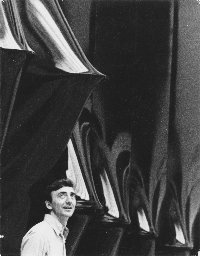
Why Agostino Bonalumi matters
Agostino Bonalumi (1935 to 2013) was one of the defining figures of Italian Post-War abstraction, best known for "estroflessioni," monochrome canvases shaped from behind with internal armatures so that the surface bulges and folds outward into what he called "Picture-Objects." He moved in the same Milan circle as Enrico Castellani and Piero Manzoni, who founded the gallery Azimut and its journal Azimuth in 1959, placing him among the generation that extended Lucio Fontana's legacy and ran parallel to Germany's Zero movement. For a collector, he is a case study in a market built on museum standing and historical position within a tightly documented avant-garde circle, rather than on deep, liquid auction turnover.
- Born
- 1935-07-10, Vimercate, Italy
- Nationality
- Italian
- Media
- Painting, Sculpture
- Movement
- Italian Post-War avant-garde, Zero movement
- Education
- Self-taught as a painter. Completed formal studies in technical and mechanical drawing; no art-academy training confirmed.
- Signature motifs
- "Estroflessioni (extroflexions)", "Shaped monochrome Picture-Objects"
- Representation
- Archivio Bonalumi (estate), Mazzoleni, Cardi Gallery
By the numbers
- USD 1,007,765Auction high (reported)Struttura modulare bianca (1970), sculpture; sale house and exact date not publicly disclosed (MutualArt)
- 1966, 1970, 1986Venice Biennale
- Azimut / AzimuthAssociated circleCircle of Enrico Castellani and Piero Manzoni, who founded the gallery and journal, Milan, 1959
- Archivio Bonalumi; Mazzoleni; Cardi GalleryRepresented by
Biography
Bonalumi was born on 10 July 1935 in Vimercate, near Milan. He completed formal studies in technical and mechanical drawing, and beyond that training he is consistently described as a self-taught painter who later pursued private study of philosophy, particularly phenomenology, along with art theory and poetry.
His first solo exhibition, in 1956 at Galleria Totti in Milan, came when he was twenty-one. In 1958 he met Piero Manzoni and Enrico Castellani in Milan; the following year Manzoni and Castellani founded the gallery Azimut and its journal Azimuth, a short-lived but influential venture, and Bonalumi moved within that circle, in dialogue with the European Zero movement. Through the following decade he developed his signature estroflessioni technique, using shaped stretchers and internal supports to push monochrome canvases into sculptural relief.
He exhibited at the Venice Biennale in 1966, 1970 (with a room devoted to his work), and 1986. A major retrospective was held at Palazzo Te in Mantua in 1980. In 2002 he received the Premio Presidente della Repubblica, with recognition from the Accademia Nazionale di San Luca in Rome, an occasion marked by a retrospective at Palazzo Carpegna in Rome and the exhibition "Themes and Variations" at the Peggy Guggenheim Collection in Venice. An anthological exhibition followed at the Institut Mathildenhoehe in Darmstadt in 2003 to 2004. Bonalumi died on 18 September 2013; his official archive and Wikipedia give Monza, Italy, as the place of death, though some gallery sources instead cite the nearby towns of Desio or Vimercate, and the exact municipality is not fully settled across sources.
Critical reception
Bonalumi is consistently framed by museums and galleries as part of the generation that carried Lucio Fontana's spatial concerns into the 1960s and beyond, working alongside Castellani and Manzoni around the Azimut gallery and Azimuth journal and read in relation to the German Zero movement. His estroflessioni are treated as a distinct contribution to that lineage: monochrome painting pushed into three-dimensional "Picture-Objects" that blur the line between canvas and sculpture. That reading is reinforced by steady museum acquisition over decades, including holdings at GAM Turin, GNAM Rome, Mart Rovereto, the Peggy Guggenheim Collection, the Museu Colecao Berardo, the Walker Art Center, and the Solomon R. Guggenheim Museum. No exact, attributable critic quotation from a major outlet could be confirmed for this profile, so this section relies on documented exhibition history and museum framing rather than direct quotation.
Market
The highest figure publicly reported for Bonalumi at auction is approximately USD 1,007,765, cited by MutualArt for a sculpture identified as "Struttura modulare bianca" (1970); the auction house and exact sale date are not disclosed in that source. Separately, Phillips' own artist overview lists a fully documented result of GBP 225,000 for the painting "Bianco e Nero," though without an exact sale date. Other market aggregators cite still different headline figures for the artist, and none of the sources reviewed provide a complete, lot-level record, meaning title, price, house, and date together, for a confirmed all-time high. Collectors should treat any single headline auction figure for Bonalumi with caution until it can be verified against a primary sale record.
Top auction results
| Work | Price | Sale |
|---|---|---|
| Struttura modulare bianca (1970) (1970) | USD 1,007,765 | |
| Bianco e Nero | GBP 225,000 | Phillips |
Selected exhibitions
| Years | Exhibition | Venues |
|---|---|---|
| 1956 | First solo exhibition | Galleria Totti, Milan |
| 1958 | Group exhibition with Enrico Castellani and Piero Manzoni | Galleria Pater, Milan |
| 1966 | Venice Biennale | Venice Biennale |
| 1970 | Venice Biennale, dedicated room | Venice Biennale |
| 1980 | Retrospective | Palazzo Te, Mantua |
| 1986 | Venice Biennale | Venice Biennale |
| 2002 | Retrospective, on the occasion of the Premio Presidente della Repubblica | Palazzo Carpegna, Rome |
| 2003 to 2004 | Anthological exhibition | Institut Mathildenhoehe, Darmstadt |
Museum collections
- Galleria Civica d'Arte Moderna e Contemporanea (GAM), Turin
- Galleria Nazionale d'Arte Moderna e Contemporanea, Rome
- Mart, Museo di Arte Moderna e Contemporanea di Trento e Rovereto
- Peggy Guggenheim Collection, Venice
- Museu Colecao Berardo, Lisbon
- Walker Art Center, Minneapolis
- Solomon R. Guggenheim Museum, New York
Awards and honors
- Premio Presidente della Repubblica, with recognition from the Accademia Nazionale di San Luca, Rome (2002)
Authentication and provenance
No catalogue raisonne.
No published catalogue raisonne has been confirmed for this artist. Works are authenticated through Archivio Bonalumi, the artist's estate and archive, which also collaborates with dealers on major sales and exhibitions.
Primary reference: https://www.archiviobonalumi.com/en/agostino-bonalumi/
What collectors should know
There is no published catalogue raisonne for Bonalumi; authentication runs through Archivio Bonalumi, the artist's estate and archive, which also collaborates with galleries on major sales and exhibitions. Public reporting on his top auction prices is inconsistent across market databases, so provenance and direct verification through the archive matter more than any single headline figure. On the primary market, Archivio Bonalumi anchors the estate's authentication, while Mazzoleni, Cardi Gallery, and other dealers actively present and sell his work; no source consulted names a single exclusive worldwide representative, so any such claim should be verified directly before it is relied upon. Overall, his market is thin at the very top end and is currently supported more by museum standing than by deep, frequent auction turnover.
Further reading and resources
Data current as of 2026-07-10.

