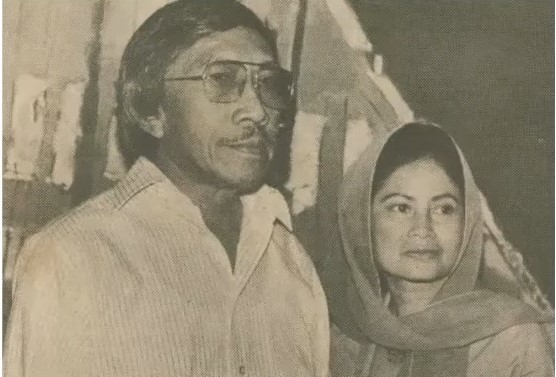
Why Ahmad Sadali matters
Ahmad Sadali is one of the founding figures of Indonesian modern abstract painting, a member of the Bandung school who moved the country's art away from realism and toward geometric, color-field, and gold-toned abstraction rooted in Islamic spirituality. He held a long teaching career at the Bandung Institute of Technology, and his paintings anchor the modern collections of both the National Gallery of Indonesia and National Gallery Singapore. For collectors, he represents a canonical but thinly traded market, where museum standing is well established and auction data is comparatively sparse.
- Born
- 1924-07-24, Garut, West Java, Indonesia
- Nationality
- Indonesian
- Media
- Painting
- Movement
- Indonesian modernism, Bandung School, Abstract expressionism
- Education
- Faculty of Drawing Teachers, University of Indonesia, Bandung (now ITB/FSRD), 1948 to 1953, graduated 1953; further study from 1956 at the University of Iowa, Department of Fine Arts, and the Art Students League of New York
- Signature motifs
- Geometric color-field abstraction, Gold-toned mosaic compositions
By the numbers
- USD 674,416Auction highHighest recorded price for a painting, per MutualArt; the specific work, auction house, and sale date are not independently confirmed in current sources.
- 1951 to 1987Career spanSourced range of group exhibitions through the year of his death
- 2 national galleriesMuseum collectionsNational Gallery of Indonesia; National Gallery Singapore
- No current gallery representationRepresented byWorks trade primarily through international auction houses
Selected works
Click any work to view it full screen.
Biography
Ahmad Sadali was born in Garut, West Java, Indonesia, on 24 July 1924. He began his schooling at HIS Boedi Priyayi in Garut around 1938, continued at the Muhammadiyah MULO in Yogyakarta, and studied at the Jakarta Islamic College from 1944 to 1945. From 1948 to 1953 he trained at the Faculty of Drawing Teachers within the Faculty of Engineering, University of Indonesia, in Bandung, an institution that later became the Faculty of Art and Design at the Bandung Institute of Technology (ITB). He graduated in 1953 and immediately joined the faculty as one of its first Indonesian lecturers.
In 1956 he received a scholarship to study fine art in the United States, attending the Department of Fine Arts at the University of Iowa and the Art Students League of New York, where he encountered modernism and abstract expressionism directly. He returned to Indonesia to build a long academic career at ITB, eventually serving as Secretary and then Head of the Department of Fine Arts and as assistant to the Rector from 1969 to 1976, holding the title Professor Drs. Ahmad Sadali. He was also a co-founder of the Islamic college that later became the Islamic University of Bandung, and at the end of his life chaired the Salman Mosque Development at ITB. His painting drew on Islamic thought as much as on Western abstraction, and he was known as a public speaker on religious themes as well as a painter.
Ahmad Sadali died on 19 September 1987. Sources confirm the date but do not document the exact place of death.
Critical reception
Sadali is credited as a pioneer of Indonesian abstraction, and critics have consistently framed his geometric and gold-toned compositions as a fusion of Western modernist form with Islamic spiritual content. Writing in e-flux Criticism, Innas Tsuroiya has described Sadali's life and work as inseparable from his role as a religious thinker and public figure, noting his service as a national representative to UNESCO and his standing as a public speaker on religious themes, including a well-known address at Istiqlal Mosque in Jakarta in 1975. This framing underscores how criticism of his painting tends to fold in his broader civic and religious life. Earlier, in 1954, critic Trisno Sumardjo raised questions about the Bandung school's relationship to Western training, a debate that has continued to shape how Sadali's abstraction is read against ideas of national identity.
Market
Sadali's market runs almost entirely through international auction houses rather than a living or estate-managed gallery; no current gallery or estate representation has been identified. His works appear periodically at Southeast Asian modern and contemporary sales at Sotheby's, Christie's, and Bonhams, among others. The highest recorded price for a painting is USD 674,416, per MutualArt market data; the specific work, auction house, and exact sale date are not independently confirmed in current sources. No catalogue raisonne has been published, so provenance research and family or estate documentation carry added weight in authentication.
Top auction results
| Work | Price | Sale |
|---|---|---|
| Not confirmed in current sources | USD 674,416 |
Selected exhibitions
| Years | Exhibition | Venues |
|---|---|---|
| 1964 | Contemporary Indonesian Art | Rio de Janeiro, Brazil |
| 1966 | Sebelas Seniman Bandung | Bandung, Indonesia |
| 1970 | Solo exhibition | Goethe-Institut, Jakarta |
| 1972 | Painting Retrospective | Cipta Galeri, Taman Ismail Marzuki, Jakarta |
| 1997 | Retrospective | Jakarta (venue not further specified in sources), 17 to 26 October 1997 |
| 2014 | Exhibition of an Indonesian Master Painter | National Gallery of Indonesia, Jakarta, 25 June to 14 July 2014 |
| 1951 to 1987 | Group exhibitions worldwide | More than 75 group exhibitions, Indonesia and abroad |
Museum collections
- National Gallery of Indonesia, Jakarta
- National Gallery Singapore
Awards and honors
- National Cultural Consultative Body Award, for Kembang Matahari (Sunflower) (1952)
- Anugerah Seni Negara (National Art Award, Government of Indonesia) (1972)
- Award, First National Painting Exhibition (Biennale Lukisan Indonesia), Jakarta (1974)
- Australian Government Award for Leadership in Islam (1977)
- UNESCO Poster Prize, third place, Year of the Child (1978)
- Award, National Painting Exhibition (Biennale Lukisan Indonesia), Jakarta (1978)
Authentication and provenance
No catalogue raisonne.
No catalogue raisonne exists for Ahmad Sadali and no certificate-of-authenticity program has been identified in current sources. Attribution relies on provenance research, exhibition history, and family and estate records, with the National Gallery of Indonesia's 2014 retrospective serving as a key documentary reference.
Primary reference: https://en.wikipedia.org/wiki/Ahmad_Sadali
What collectors should know
Sadali's institutional standing is strong, with holdings at the National Gallery of Indonesia and National Gallery Singapore and a major 2014 retrospective in Jakarta, but his auction record is comparatively thin, with relatively few tracked sales and no catalogue raisonne to anchor attribution. The absence of a representing gallery or estate means that provenance and exhibition history, rather than a single verifying authority, do the work of establishing confidence in a given work. Collectors should treat any single auction result, including the current record price, as a useful data point rather than a stable trend line, given how few comparable sales exist and how little detail is publicly documented about the record sale itself.
Further reading and resources
Data current as of 2026-07-10.

