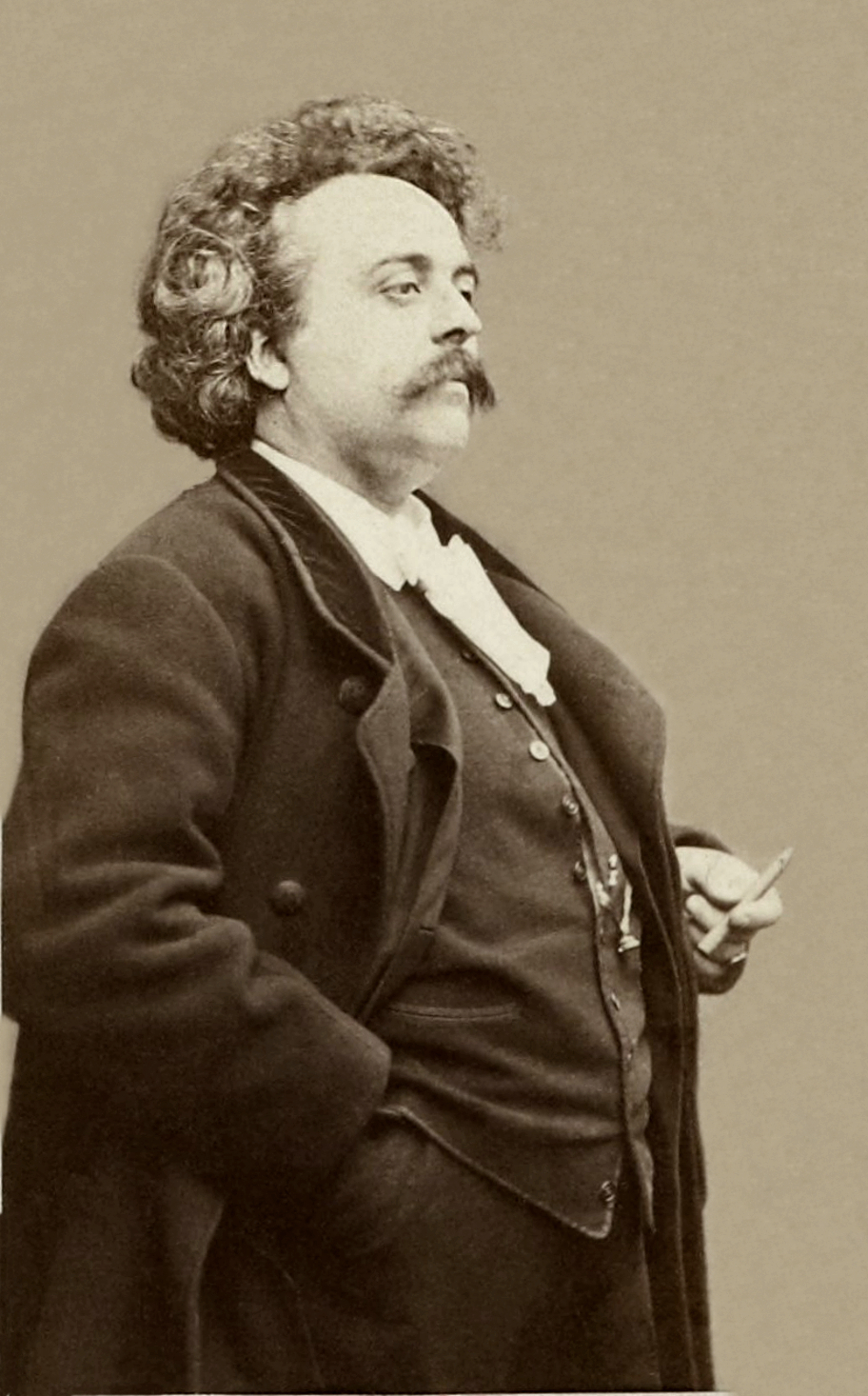
Why Albert-Ernest Carrier-Belleuse matters
Albert-Ernest Carrier-Belleuse was one of the most prolific and commercially successful sculptors of the French Second Empire, an artist whose workshop output ranged from Salon marbles to mass-produced Sevres porcelain and decorative bronzes for the Parisian trade. He trained and employed a young Auguste Rodin, helped shape the taste of the era's decorative arts through his role at the Manufacture nationale de Sevres, and left a body of work now held across major museum collections worldwide. For collectors, he represents a market defined by museum-grade masterworks at one end and abundant, widely reproduced decorative bronzes at the other, which makes documentation and provenance unusually important.
- Born
- 1824-06-12, Anizy-le-Chateau, Aisne, France
- Nationality
- French
- Media
- Sculpture, Ceramics, Decorative arts
- Movement
- Academic sculpture, Second Empire sculpture
- Education
- Apprenticeship in chasing and goldsmithing, Paris, from age 13 (workshops of Bauchery/Beauchery and Jacques-Henri Fauconnier); admitted to the Ecole des Beaux-Arts, Paris, in 1840, under Pierre-Jean David d'Angers, a brief stay; completed training at the Ecole royale gratuite de Dessin (the Petite Ecole), Paris, in decorative arts. No degree or diploma is documented.
- Signature motifs
- Mythological and allegorical busts, Sevres decorative ceramics
By the numbers
- USD 99,680Highest documented saleChristie's New York, 1 October 2012; not confirmed as an all-time record given fragmentary public auction data
- 1867Salon Medal of HonorFor Le Messie (The Messiah)
- Officier, 1885Legion d'HonneurChevalier from 1867
- 1876Sevres directorshipDirector of Works of Art, Manufacture nationale de Sevres
Selected works
Click any work to view it full screen.
Biography
Carrier-Belleuse was born on 12 June 1824 in Anizy-le-Chateau, in the Aisne region of France. At 13 he began an apprenticeship as a chaser and goldsmith in Paris, first in the workshop of a craftsman named Bauchery or Beauchery, then with the goldsmith Jacques-Henri Fauconnier and the firm Fannieres Freres. Through the scientist Francois Arago he met the sculptor Pierre-Jean David d'Angers, who helped secure his admission to the Ecole des Beaux-Arts in 1840. The stay was brief and is described in multiple sources as unhappy; lacking the means to continue, he left and completed his artistic education at the Ecole royale gratuite de Dessin, known as the Petite Ecole, studying decorative arts and drawing while working to support his family.
He made his Salon debut in 1851 and spent 1851 to 1855 in England, where he directed the modelling and drawing school at the Mintons porcelain works in Stoke-on-Trent and designed ceramics and metalwork. Back in Paris, his reputation grew through the 1860s: his marble Bacchante was purchased by Napoleon III from the 1863 Salon for the Jardin des Tuileries, and Angelique won a first-class Salon medal in 1866. In 1867 his marble Le Messie (The Messiah) was purchased by the French state, earning him the Salon's Medal of Honor and appointment as a Chevalier of the Legion d'Honneur. Some secondary sources also credit him with a gold medal at the 1867 Exposition Universelle in Paris, but this specific award is not confirmed by primary documentation and is treated here with caution rather than stated as fact. In the early 1870s he directed a large decorative program for the Brussels Stock Exchange, working alongside his assistant Auguste Rodin. In 1876 he was named Director of Works of Art at the Manufacture nationale de Sevres, a post that shaped the porcelain factory's output for the rest of his career. He exhibited at the Salon for the last time in 1885 with Diane victorieuse, the same year he was promoted to Officier of the Legion d'Honneur.
Carrier-Belleuse died in Sevres, France, in the first days of June 1887, at age 62. Major sources disagree on the exact day: Encyclopaedia Britannica and some French art-historical accounts give 3 June, while Wikipedia and other references give 4 June. He is buried in the cemetery of Saint-Germain-en-Laye.
Critical reception
Contemporary critics were struck above all by Carrier-Belleuse's sheer productivity. Secondary biographical sources attribute to the critic Edouard Lockroy, writing in L'Artiste in 1865, a characterization of him as a kind of sculpting machine, a description repeated by later biographers to capture the scale of a workshop that turned out sculpture in bronze, marble, plaster, and alabaster alongside designs for Sevres porcelain; the exact original wording could not be independently confirmed, so it is not reproduced here as a direct quotation. Napoleon III is reported by several secondary sources to have praised him as a modern successor to the eighteenth-century sculptor Clodion, though the exact wording of that praise varies across accounts and should be treated as an anecdote rather than a fixed quotation. Later assessments, including museum and academic sources, place him as a key figure bridging Second Empire academic sculpture and the emerging decorative sensibility that would feed into Art Nouveau, and note his importance as an early employer and influence on Auguste Rodin. Debate around his reputation tends to center on the tension between his official Salon honors and the popular, market-driven decorative production that made up much of his output.
Market
Carrier-Belleuse's auction market is wide-ranging. Decorative bronzes and terracottas by him circulate regularly at mid-market and regional auction houses, often selling in the low thousands of dollars, as seen in results at houses such as Brunk Auctions and Bonhams. The highest single result located in the sources reviewed for this profile is USD 99,680, reported for a sculpture attributed to him at Christie's New York on 1 October 2012, well above its presale estimate; the exact lot title could not be confirmed. A separate market guide (Aucties) references a marble sculpture sold for roughly EUR 108,100 in 2019, and gives aggregated valuation ranges showing marble examples reaching as high as roughly EUR 720,000 and bronzes as high as roughly EUR 180,000, though without lot-level detail to confirm those as specific, dated auction results. Given his large workshop output, the range of media he worked in, and the fragmentary state of public auction data, collectors should treat any single "record" figure, including the USD 99,680 Christie's result above, as provisional rather than a confirmed all-time high.
Top auction results
| Work | Price | Sale |
|---|---|---|
| Sculpture, attributed (title not recorded in public sources) (2012) | USD 99,680 (USD 99,680) | Christie's, New York, 2012-10-01 |
Selected exhibitions
| Years | Exhibition | Venues |
|---|---|---|
| 1851 | Paris Salon debut | Paris Salon |
| 1861 | Salve Regina | Paris Salon (third-class medal) |
| 1863 | Bacchante | Paris Salon; purchased by Napoleon III for the Jardin des Tuileries |
| 1866 | Angelique | Paris Salon (first-class medal) |
| 1867 | Le Messie (The Messiah) | Paris Salon (Medal of Honor); purchased by the French state |
| 1885 | Diane victorieuse | Paris Salon, his final Salon presentation |
Museum collections
- Musee d'Orsay, Paris
- Musee du Louvre, Paris
- Victoria and Albert Museum, London
- Metropolitan Museum of Art, New York
- Los Angeles County Museum of Art
- National Gallery of Art, Washington, D.C.
- Hermitage Museum, Saint Petersburg
Awards and honors
- Third-class medal, Paris Salon (1861)
- First-class medal, Paris Salon (1866)
- Medal of Honor, Paris Salon (1867)
- Chevalier, Legion d'Honneur (1867)
- Officier, Legion d'Honneur (1885)
Authentication and provenance
No catalogue raisonne.
No catalogue raisonne of Carrier-Belleuse's work has been published. Attribution rests on museum documentation, foundry and factory marks, and the recurring signature forms 'Carrier' or 'A. Carrier' on bronzes and terracottas. Because his workshop produced large editions and later foundries continued casting after his death, provenance and documented casting history carry more weight than signature alone.
Primary reference: https://www.musee-orsay.fr/en/ressources/artists-personalities-catalog/albert-ernest-carrier-belleuse-38208
What collectors should know
Carrier-Belleuse died in 1887, and there is no gallery or estate structure representing him in the way a living artist's dealer would; his work reaches the market through auction houses and specialist dealers in nineteenth-century sculpture. No catalogue raisonne of his work has been published, and because his workshop and later foundries produced editions and casts both during and after his lifetime, signature alone (typically reading "Carrier" or "A. Carrier") is not sufficient to establish authenticity or edition status. Prices vary enormously by medium, scale, and documentation, from low-thousand-dollar decorative bronzes to occasional results near or above USD 100,000 for well-provenanced Salon-related pieces, which makes provenance research and comparison to documented museum examples especially important before any purchase.
Further reading and resources
Data current as of 2026-07-16.

