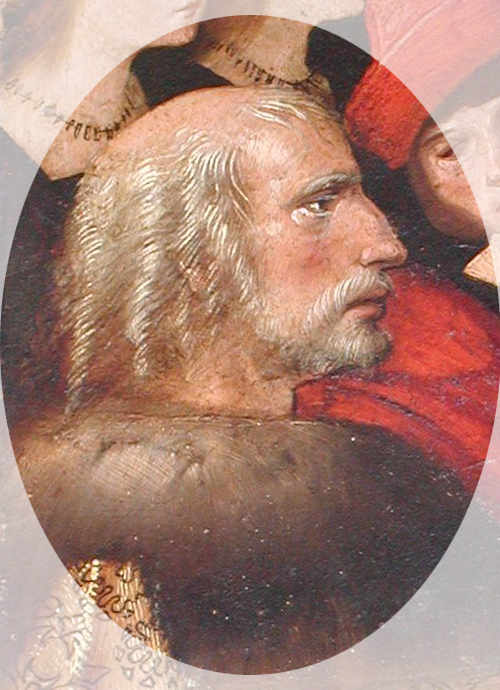
Why Alejo Fernandez matters
Alejo Fernandez was one of the founding masters of the Sevillian school of painting, credited with carrying Flemish-influenced perspective and spatial construction into Spanish panel painting during the transition from late Gothic convention to Renaissance form. His Virgen de los Navegantes, painted for Seville's Casa de la Contratacion, includes an early depiction of Christopher Columbus and is among the works for which he is best known, closely associated with the era of the Spanish voyages of discovery. For collectors, Fernandez matters less as an active market name than as a documented Old Master whose surviving output sits almost entirely inside museum, cathedral, and church collections, which makes any market appearance rare and historically significant.
- Nationality
- Spanish
- Media
- Panel painting
- Movement
- Spanish Renaissance, Sevillian School
- Education
- No documented school, degree, or dates. Reference sources describe early study of perspective and the structure of space in Cordoba, under the influence of Flemish masters, but name no institution or teacher.
- Signature motifs
- Marian devotional imagery, Flemish-influenced perspectival space
By the numbers
- USD 208,748Auction highL'Arrestation du Christ, Christie's Paris, 2011
- 1496 to 1545Documented activityCordoba and Seville
- NoneRepresented byNo current gallery or estate representation identified
- None publishedCatalogue raisonne
Selected works
Click any work to view it full screen.
Biography
Alejo Fernandez was a Spanish Renaissance painter documented in Andalusia from 1496 to 1545. His exact birthplace and birth year are unsettled in the scholarly record. Most standard reference sources give a birth date of around 1474 to 1475. General reference works often place his birth in Cordoba, Spain, while archival account books of Seville Cathedral describe him as a "pintor aleman" (German painter), pointing to a possible German or northern European origin; no source consulted for this profile resolves the question. He is recorded working in Cordoba, where, under the influence of Flemish masters, he studied perspective and the structure of space, though no specific workshop, teacher, or course of training is documented.
By 1497 he was married to Maria Fernandez, daughter of the Cordoba painter Pedro Fernandez, one of the principal painters active in that city; the marriage is the first securely documented date in his biography. Around 1508 he moved to Seville to work on the main altarpiece of Seville Cathedral, and his commissions increasingly turned toward monumental religious subjects for the city's churches and civic institutions.
His best known works include the Virgen de los Navegantes, an altarpiece painted around 1531 to 1536 for the Casa de la Contratacion and now held in the Real Alcazar de Sevilla, which includes an early depiction of Christopher Columbus, and the Virgen de la Rosa, held in the church of Santa Ana in Seville's Triana district. He died in Seville. Standard reference sources most often give a death date of around 1545, though some secondary sources cite 1543 and others 1546, and no source consulted for this profile confirms an exact day of death.
Critical reception
Fernandez is treated in standard reference literature, including the Museo del Prado's own encyclopedia, as a founding figure of the Sevillian school and a key transitional painter between late Gothic convention and Spanish Renaissance form. No signed, quotable criticism from named critics in major outlets was located for this profile; discussion of his work comes almost entirely from museum and academic reference sources rather than journalistic art criticism. Those sources consistently credit him with introducing Flemish-derived perspective and spatial modeling to Cordoba and Seville, and single out the Virgen de los Navegantes as a work of particular historical importance for its early association with the Spanish voyages to the Americas.
Market
Fernandez has no current gallery or estate representation, which is expected for a painter who died roughly 480 years ago and whose surviving works sit almost entirely in institutional hands rather than private ones. The Old Master specialist dealer Sam Fogg has catalogued a panel attributed to him. Public auction activity is thin: the market-tracking service MutualArt records realized prices for the artist ranging from roughly USD 28,689 to a record USD 208,748, the latter for L'Arrestation du Christ (The Arrest of Christ), sold at Christie's Paris in 2011. No source consulted for this profile shows a higher price achieved since that sale, though the exact calendar date of the 2011 sale could not be confirmed. Because so few of his works ever reach the open market, any individual result is best read as a data point about a specific panel rather than as a signal about a broader trend.
Top auction results
| Work | Price | Sale |
|---|---|---|
| L'Arrestation du Christ (The Arrest of Christ) (2011) | USD 208,748 | Christie's, Paris |
Selected exhibitions
| Years | Exhibition | Venues |
|---|---|---|
| 1911 | Group exhibition including a work attributed to the artist | Real Academia de San Fernando, Madrid |
| on view | Virgen de los Navegantes | Real Alcazar de Sevilla, Capilla de los Navegantes |
| on view | San Joaquin y Santa Ana, Nacimiento de la Virgen, Adoracion de los Reyes, Presentacion en el Templo | Sacristy, Seville Cathedral |
| on view | Virgen de la Rosa | Church of Santa Ana, Seville (Triana) |
| on view | Triptych of the Last Supper | Basilica of Our Lady of the Pillar, Zaragoza |
Museum collections
- Museo del Prado, Madrid
- Museo de Bellas Artes de Cordoba
- Museo de Bellas Artes de Sevilla
- Seville Cathedral, sacristy
- Real Alcazar de Sevilla, Capilla de los Navegantes
- Church of Santa Ana, Seville
- Basilica of Our Lady of the Pillar, Zaragoza
Authentication and provenance
No catalogue raisonne.
No catalogue raisonne has ever been published for this artist. Attribution rests on archival parish and payment records, stylistic connoisseurship, and the documentation held by the museums and churches that own the great majority of his known works.
Primary reference: https://www.museodelprado.es/aprende/enciclopedia/voz/fernandez-alejo/b13ba772-ab48-4177-946e-911179e2cd9f
What collectors should know
Collectors should treat Fernandez as a documented Old Master with an almost nonexistent open market rather than as an actively traded name. There is no catalogue raisonne, so attribution rests on archival parish and payment records, connoisseurship, and the institutional documentation held by the museums and churches that own the great majority of his known works. Basic biographical facts, including his birthplace and the exact date of his death, remain debated among scholars, and any newly surfaced panel attributed to him should be expected to require careful, source-based authentication rather than reliance on a single database entry.
Further reading and resources
Data current as of 2026-07-18.

