Alexander Rodchenko
Russian (Soviet), 1891 to 1956
Photography · Photomontage · Graphic design · Painting · Sculpture
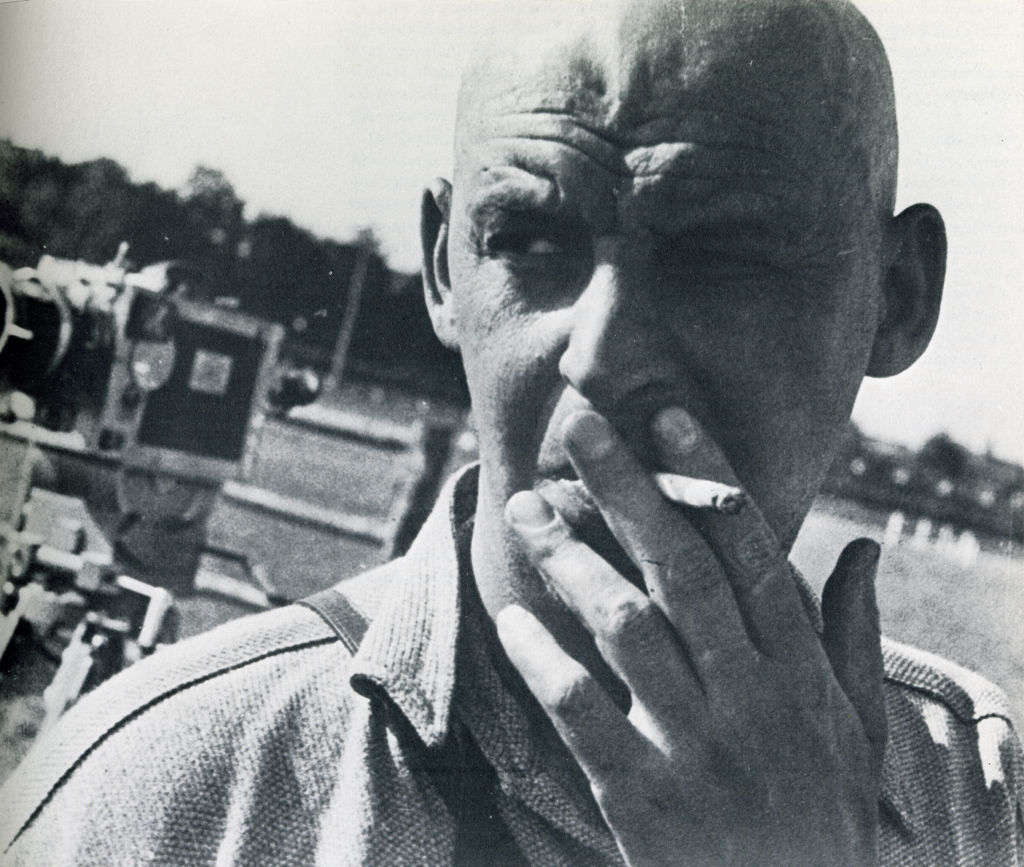
Why Alexander Rodchenko matters
Alexander Rodchenko is one of the founding figures of Russian Constructivism and one of the most influential figures in the history of photography and graphic design. He moved across painting, sculpture, photomontage, poster design, and teaching, and his experiments with camera angle, cropping, and montage reshaped how photography was used for advertising, propaganda, and reportage across the twentieth century. For a collector, he represents a market with an unusual split: mass-produced posters and photographic prints trade for modest sums, while his rare unique paintings and constructions have set multimillion-dollar prices.
- Born
- 1891-12-05, Saint Petersburg, Russian Empire
- Nationality
- Russian (Soviet)
- Media
- Photography, Photomontage, Graphic design, Painting, Sculpture
- Movement
- Constructivism, Russian avant-garde
- Education
- Kazan School of Art, 1910 to 1914 (under Nikolai Feshin and Georgii Medvedev); Stroganov School of Applied Art, Moscow, from about 1914 to 1915. No degree or diploma is documented at either school.
- Signature motifs
- Photomontage, Constructivist typography and graphic design, Geometric abstraction
- Representation
- No single exclusive gallery or estate representative is confirmed, Nailya Alexander Gallery, New York (secondary market), Annely Juda Fine Art, London (secondary market)
By the numbers
- USD 4.5MAuction highDesign No. 95, Sotheby's London, 29 November 2016
- ConstructivismMovementFounding figure of Russian Constructivism and the broader avant-garde
- Professor, 1920 to 1930VKhUTEMAS / VKhUTEINHigher State Art-Technical Institute, Moscow
- MoMA, Guggenheim, Art Institute of Chicago, Museum LudwigMuseum collections
Biography
Alexander Rodchenko was born on 5 December 1891 (23 November 1891, Old Style) in Saint Petersburg, in the Russian Empire. He studied drawing and painting at the Kazan School of Art from 1910 to 1914 under Nikolai Feshin and Georgii Medvedev, then moved to Moscow, where he continued his training at the Stroganov School of Applied Art from about 1914 to 1915. He made his first abstract drawings around 1915 and married the artist Varvara Stepanova, who became his lifelong collaborator.
Rodchenko became a central figure of the Soviet avant-garde in the years after the 1917 revolution, contributing to group exhibitions including the Third OBMOKhU Exhibition and the Constructivist show 5 x 5 = 25, both in Moscow in 1921. From 1920 to 1930 he taught at the Higher Technical-Artistic Studios, known as VKhUTEMAS and later VKhUTEIN, one of the Soviet Union's central art and design schools. Through the 1920s he shifted increasingly toward photography and photomontage, developing the unconventional angles and dynamic compositions that became his signature contribution to modern visual culture, alongside book covers, posters, and stage and exhibition design. He returned to painting between 1932 and 1942, then worked as an exhibition designer in Moscow, continuing until his death there on 3 December 1956, at the age of 64.
Critical reception
Rodchenko's institutional standing rests less on prizes than on roles within the Soviet art system: he served as secretary of the Moscow Artists' Union, was a founding professor at VKhUTEMAS, and helped found the Institute for Artistic Culture. No major international art prizes are documented for him, and critical accounts note that after Socialist Realism became state doctrine, he did not regain the standing or official recognition of his Constructivist years. His work has since been the subject of renewed institutional attention, including a 2008 retrospective at Berlin's Gropius Bau. Today his work is held in the collections of the Museum of Modern Art, the Solomon R. Guggenheim Museum, the Art Institute of Chicago, and the Museum Ludwig, among other institutions, reflecting a critical consensus that treats him as a founding figure of both Constructivist art and modern photographic practice.
Market
Rodchenko's market divides sharply by medium and rarity. His auction record is Design No. 95 (1919), which sold for GBP 3,650,000 (about USD 4.5 million) at Sotheby's London on 29 November 2016. The next-highest recorded price is Maquette for "War of the Future" (1930), which Christie's has described as the record for a Rodchenko work on paper and the second-highest price for the artist overall; it sold for USD 1,524,000 in a Christie's Spring Marquee Week evening sale reported as 18 May, though the exact year of that sale could not be confirmed in the sources reviewed here. Outside these unique painted and constructed works, the great majority of Rodchenko material at auction, vintage and later photographic prints, portfolios, and posters, sells for four to low six figure sums, a far more liquid but far less spectacular segment of his market.
Top auction results
| Work | Price | Sale |
|---|---|---|
| Design No. 95 (1919) | USD 4,500,000 (GBP 3,650,000) | Sotheby's, London, 2016-11-29 |
| Maquette for 'War of the Future' (1930) | USD 1,524,000 | Christie's, New York, 18 May (year not confirmed) |
Selected exhibitions
| Years | Exhibition | Venues |
|---|---|---|
| 1920 | XIX State Exhibition | Moscow |
| 1921 | Third OBMOKhU Exhibition | Moscow |
| 1921 | 5 x 5 = 25 | Moscow (with Aleksandra Ekster, Lyubov Popova, Varvara Stepanova, Alexander Vesnin) |
| 1925 | Exposition Internationale des Arts Decoratifs | Paris |
| 2008 | Alexander Rodchenko | Gropius Bau / Berliner Festspiele, Berlin |
Museum collections
- Museum of Modern Art, New York
- Museum Ludwig, Cologne
- Solomon R. Guggenheim Museum, New York
- Art Institute of Chicago
Authentication and provenance
No catalogue raisonne.
No published catalogue raisonne of Rodchenko's work has been identified. Works are documented through institutional archives, including the State A. V. Shchusev Architectural Museum in Moscow, and through family and estate holdings maintained by his grandson, Alexander Lavrentiev. Secondary-market authentication relies on these archives together with auction-house due diligence.
Primary reference: https://www.moma.org/collection/artists/4975
What collectors should know
There is no published catalogue raisonne for Rodchenko, so provenance research depends on institutional archives, including the State A. V. Shchusev Architectural Museum in Moscow, and on the family estate maintained by his grandson, Alexander Lavrentiev. No single gallery or estate representative currently handles his market; instead, his work moves through major auction houses and specialist dealers in Russian art and photography. Collectors should also note that the artist's auction record, Design No. 95 at Sotheby's in 2016, is well corroborated, while the reported second-highest price, the Christie's sale of Maquette for "War of the Future," rests on more limited press coverage and an unconfirmed sale year, so it is worth treating as the best available figure rather than an exhaustively verified one. This should be distinguished from the far more modest prices typical of his photographic prints and posters.
Further reading and resources
Data current as of 2026-07-09.

