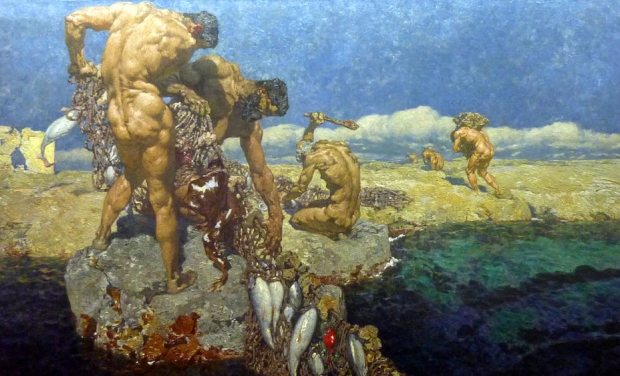
Why Alexander Rothaug matters
Alexander Rothaug is a documented figure of Vienna's late Symbolist era, an academically trained history and mythological painter whose formation under some of the Vienna Academy's leading professors places him squarely in the city's turn-of-the-century art establishment. He is not a blue-chip name, and his surviving auction record is modest, but he is a real, verifiable presence in the European auction market for Symbolist painting, which makes him useful to collectors building a picture of that period at a level below the marquee names.
- Born
- 1870-03-13, Vienna, Austria
- Nationality
- Austrian
- Media
- Painting, Watercolor, Illustration
- Movement
- Symbolism
- Education
- Academy of Fine Arts Vienna, 1885 to 1892, under August Eisenmenger, Christian Griepenkerl, Franz Rumpler, and Leopold Carl Muller; apprenticed in sculpture under Johann Schindler beginning 1884.
- Signature motifs
- Greek and Norse mythology, Symbolist figure painting
By the numbers
- EUR 171,250Auction highThe Abduction (Die Entfuhrung), Im Kinsky, Vienna, 2010
- 1885 to 1946Academy to deathVienna Academy enrollment to death in Vienna
- SymbolismMovement
Selected works
Click any work to view it full screen.
Biography
Alexander Rothaug was born in Vienna on 13 March 1870 into a family of artists; he and his older brother Leopold received their first painting instruction from their father, Theodor Rothaug. In 1884 he began an apprenticeship in sculpture under Johann Schindler in Vienna, but the following year he left sculpture for painting and enrolled at the Academy of Fine Arts Vienna, where he studied from 1885 to 1892 under August Eisenmenger, Christian Griepenkerl, and Franz Rumpler, with the orientalist painter Leopold Carl Muller cited as his most significant teacher. During these years he won several Academy prizes, including the Lampi Prize in 1888 and the Golden Fuger Medal in 1889.
After completing his studies in Vienna, Rothaug moved to Munich, where he worked as an illustrator for the satirical journal Munchener Fliegende Blatter and devoted himself to nature studies; some sources also describe further attendance at the Academy of Fine Arts Munich in this period, though the exact years and any degree there are not clearly documented and should be treated as unconfirmed.
Rothaug's mature work centers on mythological and allegorical subjects drawn from Greek and Norse legend, rendered in a Symbolist idiom. He exhibited regularly in Vienna through the 1900s and 1910s, including at the Kunstlerhaus's annual and autumn exhibitions and at the city's watercolor painters' club shows, and received the Drasche Prize in 1913. In 1938, during the Nazi period, he was represented with eight panel paintings at the Grosse Deutsche Kunstausstellung, the officially sanctioned exhibition held at Munich's Haus der Kunst; this participation is documented in his biographical record and is noted here as part of the historical account of his exhibition activity. He showed again at the Kunstlerhaus in Vienna in 1941. Alexander Rothaug died in Vienna on 5 March 1946.
Critical reception
Rothaug is documented in specialist references on Austrian Symbolist painting. Independent research did not turn up a specific, confirmable named museum holding beyond auction and dealer databases, so no institutional collection is asserted here. No verbatim critical assessment from a named critic in a major outlet could be confirmed in the available research, so none is quoted here. Beyond biographical and auction-catalogue descriptions, his standing rests primarily on his Academy training, his exhibition record in Vienna's major artists' associations, and the presence of his mythological subject matter in period surveys of Austrian Symbolist painting.
Market
Rothaug's auction market is thin and largely confined to Austrian and German houses. The highest price on record is EUR 171,250 (about USD 210,648) for The Abduction (Die Entfuhrung), sold at Im Kinsky in Vienna on 22 June 2010. No later or higher sale has been identified across the major auction databases checked, including Christie's, Lempertz, and Dorotheum. Other notable results sit well below that figure: Danae and the Rain of Gold made EUR 36,250 at Lempertz, The Death of Achilles made about USD 32,500 at Christie's New York in October 2017 (source reporting on the currency for this specific figure is inconsistent, so it is treated as approximate), and recent Dorotheum sales of smaller works have realized figures in the low thousands of euros, for example EUR 3,380 in March 2024. The pattern is consistent with a secondary-market artist whose top results depend heavily on the specific subject and scale of the individual work.
Top auction results
| Work | Price | Sale |
|---|---|---|
| The Abduction (Die Entfuhrung) | USD 210,648 (EUR 171,250) | Im Kinsky, Vienna, 2010-06-22 |
Selected exhibitions
| Years | Exhibition | Venues |
|---|---|---|
| 1900 | Royal Glass Palace exhibition (work: Magic Sleep) | Konigliches Glaspalast, Munich |
| 1909 | 35th Annual Exhibition | Kunstlerhaus, Vienna |
| 1909 | Autumn Exhibition | Kunstlerhaus, Vienna |
| 1911 | Anniversary exhibition of watercolor painters' clubs | Vienna |
| 1912 to 1913 | 27th Exhibition of Watercolourists' Clubs | Vienna |
| 1915 | Exhibition of four Viennese artists' associations (Kunstlerhaus, Secession, Hagenbund, Association of Austrian Artists; work: Lethe) | Vienna |
| 1938 | Grosse Deutsche Kunstausstellung (represented with eight panel paintings) | Haus der Kunst, Munich |
| 1941 | Collective exhibition with Maximilian Lenz, Johann Victor Kramer, Ernst Graner, and Gottlieb Theodor Kempf | Kunstlerhaus, Vienna |
Awards and honors
- Lampi Prize (1888)
- Golden Fuger Medal (1889)
- Special School Award, Academy of Fine Arts Vienna (1890)
- Drasche Prize (Baron Richard-Drasche-Ehrenpreis) (1913)
Authentication and provenance
No catalogue raisonne.
No catalogue raisonne has been identified for Rothaug. He died in 1946 with no known estate-representing gallery, so attribution and authentication rely on auction house provenance research and documented exhibition history rather than a certifying body.
Primary reference: https://www.biographien.ac.at/oebl/oebl_R/Rothaug_Alexander_1870_1946.xml
What collectors should know
There is no catalogue raisonne for Alexander Rothaug and no gallery or estate currently represents his work; pieces reach the market almost entirely through European auction houses such as Im Kinsky, Dorotheum, Lempertz, and occasionally Christie's. Prices vary widely by subject and scale, from the low thousands of euros for smaller studies to the six-figure record set in 2010, so provenance and documented exhibition history matter more than they would for an artist with a settled reference catalogue. Given the small and inconsistent sample of public sales, any single result should be read as a data point about that specific work rather than as evidence of a broad market trend.
Further reading and resources
Data current as of 2026-07-18.

