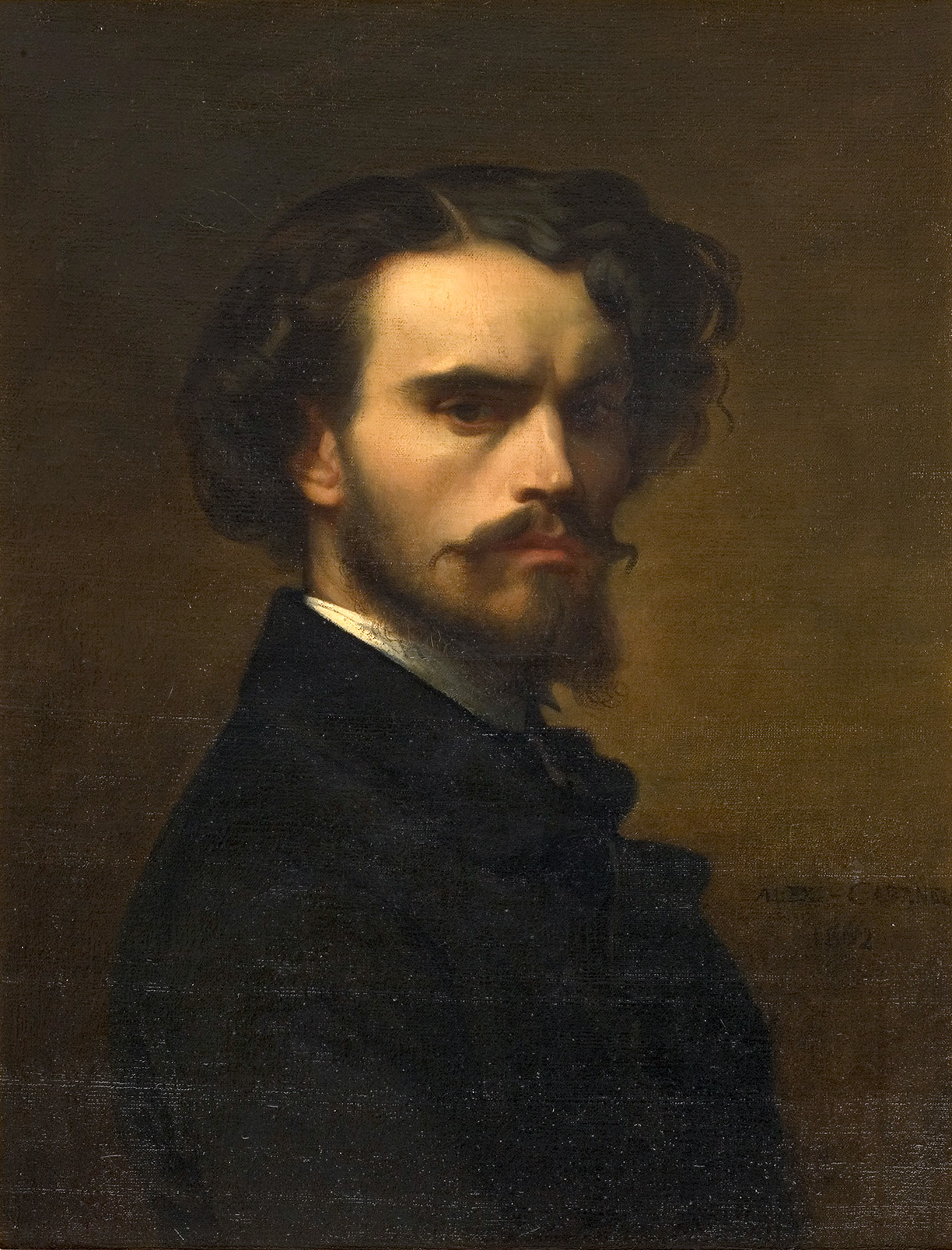
Why Alexandre Cabanel matters
Alexandre Cabanel was among the most successful painters of the French Second Empire, working alongside contemporaries such as Jean-Leon Gerome and Ernest Meissonier, and is closely associated with the personal taste of Napoleon III. His 1863 Salon painting The Birth of Venus, bought by the emperor himself, became one of the defining images of nineteenth-century academic art and remains the benchmark for his market today. For a collector, Cabanel is a study in how a painter can dominate the official taste of an era, train a generation of successors at the Ecole des Beaux-Arts, and then be recast by later art history as both a master of technique and the establishment figure that early modernism defined itself against.
- Born
- 1823-09-28, Montpellier, France
- Nationality
- French
- Media
- Painting
- Movement
- Academic art
- Education
- Municipal art school, Montpellier, under Charles Matet, from about 1834; atelier of Francois-Edouard Picot and Ecole des Beaux-Arts, Paris, matriculated October 1840; Prix de Rome, 1845; resident at the Villa Medici, Rome, 1845 to 1850
- Signature motifs
- Idealized classical nudes, History and mythological painting
By the numbers
- USD 834,500Auction highThe Birth of Venus, Christie's New York, 2001
- 1845Prix de RomeWon at age 22; resident at the Villa Medici, Rome, 1845 to 1850
- Chevalier, 1855Legion of HonourAwarded 1855
- Elected 1863Institut de FranceProfessor at the Ecole des Beaux-Arts from the early 1860s
Selected works
Click any work to view it full screen.
Biography
Alexandre Cabanel was born on 28 September 1823 in Montpellier, France. He began drawing lessons around age ten or eleven at the municipal art school in Montpellier, in the same building as the Musee Fabre, under the painter and museum curator Charles Matet. Municipal scholarships sent him to Paris by 1839 or 1840 to train in the atelier of Francois-Edouard Picot, and in October 1840, at seventeen, he formally entered the Ecole des Beaux-Arts.
After two unsuccessful attempts, Cabanel won the Prix de Rome in 1845 at age twenty-two and spent roughly the next five years, to 1850, as a resident at the Villa Medici in Rome. His reputation in Paris was established with The Death of Moses at the 1852 Salon, and cemented with The Glorification of Saint Louis at the 1855 Salon, a commission for the royal chapel at Vincennes that also traveled to the International Exhibition in London in 1862. That same year, 1855, he received the Legion of Honour. The Birth of Venus, shown at the Salon of 1863 and purchased by Napoleon III, brought him international fame; the composition proved popular enough that Cabanel and his studio produced several smaller reduced versions, now held by institutions including the Metropolitan Museum of Art and the Dahesh Museum.
Cabanel was elected to the Institut de France in 1863 and took up a professorship at the Ecole des Beaux-Arts, where he taught until his death and trained a generation of academic painters. He won the Salon's Grande Medaille d'Honneur in 1865, 1867, and 1878. He died in Paris on 23 January 1889, at age sixty-five.
Critical reception
Cabanel's contemporaries recognized him early as an heir to the grand academic tradition, and his history paintings from the 1850s onward secured his reputation within the official Salon system. The same qualities, polish, classical idealization, and institutional authority as a professor, made him a natural target once Impressionism and later modernism defined themselves in opposition to Academic painting. Twentieth-century criticism largely treated him as a symbol of Salon conservatism. More recent scholarship, including museum and auction-house writing tied to shows like the Musee d'Orsay's reassessments of academic painting, has returned attention to his technical command and his influence as a teacher.
Market
Cabanel's auction market is anchored by a single, long-standing record. The Birth of Venus sold for USD 834,500 at Christie's New York on 30 October 2001, acquired by the Dahesh Museum. No public sale since 2001 has been documented as surpassing that figure. Beyond the record, his market runs deep but comparatively modest in value: aggregator data cited in trade sources put several hundred lots by Cabanel through public auction over recent decades, dominated by Salon-period history and mythological subjects and smaller studio reductions rather than his largest exhibition canvases, most of which are now in museum collections.
Top auction results
| Work | Price | Sale |
|---|---|---|
| The Birth of Venus (2001) | USD 834,500 (USD 834,500) | Christie's, New York, 2001-10-30 |
Selected exhibitions
| Years | Exhibition | Venues |
|---|---|---|
| 1845 to 1850 | Prix de Rome residency | Villa Medici, French Academy in Rome |
| 1852 | The Death of Moses | Paris Salon |
| 1855 | The Glorification of Saint Louis | Paris Salon; commissioned for the royal chapel at Vincennes |
| 1862 | The Glorification of Saint Louis | International Exhibition, London |
| 1863 | The Birth of Venus | Paris Salon; acquired by Napoleon III |
| 1865, 1867, 1878 | Grande Medaille d'Honneur | Paris Salon |
Museum collections
- Musee d'Orsay, Paris
- Musee Fabre, Montpellier
- Musee des Beaux-Arts, Beziers
- Musee des Beaux-Arts, Lille
- The Metropolitan Museum of Art, New York
- Milwaukee Art Museum
- Cleveland Museum of Art
Awards and honors
- Prix de Rome (1845)
- Legion of Honour, Chevalier (1855)
- Institut de France, elected member (1863)
Authentication and provenance
No catalogue raisonne.
No published catalogue raisonne is confirmed and there is no artist estate or foundation actively representing the work today. Works are typically vetted through museum scholarship, exhibition and sale provenance, and the expertise of major auction houses such as Christie's and Sotheby's, which regularly catalogue his Salon-period paintings and later reductions.
Primary reference: https://www.sothebys.com/en/artists/alexandre-cabanel
What collectors should know
There is no confirmed catalogue raisonne for Cabanel and no active estate or foundation managing his work, so attribution and condition depend heavily on provenance research, exhibition history, and the standing of the auction house or museum involved. Because his most famous composition, The Birth of Venus, exists in more than one studio version and reduction, collectors should confirm which specific version a work descends from before comparing it to the record sale. The market itself is thin at the very top: the current record dates to 2001, and headline results should be read against that gap rather than assumed to reflect a fast-moving contemporary market.
Further reading and resources
Data current as of 2026-07-11.

