Alexandre Nikolaevich Benois
Russian, 1870 to 1960
Painting · Stage and costume design · Illustration
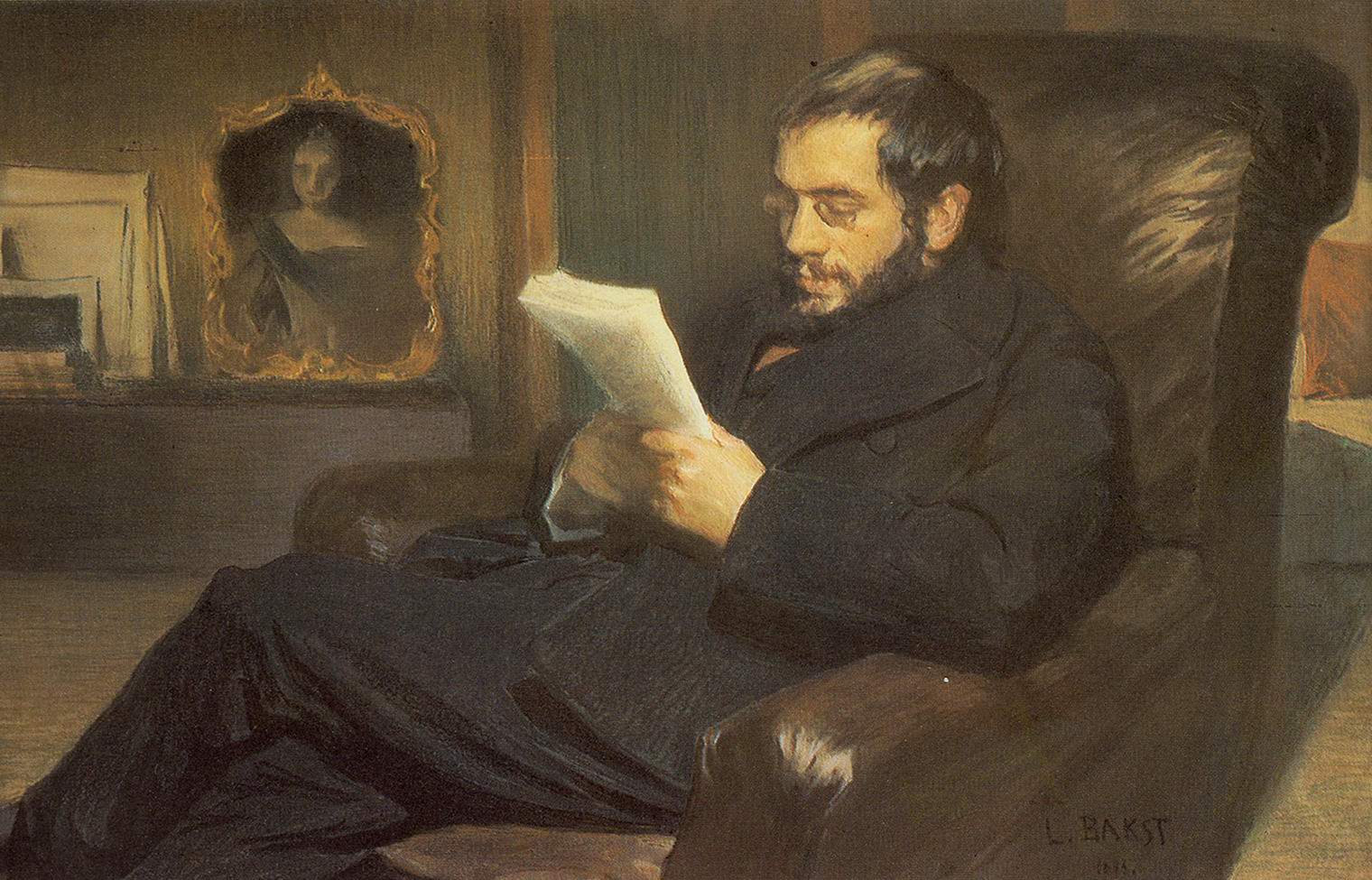
Why Alexandre Nikolaevich Benois matters
Alexandre Nikolaevich Benois stands at the hinge between the Russian Silver Age and European modernism. As a co-founder of Mir iskusstva, the World of Art movement and magazine, and as a principal designer for Sergei Diaghilev's Ballets Russes, he helped redefine what stage design could be, giving painters a central creative role in ballet and opera production rather than a decorative one. For a collector, his significance rests less on a deep auction record than on his position at the origin of a design language that shaped modern ballet, opera, and book illustration across Europe for decades.
- Born
- 1870-05-03, Saint Petersburg, Russia
- Nationality
- Russian
- Media
- Painting, Stage and costume design, Illustration
- Movement
- Mir iskusstva (World of Art), Russian Art Nouveau
- Education
- Private gymnasium of K. I. May, St. Petersburg (secondary); evening classes, Imperial Academy of Arts, 1887 (four months, non-degree); Faculty of Law, Saint Petersburg Imperial University, graduated 1894
- Signature motifs
- Ballets Russes stage and costume design, Historicist scenes of 18th-century Versailles and Imperial Russia
By the numbers
- Not reliably confirmedAuction highSecondary-market commentary cites a figure near 482,500 (currency unconfirmed, likely GBP) for a Ballets Russes stage design; the work, sale house, location, and date could not be independently verified
- Mir iskusstva (World of Art)Co-founderWith Sergei Diaghilev and Leon Bakst, 1898
- 1918 to 1926Hermitage curatorshipHead of the Gallery of Old Masters, State Hermitage Museum
- None confirmedGallery representationHistoric estate; market activity is concentrated at auction houses rather than dealers
Selected works
Click any work to view it full screen.
Biography
Alexandre Nikolaevich Benois was born on 3 May 1870 (21 April, Old Style) in Saint Petersburg into the Benois family, a dynasty of architects, artists, and musicians of French and Italian descent long settled in Russia. He attended the private gymnasium of K. I. May in Saint Petersburg and, as a young man, took four months of evening classes at the Imperial Academy of Arts in 1887, supplementing this with informal training in watercolor under his elder brother, the painter Albert Benois. Rather than pursue art as a formal course of study, Benois enrolled in law, graduating from the Faculty of Law at Saint Petersburg Imperial University in 1894.
In 1898, Benois co-founded Mir iskusstva with Sergei Diaghilev and Leon Bakst, a magazine and loosely affiliated circle of artists that became the leading vehicle for Russian Art Nouveau and for a broader reappraisal of Russian art history and craftsmanship. The circle's aesthetic and its personal networks fed directly into Diaghilev's Ballets Russes, for which Benois worked as a designer; his stage designs are considered part of his most historically significant and commercially notable work. He also worked as a painter of historicist scenes, frequently returning to eighteenth-century Versailles and the palaces of Imperial Russia, and as a stage historian, illustrator, and critic.
After the 1917 Revolution, Benois remained in Russia for a period, serving from 1918 to 1926 as head of the Gallery of Old Masters at the State Hermitage Museum in Petrograd/Leningrad. In 1926 he emigrated permanently to Paris, where he continued to design for ballet and opera and held solo exhibitions in Paris, London, and Como over the following decades. He died on 9 February 1960 in Paris, France, at the age of 89.
Critical reception
Major reference sources consistently frame Benois as a foundational figure in early twentieth-century Russian art and in the modern history of stage design. Encyclopaedia Britannica and Tate both identify him as a central figure of Mir iskusstva and credit his work for Diaghilev's Ballets Russes with a seminal influence on modern ballet and set design. His historicist paintings of Versailles and the Russian imperial palaces are generally treated as an extension of the same interests that animated his stage work: a fascination with courtly spectacle, decorative detail, and the theatrical possibilities of historical setting. No verbatim critical assessment from a named critic in a major outlet could be confirmed for this profile, so his critical standing here rests on museum and encyclopedic sources rather than a quoted review.
Market
Benois's auction market is thin and dominated by works on paper related to his theater practice rather than by a deep body of oil paintings. Secondary-market commentary cites a figure near 482,500 (currency unconfirmed, likely GBP) as a possible record for a Ballets Russes stage design, but the specific work, sale house, location, and date could not be independently verified and should be treated with caution. Outside that figure, tracked auction prices for Benois are typically far lower, with some databases showing realized prices in the low tens of thousands of dollars, and Artprice placing him well outside the top ranks of global auction turnover. Sotheby's has also included his work in its sales, a further indication of sustained if modest secondary-market interest in his stage and costume designs.
Selected exhibitions
| Years | Exhibition | Venues |
|---|---|---|
| 1893 to 1918 | Society of Russian Watercolorists exhibitions | Saint Petersburg |
| 1898 | Secession exhibition | Munich |
| 1926 | Personal exhibition | Paris |
| 1929 | Personal exhibition | Paris |
| 1937 | Personal exhibition | London |
| 1939 | Personal exhibition | London |
| 1953 | Personal exhibition | Paris |
| 1959 | Personal exhibition | London |
Museum collections
- State Russian Museum, St. Petersburg
- State Tretyakov Gallery, Moscow
- Pushkin State Museum of Fine Arts, Moscow
- Tate, London
Authentication and provenance
No catalogue raisonne.
No published catalogue raisonne has been located for Alexandre Nikolaevich Benois. Attribution is complicated by the size of the Benois family of artists, which includes a different painter, Alexandre Benois di Stetto (1896 to 1979), so works should be verified against exact dates, signature, and Mir iskusstva or Ballets Russes provenance rather than the surname alone.
Primary reference: https://www.britannica.com/biography/Alexandre-Benois
What collectors should know
Benois has no published catalogue raisonne, and no current gallery or estate representation could be confirmed, so works reach the market almost exclusively through auction houses rather than dealers. Because the extended Benois family produced several artists, including the separate painter Alexandre Benois di Stetto (1896 to 1979), buyers should confirm attribution against exact dates, signature, and documented Mir iskusstva or Ballets Russes provenance rather than the surname alone. Values vary widely by medium and subject: theater-related gouaches and watercolors tied to major Ballets Russes productions have brought the highest prices, while other works, particularly smaller decorative pieces, have typically traded in the low tens of thousands of dollars or less.
Further reading and resources
Data current as of 2026-07-11.

