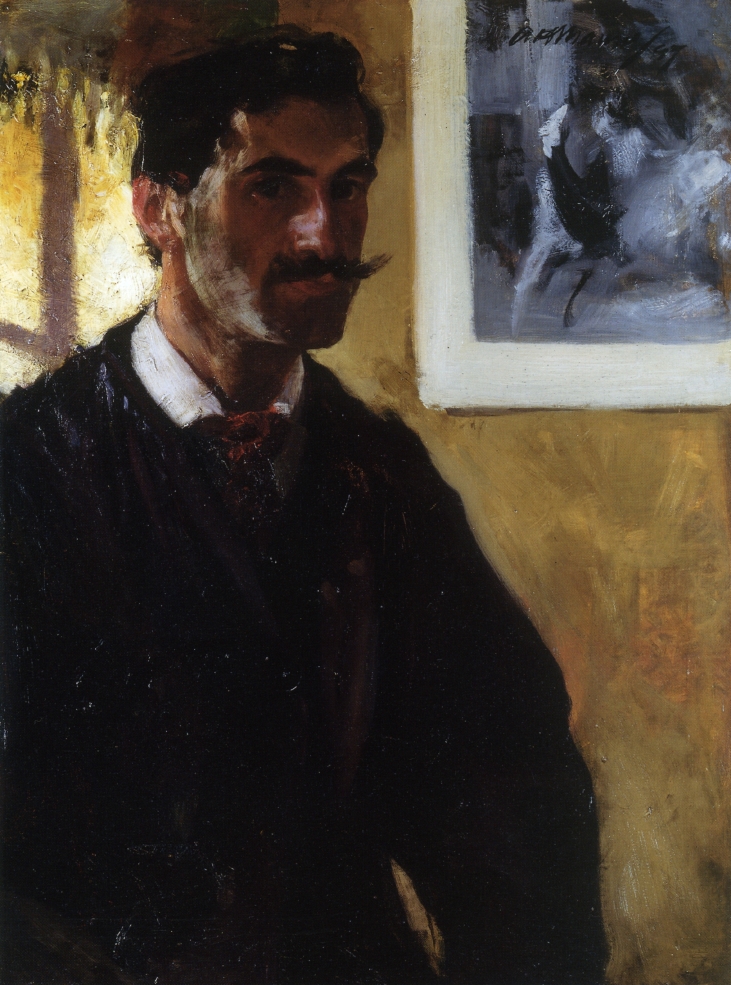
Why Alfred Henry Maurer matters
Alfred Henry Maurer was among the first American painters to absorb European modernism directly at its source. He began as an academically decorated portrait and figure painter in the 1890s, then moved to Paris, where exposure to Henri Matisse and the Fauvist circle around Gertrude and Leo Stein pushed his work toward bright, flattened color and, later, a Cubist-inflected abstraction of the human head that anticipated directions other American painters would not reach for years. He showed four works at the landmark 1913 Armory Show in New York. For collectors, he is a case study in a gap between historical importance and market size: an artist whose place in the story of American modernism is far larger than the thin, modestly priced auction market his estate has generated.
- Born
- 1868-04-21, New York City, USA
- Nationality
- American
- Media
- Painting, Watercolor
- Movement
- American Modernism, Fauvist and Cubist influenced abstraction
- Education
- National Academy of Design, New York, from 1884 into the mid-1890s (sources vary on the exact span); Academie Julian, Paris, from 1897. Studied at the Academy under sculptor John Quincy Adams Ward and painter William Merritt Chase, and is described in some sources as one of the few Americans to have briefly trained with Henri Matisse in Paris.
- Signature motifs
- Abstracted, doubled heads, Fauvist still life and landscape
- Representation
- Forum Gallery, Rosenberg & Co., Aaron Payne Fine Art
By the numbers
- USD 153,600Auction highThe Yellow Screen, Sotheby's New York, 2026-05-20. A market aggregator separately cites an unverified figure near USD 590,500 with no disclosed work, house, or date.
- First Prize, 1901Carnegie InternationalAn Arrangement, jurors included Thomas Eakins and Winslow Homer
- 1913, New YorkArmory ShowFour works included, International Exhibition of Modern Art
- Forum Gallery; Rosenberg & Co.; Aaron Payne Fine ArtRepresented byEstate and secondary market representation
Selected works
Click any work to view it full screen.
Biography
Alfred Henry Maurer was born in New York City on April 21, 1868, the son of Louis Maurer, a prominent lithographer for Currier and Ives. He was taken out of school at sixteen to work in his father's lithographic firm, then studied at the National Academy of Design in New York from 1884 into the mid-1890s (sources vary on the exact span). His early paintings, dark, Whistlerian genre and portrait scenes, won him rapid recognition: the Inness Jr. Prize at the Salmagundi Club in 1900, first prize at the 1901 Carnegie International Exhibition for the painting An Arrangement (juried in part by Thomas Eakins and Winslow Homer), a bronze medal at the 1901 Pan-American Exposition in Buffalo, and medals at international expositions in Liege, Belgium, and Munich in the early 1900s.
In 1897 Maurer left for Paris after several years of study at the National Academy under sculptor John Quincy Adams Ward and painter William Merritt Chase. He enrolled at the Academie Julian but found its instruction too limited and spent much of his time copying paintings in the Louvre instead. Living in France until 1914, he became part of the circle around Gertrude and Leo Stein and is described in gallery and museum accounts as one of the few Americans to have studied, if only briefly, with Matisse. His work shifted decisively toward Fauvist color and, in later years, toward abstracted, often doubled or fractured heads that drew on Cubism. He exhibited at the 1907 Salon d'Automne in Paris, showed in New York at Alfred Stieglitz's gallery 291 (including a two-man exhibition with John Marin), and had four paintings included in the 1913 Armory Show. He exhibited regularly with the Society of Independent Artists after 1917 and was elected one of its directors in 1919.
Maurer's later career was marked by financial hardship and estrangement from his father, with whom he lived for much of his adult life. Louis Maurer died in 1932 at the age of one hundred. Several weeks later, on August 4, 1932, Alfred Henry Maurer died by suicide, by hanging, in New York City, at the age of sixty-four. He was interred at Green-Wood Cemetery in Brooklyn.
Critical reception
Maurer's reputation has moved in two distinct waves. During his lifetime he was praised as a technically gifted, prize-winning painter in an academic and Whistlerian mode, then, after his Paris years, as one of the earliest American painters to work through Fauvism and Cubism, a status confirmed by his inclusion in the 1907 Salon d'Automne, exhibitions at Stieglitz's 291, and the 1913 Armory Show. His later, more austere abstracted heads drew less attention in his own time. After his death, the critic Henry McBride reviewed a memorial exhibition of his work at the Hudson Walker Gallery in New York around 1937, praising Maurer's single-minded devotion to his art over commercial success. A 2015 to 2016 traveling retrospective, Alfred Maurer: At the Vanguard of Modernism, organized by the Addison Gallery of American Art and shown at Crystal Bridges Museum of American Art, renewed scholarly attention and is frequently cited as the clearest recent case for his standing as one of America's first modernist painters.
Market
Maurer's best fully documented auction result is The Yellow Screen, which sold for USD 153,600 at Sotheby's in New York on May 20, 2026. A market aggregator, MutualArt, separately reports realized prices of "up to" USD 590,500 for a Maurer painting, but does not disclose the specific work, auction house, or sale date behind that figure, so it cannot be confirmed as a verified record. Trading in his work is thin, and public results vary widely by venue and lot; no single sale should be read as representative of his broader market. Because Maurer died in 1932, current market activity runs through galleries and specialists handling his estate and secondary-market inventory, principally Forum Gallery, Rosenberg & Co., and Aaron Payne Fine Art, all in New York.
Top auction results
| Work | Price | Sale |
|---|---|---|
| The Yellow Screen | USD 153,600 (USD 153,600) | Sotheby's, New York, 2026-05-20 |
Selected exhibitions
| Years | Exhibition | Venues |
|---|---|---|
| 1907 | Salon d'Automne | Paris |
| c. 1910s | Two-man exhibition with John Marin | 291 (Alfred Stieglitz's gallery), New York |
| 1913 | International Exhibition of Modern Art (the Armory Show) | 69th Regiment Armory, New York |
| 1916 | The Forum Exhibition of Modern American Painters | Anderson Galleries, New York |
| 1917 to 1932 | Society of Independent Artists, annual exhibitions | New York; Maurer was elected a director of the Society in 1919 |
| 1931 | Whitney Museum exhibition | Whitney Museum of American Art, New York |
| 1937 | Memorial exhibition | Hudson Walker Gallery, New York |
| 2015 to 2016 | Alfred Maurer: At the Vanguard of Modernism | Addison Gallery of American Art, Andover; traveled to Crystal Bridges Museum of American Art |
Museum collections
- Metropolitan Museum of Art, New York
- Whitney Museum of American Art, New York
- Art Institute of Chicago
- Philadelphia Museum of Art
- The Phillips Collection, Washington, D.C.
- National Gallery of Art, Washington, D.C.
- Barnes Foundation, Philadelphia
- Crystal Bridges Museum of American Art, Bentonville
Awards and honors
- Inness Jr. Prize, Salmagundi Club, New York (1900)
- First Prize, Carnegie International Exhibition, for An Arrangement (1901)
- Bronze medal, Pan-American Exposition, Buffalo (1901)
- Third medal, international exposition, Liege, Belgium (1905)
- Gold medal, international exposition, Munich (exact year not confirmed by sources; associated with the early 1900s)
Authentication and provenance
No catalogue raisonne.
No published catalogue raisonne has been confirmed for Maurer. Verification of paintings and watercolors is generally handled through the galleries that deal in his estate and secondary market material, including Forum Gallery, Rosenberg & Co., and Aaron Payne Fine Art.
Primary reference: https://www.forumgallery.com/artists/alfred-henry-maurer/biography
What collectors should know
There is no confirmed catalogue raisonne for Maurer, so authentication runs through the galleries and specialists who handle his estate, and provenance tracing back through his family and early dealers carries real weight. His market is small: the best documented auction result, USD 153,600 for The Yellow Screen at Sotheby's in 2026, is modest next to his historical standing, and an unverified aggregator figure near USD 590,500 cannot be confirmed as a genuine record, so any single result should be weighed against the broader, thin sales history rather than treated as a market benchmark. Collectors should also expect his output to be uneven in character across two distinct phases, an earlier academic and Fauvist-inflected body of work and a later, more abstract Cubist-influenced one, which affects both attribution questions and relative demand.
Further reading and resources
Data current as of 2026-07-11.

