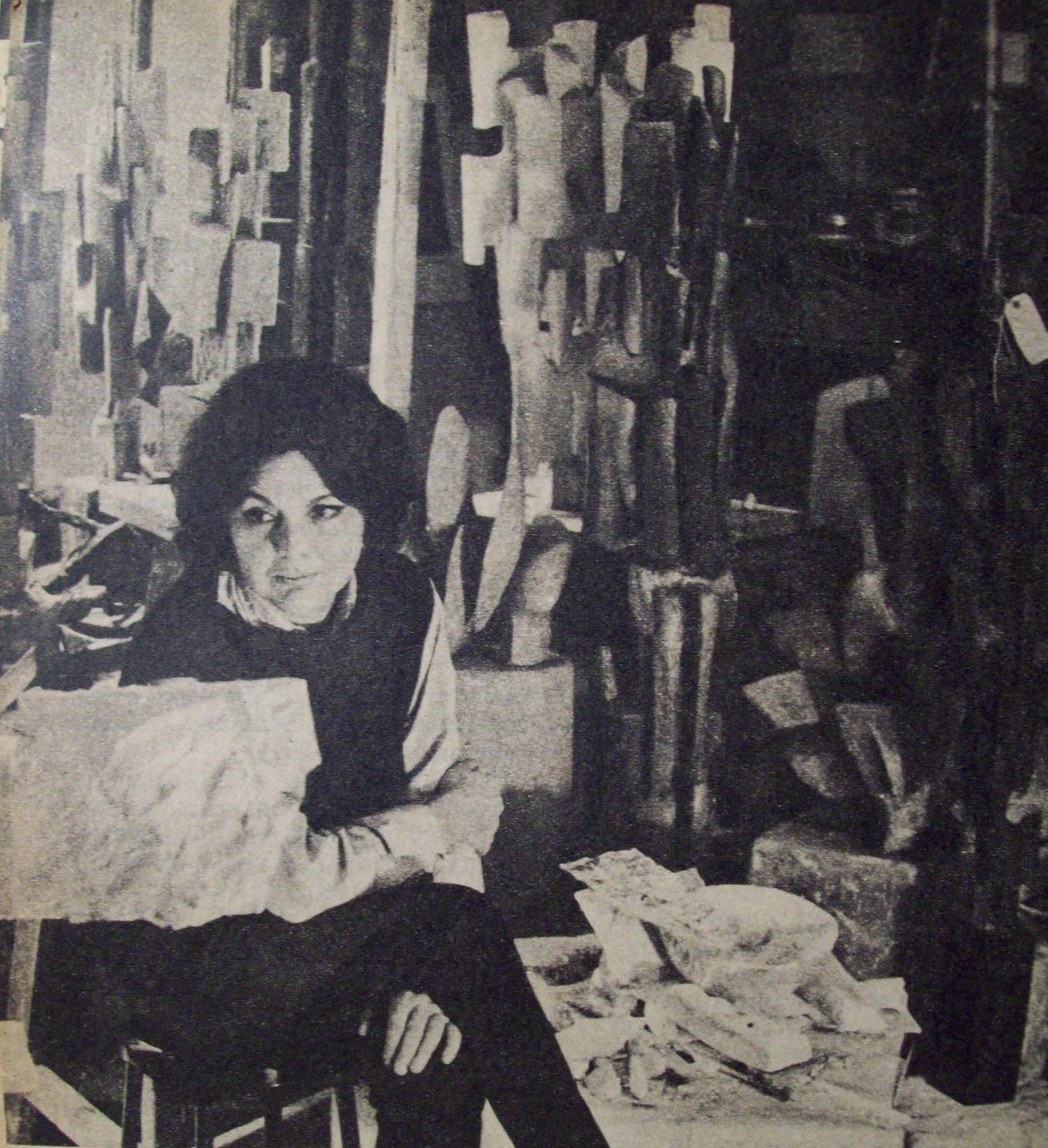
Why Alicia Penalba matters
Alicia Penalba was one of the leading sculptors of the postwar Paris scene, an Argentine-born artist who trained in Ossip Zadkine's studio and developed a distinct language of vertical, totemic, biomorphic bronze forms. Her work was included in two editions of documenta and she won the top sculpture prize at the 1961 Sao Paulo Biennale, and her work sits today in major public collections across Europe, the Americas, and Latin America. For a collector, she is a case study in a museum-validated postwar sculptor whose auction market remains small and comparatively undervalued relative to that institutional standing.
- Born
- 1913-08-09, San Pedro, Buenos Aires Province, Argentina
- Nationality
- Argentine
- Media
- Sculpture, Works on paper
- Movement
- Post-war abstraction, Non-figurative sculpture
- Education
- Escuela Superior de Bellas Artes Ernesto de la Carcova, Buenos Aires, drawing and painting, 1930 to 1934, teaching diploma; moved to Paris in 1948; studied sculpture with Ossip Zadkine at the Academie de la Grande Chaumiere, Paris, from about 1949
- Signature motifs
- Totemic vertical forms, Biomorphic abstraction, Cast bronze
- Representation
- Galerie A&R Fleury (Paris, estate)
By the numbers
- USD 177,800Auction highLe Voyageur des nuits (1957), Sotheby's New York, 21 Nov 2025
- USD 125,000Prior auction recordGrand Voyageur des Nuits (1968), Christie's New York, 28 May 2014
- International Grand Prize in Sculpture1961 Sao Paulo Biennale
- Galerie A&R Fleury (estate)Represented by
Biography
Alicia Rosario Perez Penalba was born on August 9, 1913, in San Pedro, in Buenos Aires Province, Argentina, to Spanish immigrant parents, Santiago Perez and Remedios Penalba. She studied drawing and painting at the Escuela Superior de Bellas Artes Ernesto de la Carcova in Buenos Aires from 1930 to 1934, earning a teaching diploma.
In 1948 she moved to Paris, where she worked at the Academie de la Grande Chaumiere in the studio of the Russian sculptor Ossip Zadkine, a period that redirected her practice toward sculpture. By 1950 she had committed fully to three-dimensional work, developing the vertical, totem-like abstract bronze forms that would define her career.
Her first solo exhibition took place in 1957, and her international profile grew quickly: she was included in documenta II in Kassel in 1959 and documenta III in 1964, and in 1961 she won the International Grand Prize in Sculpture at the VI Bienal de Sao Paulo. In 1968 the Musee d'Art Moderne de la Ville de Paris presented her exhibition Totems et Tabous, and the same museum gave her a full retrospective in 1977. She received the Gulbenkian Foundation Prize in 1974.
Penalba died on November 4, 1982, in a traffic accident in the Landes region of southwestern France, near Dax, when the car she was traveling in was struck by a train. Her partner, Michel Chilo, died in the same accident. Most institutional sources, including the French Wikipedia entry and AWARE, place the accident near Saint-Geours-de-Maremne in Landes; a smaller number of sources, including some Wikipedia language editions, cite Paris as the place of death, a discrepancy that has not been resolved in the available record.
Critical reception
Penalba's inclusion in two editions of documenta and her 1961 Grand Prize at the Sao Paulo Biennale placed her among the internationally recognized sculptors of her generation during her lifetime, alongside her training lineage through Ossip Zadkine. The Musee d'Art Moderne de la Ville de Paris's decision to give her both a dedicated 1968 exhibition, Totems et Tabous, and a full retrospective in 1977 reflects sustained institutional confidence in her work within France. In the decades since her death, museums and researchers, including AWARE and MALBA, have worked to restore her visibility within the broader history of postwar abstraction and within the history of women sculptors specifically, framing her sudden death in 1982 as an interruption of a still-developing body of work rather than its natural conclusion.
Market
Penalba's auction market is thin but has strengthened recently. Her current auction record is USD 177,800, set by the 1957 bronze Le Voyageur des nuits at Sotheby's New York on November 21, 2025, a result reported as a 42 percent jump over her previous record. That prior record, USD 125,000, was set by Grand Voyageur des Nuits (1968) at Christie's New York on May 28, 2014. Outside these headline results, French valuation sources describe most of her bronzes as trading in the tens of thousands of dollars or euros in the secondary market, well below the 2025 record.
Top auction results
| Work | Price | Sale |
|---|---|---|
| Le Voyageur des nuits (1957) | USD 177,800 (USD 177,800) | Sotheby's, New York, 2025-11-21 |
| Grand Voyageur des Nuits (1968) | USD 125,000 (USD 125,000) | Christie's, New York, 2014-05-28 |
Selected exhibitions
| Years | Exhibition | Venues |
|---|---|---|
| 1959 | documenta II | Kassel, Germany |
| 1960 | Solo exhibition | Galerie Claude Bernard, Paris |
| 1961 | VI Bienal de Sao Paulo | Sao Paulo, Brazil (International Grand Prize in Sculpture) |
| 1964 | documenta III | Kassel, Germany |
| 1968 | Totems et Tabous | Musee d'Art Moderne de la Ville de Paris |
| 1977 | Retrospective | Musee d'Art Moderne de la Ville de Paris |
| 2017 | Alicia Penalba. Esculturas | MALBA, Buenos Aires |
| 2026 | Alicia Penalba | Galerie A&R Fleury, Paris |
Museum collections
- Centre Pompidou, Paris
- Musee d'Art Moderne de la Ville de Paris
- MALBA, Buenos Aires
- Museo Nacional de Bellas Artes, Buenos Aires
- Brooklyn Museum, New York
- Hirshhorn Museum and Sculpture Garden, Washington, D.C.
- Kroller-Muller Museum, Otterlo
Awards and honors
- International Grand Prize in Sculpture, VI Bienal de Sao Paulo (1961)
- Gulbenkian Foundation Prize (1974)
Authentication and provenance
No catalogue raisonne.
No published catalogue raisonne has been confirmed for Penalba. The artist's estate maintains a research archive and official site (alicia-penalba.com / penalba.com) documenting exhibition history and works, and galleries that have handled the estate, notably Galerie A&R Fleury in Paris, are the primary route for verification of major bronzes.
Primary reference: https://www.alicia-penalba.com/biography
What collectors should know
Penalba's auction supply is small, and results can move sharply on a single strong sale, as the November 2025 record demonstrates. There is no confirmed catalogue raisonne, so provenance and verification through the estate and through galleries that handle the estate, principally Galerie A&R Fleury in Paris, carry extra weight. Her deep institutional holdings, from the Centre Pompidou to the Hirshhorn and MALBA, are the clearest evidence of durability, and collectors should treat any individual auction price as one data point in a market that is still comparatively small relative to her museum standing.
Further reading and resources
Data current as of 2026-07-16.

