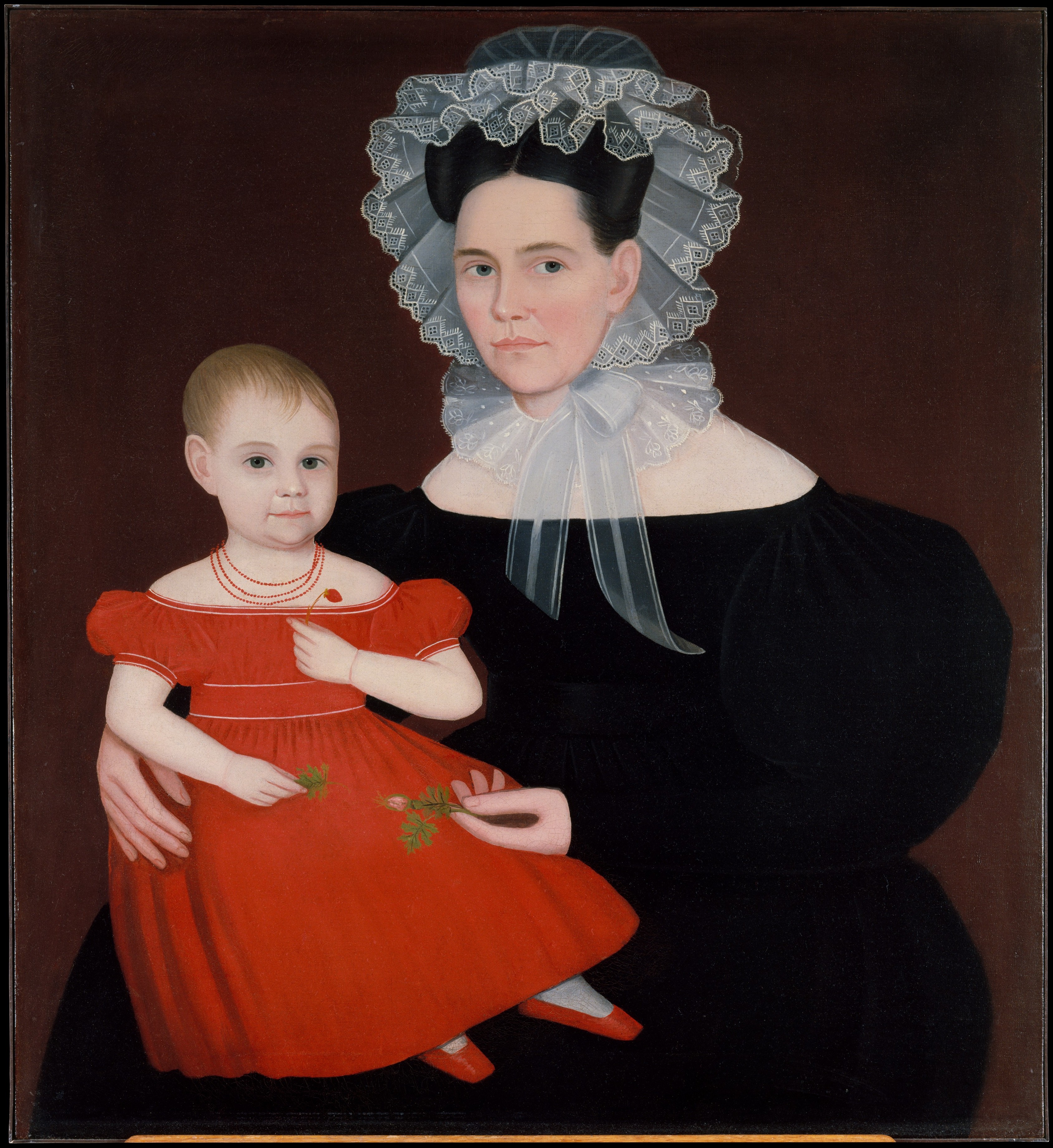
Why Ammi Phillips matters
Ammi Phillips is among the most commercially significant American folk portrait painters, the product of a decades-long itinerant career that left one of the largest and most stylistically varied bodies of surviving early American portraiture. For collectors, he is a rare case of a nineteenth-century self-taught painter, once split across multiple invented attributions, who has since been reunified into a single, museum-validated oeuvre that continues to command his own record prices for American folk art.
- Born
- 1788-04-24, Colebrook, Connecticut, USA
- Nationality
- American
- Media
- Painting
- Movement
- American folk art, Itinerant portraiture
- Education
- No documented formal schooling or apprenticeship. Traditionally described as self-taught; scholars note it is unknown whether he had informal contact with other painters active near Colebrook, Connecticut.
- Signature motifs
- Children and young women in red dresses, Pink-ribbon portraits, Flattened, high-contrast frontal composition
- Representation
- "No living estate or current gallery representation is documented for this nineteenth-century painter. Works circulate primarily through major auction houses, principally Christie's, and are otherwise concentrated in museum collections."
By the numbers
- USD 3.87MAuction highWoman with Pink Ribbons, Christie's New York, 2022
- c. 1809 to the early 1860sActive careerItinerant portrait painter across the New York, Connecticut, and Massachusetts border region
- 3+Museum collectionsMetropolitan Museum of Art, National Gallery of Art, American Folk Art Museum, and others
- None publishedCatalogue raisonneAttribution relies on museum and scholarly connoisseurship
Selected works
Click any work to view it full screen.
Biography
Ammi Phillips was born in Colebrook, Connecticut, on April 24, 1788. He was already working and advertising as an itinerant portrait painter by 1809, according to the American Folk Art Museum; the specific publication or location of his earliest documented advertisement is not confirmed in the sources reviewed for this profile. No school, apprenticeship, or named teacher has been documented for him. He is traditionally described as self-taught, likely absorbing technique from imported prints and from itinerant painters active in the Colebrook area, though scholars are explicit that his early training is undocumented.
For more than fifty years Phillips worked as an itinerant portraitist, traveling among towns in Connecticut, Massachusetts, and New York's Hudson Valley to paint local merchant and farming families. His early paintings were unsigned and his style shifted markedly over his career, so for decades twentieth-century scholars treated different phases of his output as the work of separate, unidentified painters nicknamed the Border Limner and the Kent Limner. Attribution research in 1965 by Barbara and Larry Holdridge with Mary C. Black established that both names referred to Phillips, and the Connecticut Historical Society presented what is described as his first one-person exhibition that same year, 1965 to 1966, about a century after his death. The American Folk Art Museum has since built later exhibitions, including a pairing with Mark Rothko, around his unified body of work.
Phillips died in Curtisville, near Stockbridge, Massachusetts, an area now known as Interlaken, in July 1865. His obituary in the Berkshire County Eagle gives the date as July 14; other published sources give July 11 or July 15, and the exact day remains unresolved in the record. He was buried in Amenia, New York.
Critical reception
Phillips's reputation rests almost entirely on museum scholarship rather than contemporary press, since he worked and died before any market apparatus existed to record him. Attribution research in the 1960s, and the exhibitions that followed, established him as a distinct major hand once his fractured Border Limner and Kent Limner attributions were unified. Later exhibitions, including a pairing of his portraits with paintings by Mark Rothko at the American Folk Art Museum under the title The Seduction of Light, have argued that his flattened planes of color anticipated concerns later associated with American modernism. No verified verbatim critical quotations from named critics in major outlets are available for this profile.
Market
Phillips holds his own current auction record. His painting Woman with Pink Ribbons sold for USD 3,870,000 at Christie's in New York on January 20, 2022, more than doubling his previous record of USD 1,692,500, set by Girl in a Red Dress with a Dog at Christie's New York in 2019. Both record-setting works belong to his best-known subject, children and young women in red dresses or with pink ribbons, painted in the flattened, high-contrast style of his later career. Because his market consists of a finite, largely museum-absorbed body of work rather than an active studio, individual rediscoveries can move his personal record substantially, as the 2022 sale showed.
Top auction results
| Work | Price | Sale |
|---|---|---|
| Woman with Pink Ribbons (2022) | USD 3,870,000 (USD 3,870,000) | Christie's, New York, 2022-01-20 |
| Girl in a Red Dress with a Dog (2019) | USD 1,692,500 (USD 1,692,500) | Christie's, New York |
Selected exhibitions
| Years | Exhibition | Venues |
|---|---|---|
| 1965 to 1966 | Ammi Phillips | Connecticut Historical Society, Hartford |
Museum collections
- Metropolitan Museum of Art, New York
- National Gallery of Art, Washington, D.C.
- American Folk Art Museum, New York
Authentication and provenance
No catalogue raisonne.
No catalogue raisonne has been published. Phillips's early output was historically divided among invented, unidentified 'hands' known as the Border Limner and the Kent Limner before twentieth-century scholarship unified them under his name. Attribution today relies on museum and scholarly connoisseurship rather than a single authenticating body.
Primary reference: https://www.nga.gov/artists/1781-ammi-phillips
What collectors should know
There is no catalogue raisonne for Ammi Phillips, and no living estate or exclusive gallery represents his work; paintings surface through descent, museum deaccessions, and major auction houses such as Christie's. Because his early oeuvre was historically divided among invented names before being reunified under his own, provenance research and museum-grade connoisseurship matter more than usual when evaluating an attribution. His market is thin in volume but capable of very high individual results, concentrated in the celebrated red-dress and pink-ribbon portraits that anchor his auction record.
Further reading and resources
Data current as of 2026-07-09.

