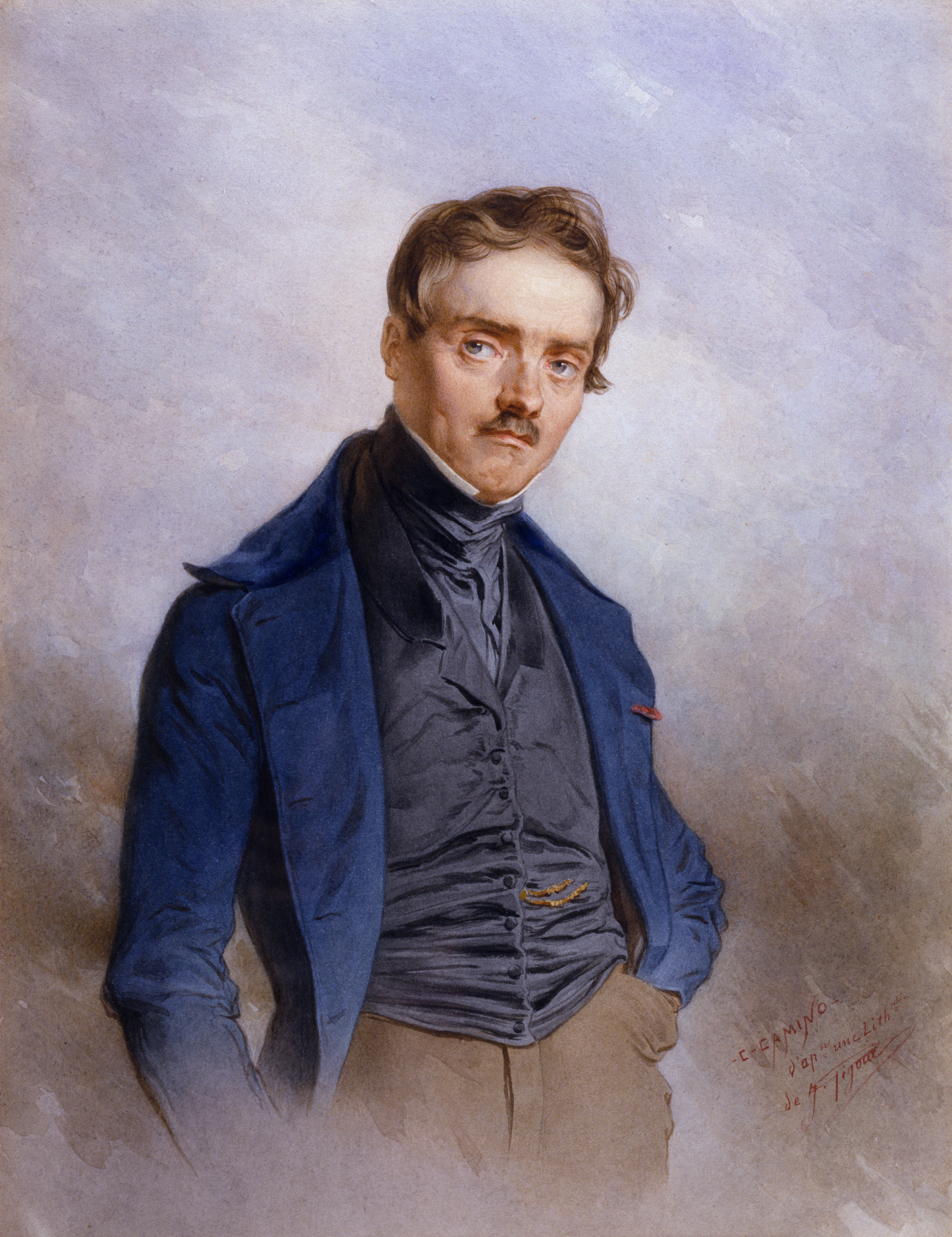
Why Antoine-Louis Barye matters
Antoine-Louis Barye is the artist most closely identified with the animalier school, the nineteenth-century French movement that treated animal subjects, especially predators locked in combat, as a vehicle for serious sculpture rather than decorative craft. His bronzes moved from the Paris Salon into the Louvre, the Tuileries gardens, and eventually into nearly every major encyclopedic museum collection in Europe and North America. For a collector, he represents a rare combination: a historical sculptor whose work is genuinely held in depth by institutions such as the Louvre, the Metropolitan Museum of Art, and the National Gallery of Art, but whose auction market remains comparatively under-documented at the very top end.
- Born
- 1795-09-24, Paris, France
- Nationality
- French
- Media
- Sculpture, Painting, Printmaking
- Movement
- Romanticism, Animalier sculpture
- Education
- Ecole des Beaux-Arts, Paris, 1818 to 1823 (sculpture and painting), after earlier studio training under Francois-Joseph Bosio (sculpture) and Antoine-Jean Gros (painting); no formal degree is documented.
- Signature motifs
- Animalier bronzes, Predator-and-prey combat groups
- Representation
- "Mark Murray Fine Paintings (secondary market, New York)", "Sladmore Gallery (secondary market, London)"
By the numbers
- USD ~1.05MAuction high (approx.)MutualArt-reported ceiling for sculptures; specific work, auction house, and sale date not confirmed in current sources
- 6,900+ works sold at auctionAuction market volumeMutualArt, lifetime auction appearances
- Awarded 1833Legion d'honneur
- Grand medals, 1855 and 1867Exposition UniverselleParis
Selected works
Click any work to view it full screen.
Biography
Antoine-Louis Barye was born in Paris on 24 September 1795. Modern scholarship, including Encyclopaedia Britannica and specialist dealers, has revised his birth year from the long-repeated 1796 to 1795 after a recalculation of dates recorded under the French revolutionary calendar; some older references still list 1796. He had little formal general schooling and trained instead as a craftsman, learning goldsmithing from his father and, from around age thirteen, apprenticing to an engraver of military equipment before working in the Paris workshop of Martin-Guillaume Biennais, Napoleon's master goldsmith.
Around 1816 to 1817 Barye entered the sculpture studio of Francois-Joseph Bosio and then began studying painting with Antoine-Jean Gros. In 1818 he was admitted to the Ecole des Beaux-Arts in Paris, where he studied for about five years, earning honors in 1819, 1820, and 1823, including an honorable mention for his medallion Milo of Crotona Devoured by a Lion. No degree or diploma from the school is documented; artists of the period competed for prizes rather than graduating with formal credentials.
He made his public breakthrough at the Salon of 1831 with Tiger Devouring a Gharial, which won a silver medal, and followed it with Lion Crushing a Serpent, exhibited as a plaster at the Salon of 1833 as an allegory of the July Revolution of 1830. The French state purchased the plaster and commissioned a bronze, installed in the gardens of the Palais des Tuileries in 1836 (the work is now associated with the Louvre). He was awarded the Legion d'honneur in 1833; some sources note a promotion to chevalier grade in 1855. His reputation continued to build at the Salon of 1850, where Centaur and Lapith and Jaguar Devouring a Hare were both acclaimed by critics as masterpieces of modern sculpture, and he returned again to the Salon in 1851.
In 1854 Barye secured a permanent post as professor of zoological drawing at the Museum national d'Histoire naturelle in Paris, a position he held until his death, and he supplemented his anatomical knowledge by attending classes there under Geoffroy Saint-Hilaire. At the Exposition Universelle of 1855 he won the Grand Gold Medal in the industrial arts section for a series of serial proofs and the grand medal of sculpture in the fine arts section for Jaguar Devouring a Hare. A Grand Medal followed at the Exposition Universelle of 1867, and in 1868 he was elected to the Institut de France. Antoine-Louis Barye died in Paris on 25 June 1875 and is buried in Division 49 of the Pere-Lachaise Cemetery, where a memorial bust marks his grave. A public monument to him was dedicated on the Ile Saint-Louis in Paris in 1894.
Critical reception
Barye's contemporaries recognized him quickly as the defining animal sculptor of his era. Nineteenth-century critics, including Theophile Gautier, are frequently cited as admirers of his animalier bronzes for the way naturalist observation and dramatic staging of predator-and-prey combat elevated animal subjects toward the status of history painting in bronze, though a verified verbatim quotation was not confirmed in current research. The Salon of 1850 reception of Centaur and Lapith and Jaguar Devouring a Hare, described in period accounts as masterpieces of modern sculpture, reinforced that standing. Modern institutional assessment has remained consistent in crediting him with helping to establish animal and small-scale sculpture as fine art during the nineteenth century. The Walters Art Museum in Baltimore and the Brooklyn Museum have each organized exhibitions built around their own deep Barye holdings, underscoring how central his work remains to museum programming on animal sculpture, though exact dates for those exhibitions were not confirmed in current sources.
Market
Barye's auction market is large in volume but thinly documented at its historical peak. Market aggregators report thousands of lifetime auction appearances, MutualArt cites more than 6,900 works sold at auction and reports realized prices for sculptures reaching approximately USD 1,047,709, and dealer surveys describe realized prices for his bronzes ranging from roughly 20 euros for small later editions to several hundred thousand euros for rare, well-provenanced casts. The specific work, auction house, sale location, and sale date behind that top figure were not identified in current research, so collectors should treat it as an approximate market ceiling rather than a confirmed single-lot record.
Selected exhibitions
| Years | Exhibition | Venues |
|---|---|---|
| 1831 | Paris Salon | Salon, Paris (breakthrough exhibition; awarded a silver medal for Tiger Devouring a Gharial) |
| 1833 | Paris Salon | Salon, Paris (plaster of Lion Crushing a Serpent, purchased by the French state) |
| 1836 | Lion Crushing a Serpent, public installation | Jardins du Palais des Tuileries, Paris |
| 1850 | Paris Salon | Salon, Paris (Centaur and Lapith and Jaguar Devouring a Hare, acclaimed by critics) |
| 1851 | Paris Salon | Salon, Paris |
| 1855 | Exposition Universelle | Paris (Grand Gold Medal, industrial arts section; grand medal of sculpture, fine arts section, for Jaguar Devouring a Hare) |
| 1867 | Exposition Universelle | Paris (Grand Medal) |
Museum collections
- Musee du Louvre, Paris
- Musee d'Orsay, Paris
- Metropolitan Museum of Art, New York
- National Gallery, London
- National Gallery of Art, Washington, D.C.
- Walters Art Museum, Baltimore
- Brooklyn Museum, New York
Awards and honors
- Silver Medal, Paris Salon (1831)
- Legion d'honneur (1833)
- Professor of Zoological Drawing, Museum national d'Histoire naturelle, Paris (1854)
- Grand Gold Medal (industrial arts) and grand medal of sculpture (fine arts), Exposition Universelle, Paris (1855)
- Grand Medal, Exposition Universelle, Paris (1867)
- Elected to the Institut de France (Academie des beaux-arts) (1868)
Authentication and provenance
No catalogue raisonne.
No published catalogue raisonne has been identified in current research. Attribution and dating typically rely on provenance, foundry marks, and comparison with documented museum casts, with specialist secondary-market dealers such as Sladmore Gallery and Mark Murray Fine Paintings active in the field.
Primary reference: https://www.nga.gov/artists/39083-antoine-louis-barye
What collectors should know
No catalogue raisonne for Barye was confirmed in current research, so attribution and dating depend on provenance, foundry marks, and comparison against well-documented museum casts, work that specialist dealers such as Sladmore Gallery and Mark Murray Fine Paintings actively perform for the secondary market. His market spans an unusually wide price range, from modest later bronze editions to rare, historically important casts, which makes the specific edition, casting history, and provenance of any individual work far more important to value than the artist's name alone. The depth and breadth of his museum representation, from the Louvre to the National Gallery of Art, is the strongest evidence of his lasting institutional standing, even where the top of the auction record remains less precisely documented than the volume of trading beneath it.
Further reading and resources
Data current as of 2026-07-11.

