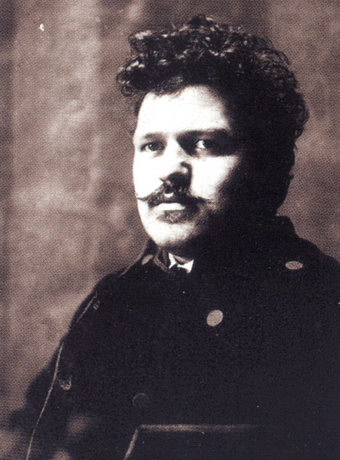
Why Antonín Slavíček matters
Antonín Slavíček is widely regarded as the leading figure of Czech Impressionism and one of the central painters in Czech art around 1900. His views of Old Prague and his repeated studies of the village of Kameničky helped define a national landscape idiom, and his work anchors the collections of the National Gallery Prague and the Gallery of Modern Art in Roudnice nad Labem, which holds roughly sixty of his paintings from the collector August Švagrovský. For collectors, he represents a historic, museum-anchored name in Central European art whose market runs almost entirely through Czech auction houses rather than international sale rooms.
- Born
- 1870-05-16, Prague, Austria-Hungary (now Czech Republic)
- Nationality
- Czech
- Media
- Painting, Drawing
- Movement
- Czech Impressionism
- Education
- Academy of Fine Arts, Prague, landscape studio of Julius Mařák, 1887 to 1899, with recorded interruptions; no formal degree documented. Earlier private study with painter Emil J. Lauffer, Prague, circa 1881 to 1885.
- Signature motifs
- Czech landscape painting, Old Prague cityscapes
By the numbers
- CZK 18MAuction highNa lavička (On a Bench), Galerie Kodl, Prague, 2016; exact sale date not independently confirmed
- 1870 to 1910LifespanBorn and died in Prague
- National Gallery PragueKey holderAlso Gallery of Modern Art, Roudnice nad Labem
Selected works
Click any work to view it full screen.
Biography
Antonín Slavíček was born on 16 May 1870 in Prague, then part of Austria-Hungary. He attended a Real Gymnasium in Prague's Spálená Street from 1881 to 1885 while privately studying painting with Emil J. Lauffer. After a study stay in Munich in 1886 and 1887, during which he failed the entrance examination to the Munich Academy, he enrolled in 1887 at the Academy of Fine Arts in Prague, joining the landscape painting studio of Julius Mařák. His studies there were interrupted more than once, including a brief stay at a Benedictine monastery in Rajhrad around 1889, and he returned to Mařák's studio from 1894 until the professor's death in 1899.
Through the 1890s and 1900s Slavíček became a central figure of Czech Impressionism, painting luminous views of Prague and returning repeatedly to the countryside around Kameničky. He exhibited at the Rudolfinum in Prague in 1897, showed in Vienna and at the Exposition Universelle in Paris in 1900, and shared a major exhibition with Max Švabinský at the Miethke Gallery in Vienna in 1901. The 1904 to 1905 fourteenth exhibition of the SVU Mánes association in Prague, though technically a group show, was organized around Slavíček as its central artistic personality and was among the most celebrated exhibitions the Mánes association had staged.
In August 1909 Slavíček suffered a disabling stroke. According to the National Gallery Prague's biographical archive and contemporary press accounts reproduced in later Czech reporting, he wrote a farewell letter describing the stroke as leaving him incurably impaired, and on 1 February 1910 he died by a self-inflicted gunshot wound at his studio in Prague. The Czech civil death register recorded the act as occurring in a state the record describes as mental incapacity. He was buried at the Olšany Cemetery in Prague, and the Mánes association mounted a posthumous exhibition of his work later that year.
Critical reception
Slavíček is treated in Czech art history as the artist in whom Czech Impressionism reaches its fullest expression, prized for translating Prague's cityscape and the rural light of Kameničky into an intimate, atmospheric idiom distinct from the French movement it drew on. His 1904 to 1905 exhibition with the Mánes association was singled out at the time for its focus on a single artistic personality and for the enthusiasm it drew from the Prague public, a response later exhibition historians have described as unusual for the era. In the decades since his death, Czech museums have periodically returned to his work, from the 1910 posthumous exhibition at Mánes and the 1945 retrospective at Prague Castle to, most recently, a 2023 exhibition at the National Gallery Prague devoted specifically to his drawn landscapes and a companion 2023 exhibition on his Old Prague views at the Vysočina Regional Gallery in Jihlava, a sustained institutional attention that has kept his standing largely undisputed.
Market
Slavíček's market is a Czech regional market, conducted almost entirely through auction houses and dealer galleries in Prague and Brno, including Galerie Kodl, Arthouse Hejtmánek, and Galerie Urban & Vysoudil, rather than through any gallery or estate that formally represents him. His auction record is Na lavička (On a Bench), a figurative painting from 1899 that Galerie Kodl's own sale records list as realized for CZK 18,000,000; the sale is widely cited as having occurred on 27 November 2016, though that specific date is corroborated only by a secondary compiled source rather than a primary auction report. The next-highest documented result is Žně v Kraskově (Harvest in Kraskov), which realized CZK 13,440,000 at Galerie Kodl, though its exact sale date could not be independently confirmed. A more precisely documented sale is Léto (Summer), a tempera on cardboard from 1897, which sold for CZK 12,400,000 at Arthouse Hejtmánek in Prague on 17 June 2021.
Top auction results
| Work | Price | Sale |
|---|---|---|
| Na lavička (On a Bench) (1899) | CZK 18,000,000 | Galerie Kodl, Prague |
| Žně v Kraskově (Harvest in Kraskov) | CZK 13,440,000 | Galerie Kodl, Prague |
| Léto (Summer) (1897) | CZK 12,400,000 | Arthouse Hejtmánek, Prague, 2021-06-17 |
Selected exhibitions
| Years | Exhibition | Venues |
|---|---|---|
| 1897 | Group exhibition | Rudolfinum, Prague |
| 1900 | Exposition Universelle | Paris |
| 1901 | Joint exhibition with Max Švabinský | Galerie Miethke, Vienna |
| 1904 to 1905 | XIV Exhibition of SVU Mánes | Mánes Pavilion, Kinský Garden, Prague |
| 1910 | Posthumous exhibition | SVU Mánes, Prague |
| 1945 | Retrospective | Picture Gallery of Prague Castle |
| 2023 | Restless Drawing: Landscapes of Antonín Slavíček | National Gallery Prague |
| 2023 | Old Prague, 1905 | Vysočina Regional Gallery, Jihlava |
Museum collections
- National Gallery Prague
- Gallery of Modern Art, Roudnice nad Labem
- Olomouc Museum of Art
- Vysočina Regional Gallery, Jihlava
Authentication and provenance
No catalogue raisonne.
No published catalogue raisonne has been located for this artist. Attribution and provenance are typically established through National Gallery Prague records, exhibition labels, and the Czech auction houses, including Galerie Kodl and Arthouse Hejtmánek, that regularly handle his market.
Primary reference: https://admin.www.ngprague.cz/storage/668/Slavicek_Antonin.pdf
What collectors should know
Slavíček's market runs almost exclusively through Czech auction houses, and public sale records are comparatively sparse, so a single strong or weak result can move the picture more than it would for an artist with deeper trading history. There is no catalogue raisonne, no exclusive representing gallery, and no organized estate, which means provenance, exhibition labels from institutions such as the National Gallery Prague, and documented sale history carry unusual weight in establishing a work's standing. Prices are denominated in Czech koruna and reported almost entirely within the Czech market, so collectors comparing his results to internationally traded artists should account for that currency and market concentration before drawing conclusions.
Further reading and resources
Data current as of 2026-07-16.

