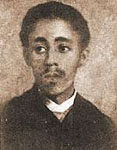
Why Antonio Bandeira matters
Antonio Bandeira is one of the central figures of mid-century Brazilian abstraction, an artist who moved between Fortaleza, Rio de Janeiro, and Paris and helped carry a Brazilian sensibility into the international lyrical abstraction of the 1950s and 1960s. He represented Brazil at the Venice Biennale three times and appeared in five editions of the São Paulo Bienal, and his work anchors the collections of the Centre Pompidou and the major museums of São Paulo and Rio de Janeiro. For a collector, he is a case study in a historically significant, museum-validated artist whose auction market remains thin, which makes sourcing and provenance especially important.
- Nationality
- Brazilian
- Media
- Painting, Gouache, Watercolor
- Movement
- Lyrical Abstraction, Art Informel
- Education
- Largely self-taught in Fortaleza. From about 1946, studied in Paris at the École Nationale Supérieure des Beaux-Arts and the Académie de la Grande Chaumière on a French government scholarship. No degree or diploma is documented.
- Signature motifs
- City-inspired lyrical abstraction, Gestural color and light
- Representation
- "Almeida & Dale, São Paulo", "Dan Galeria, São Paulo"
By the numbers
- USD 504,000Auction highUntitled, Christie's New York, Latin American Art sale, 22 November 2013; cited by Christie's as an artist record at the time
- No. 1,755Artprice rank486 recorded auction lots
- 1952, 1960, 1964Venice BiennaleRepresented Brazil
- Almeida & Dale; Dan GaleriaRepresented by
Biography
Antonio Bandeira was born in 1922 in Fortaleza, Ceará, Brazil. Largely self-taught, he began drawing and painting on his own before helping found the Centro Cultural de Belas Artes in Fortaleza in 1941, alongside artists including Aldemir Martins and Raimundo Cela. He held his first exhibition there in 1943, and in 1944 won a gold medal at the Visual Arts Salon of the newly formed Sociedade Cearense de Belas Artes.
He moved to Rio de Janeiro in 1945, and in 1946 traveled to Paris on a French government scholarship, where he studied at the École Nationale Supérieure des Beaux-Arts and the Académie de la Grande Chaumière, concentrating on drawing. In Paris he became part of the circle of tachiste painters that included Georges Mathieu, Wols, and Camille Bryen, and he exhibited at the Salon d'Automne from 1947 and at the Salon des Réalités Nouvelles in 1956 and 1958. Brazil's postwar biennial system embraced him early: he took part in the São Paulo Bienal in 1951, 1953, 1955, 1959, and 1961, designing the official poster for the 1953 edition, and he represented Brazil at the Venice Biennale in 1952, 1960, and 1964. In 1957 he held his first solo exhibition in New York, at Gallery 75; the local press at the time, as later recounted by Newcity Brazil, described him as "an abstract expressionist from Paris, born in Brazil." In 1960 he inaugurated an exhibition at the new Museu de Arte Moderna in Salvador, and in 1961 he had his first solo show at what is now the Museu de Arte da Universidade Federal do Ceará, an institution that today holds the largest single collection of his work.
Bandeira returned to France in 1964 and remained based there for the rest of his life. He died in Paris in 1967, at age 45. Newcity Brazil reports that he died following surgery on his vocal cords, a detail not corroborated in other biographical sources consulted for this profile, and no source reviewed gives an exact day and month for either his birth or his death.
Critical reception
Brazilian critic and poet Ferreira Gullar, in remarks later reproduced in the curatorial materials for the Museu de Arte Moderna de São Paulo's retrospective of the artist, wrote that Bandeira "made use of the possibilities of the new language to express his loving relationship with the reality he lived and the reality he had lived." That framing, of an artist who used the vocabulary of abstraction to hold onto lived and remembered place, has become the dominant critical reading of his work, particularly of the city-inspired compositions that recur across his output. During his lifetime, his cosmopolitan trajectory, from Fortaleza to Rio to Paris, and back, shaped how audiences received him: the New York press at his 1957 debut there framed him as a Paris-based abstractionist of Brazilian origin, reflecting the international, placeless quality often ascribed to his abstraction even as later Brazilian scholarship has worked to reclaim him within a specifically Brazilian modernist lineage.
Market
Bandeira's auction market is modest in volume relative to his museum standing. Artprice records roughly 486 lots at auction and ranks him near 1,755th among artists by public sale activity, and HENI has tracked cumulative auction sales of about USD 4.62 million over some 27 years. The best-documented auction result is Untitled, which sold for USD 504,000 at Christie's New York in the Latin American Art sale on 22 November 2013, reported by Christie's own press materials as an artist record at the time. Other six-figure results, including a painting titled Ville, have appeared at auction, but public sources do not confirm a realized price for these with the same certainty, so no higher, fully verified result is documented here.
Top auction results
| Work | Price | Sale |
|---|---|---|
| Untitled | USD 504,000 | Christie's, New York, 2013-11-22 |
Selected exhibitions
| Years | Exhibition | Venues |
|---|---|---|
| 1943 | First exhibition | Centro Cultural de Belas Artes, Fortaleza |
| 1951 to 1961 | São Paulo Bienal | 1st, 2nd, 3rd, 5th and 6th editions, São Paulo; designed the official poster for the 1953 edition |
| 1952 to 1964 | Venice Biennale | Represented Brazil in 1952, 1960 and 1964 |
| 1957 | First New York solo exhibition | Gallery 75, New York |
| 1960 | Inaugural exhibition | Museu de Arte Moderna, Salvador |
| 2017 | Antonio Bandeira, an abstractionist who is a friend of life | Espaço Cultural Unifor, Fortaleza |
| 2019 to 2020 | antonio bandeira | Museu de Arte Moderna de São Paulo (MAM-SP) |
| 2025 | What Do We Have In Common? | Museu de Arte Contemporânea da Universidade de São Paulo (MAC USP) |
Museum collections
- Centre Pompidou, Paris
- Museu de Arte de São Paulo (MASP)
- Museu de Arte Moderna de São Paulo (MAM-SP)
- Museu de Arte Moderna do Rio de Janeiro (MAM Rio)
- Museu Nacional de Belas Artes, Rio de Janeiro
- Museu de Arte Contemporânea da Universidade de São Paulo (MAC USP)
- Museu de Arte da Universidade Federal do Ceará (MAUC), Fortaleza
Awards and honors
- Gold Medal, Visual Arts Salon, Sociedade Cearense de Belas Artes, Fortaleza (1944)
Authentication and provenance
No catalogue raisonne.
No published catalogue raisonne has been confirmed for this artist. Provenance and attribution questions are generally referred to the artist's principal Brazilian galleries, Almeida & Dale and Dan Galeria.
Primary reference: https://almeidaedale.com.br/en/artistas/antonio-bandeira/
What collectors should know
Bandeira's institutional presence, in the Centre Pompidou, MASP, MAM São Paulo, MAM Rio, and MAC USP among others, is well established, but his auction record is comparatively thin, resting on one well-documented six-figure result from 2013 alongside other sales whose realized prices are not publicly confirmed. There is no confirmed catalogue raisonne, so provenance and attribution generally run through his principal Brazilian galleries rather than through a single scholarly catalogue. Collectors should also take care to distinguish this artist from Antônio Rafael Pinto Bandeira (1863 to 1896), a different, unrelated Brazilian painter, when researching sale records or archival material.
Further reading and resources
Data current as of 2026-07-10.

