Why Antonio Frilli matters
Antonio Frilli was a Florentine sculptor whose marble and alabaster figures, made for the international exhibition circuit and the decorative sculpture trade of the late nineteenth century, still circulate widely in the auction and dealer market today. He founded an atelier in Florence in 1860 that outlived him by decades under his son's direction, and that atelier's modern successor, the Frilli Gallery, remains the closest thing to an institutional steward of his work. For a collector, he is a useful case study in how a historic decorative sculptor's market gets complicated by a long-running workshop, inconsistent secondary-source biography, and the absence of a catalogue raisonne.
- Nationality
- Italian
- Media
- Marble sculpture, Alabaster sculpture
- Movement
- Academic sculpture, Florentine sculptural tradition
- Education
- Not documented. A single secondary source speculates, using the word 'likely,' that he trained at the Accademia di Belle Arti di Firenze, where sources agree he later held a professorship. No enrollment record or date has been found.
- Signature motifs
- Idealized marble female nudes, Mythological and allegorical marble and alabaster figures
- Representation
- Frilli Gallery, Florence (historic atelier founded by the artist in 1860; continues under later stewardship)
By the numbers
- USD 21,510Auction highCatalogued as Workshop of Antonio Frilli, Heritage Auctions, Dallas, 2008
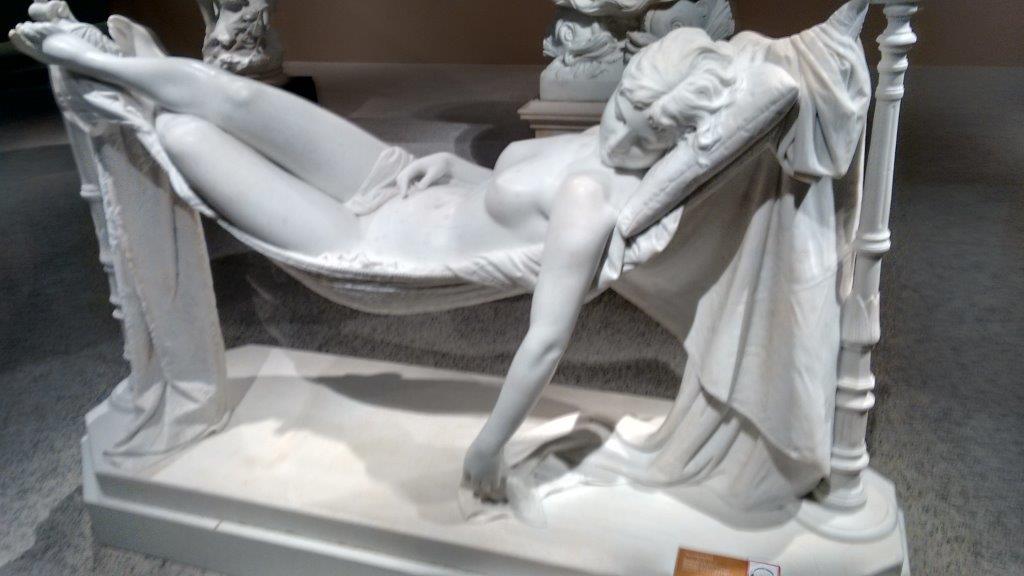
- Grand Prize, six gold medals1904 World's FairWoman on a Hammock, Louisiana Purchase Exposition, St. Louis, exhibited posthumously by his son Umberto Frilli
- Florence, from 1860ActiveFounded his own atelier; workshop continued by his son after his death
- Frilli Gallery, FlorenceSteward of legacyHistoric atelier founded by the artist; still produces from his original molds
Selected works
Click any work to view it full screen.
Biography
Antonio Frilli was an Italian sculptor active in Florence, working primarily in white Carrara marble and Volterra alabaster. According to the Frilli Gallery's own history, he founded his atelier in Florence in 1860, and it became known internationally for museum-quality decorative and figural sculpture. He exhibited at a series of international expositions, including the Esposizione Nazionale di Roma in 1883, an exhibition in Glasgow in 1888, and an exhibition in Paris in 1889.
His exact birth date is not documented in any primary source located for this profile. Secondary sources give incompatible years, including 1830, circa 1850, and around 1860, with Florence cited as his probable birthplace; this profile leaves the birth year unstated rather than choose among conflicting guesses.
His death is documented only in general terms and the exact year is contested. The Frilli Gallery's own institutional history and Christie's both state that his son, Umberto Frilli, took over the atelier at the founder's death in 1892. Other major reference sources, including Wikipedia, MutualArt, and auction databases, instead give a death year of 1902. No source located for this profile provides a specific day or month of death, or a primary document resolving the conflict, so this profile reports the death as documented but leaves the exact year unstated rather than choose between the two competing dates. Looser ranges extending into the 1920s that appear in some dealer catalogs most likely reflect the workshop's continued production and signing of work under the Frilli name for decades after the founder's death, rather than a documented later death of Antonio Frilli himself.
After his death, Umberto Frilli continued the family workshop and exhibited his father's marble Woman on a Hammock at the 1904 Louisiana Purchase Exposition in St. Louis, where it won the Grand Prize and six gold medals, the best-documented distinction associated with Antonio Frilli's name. No confirmed record exists of Antonio Frilli's own formal art education; one appraisal source speculates that he likely trained at the Accademia di Belle Arti di Firenze, where he is separately said to have held a professorship, but no enrollment date or degree has been found.
Critical reception
Named, attributed critical commentary on Antonio Frilli is scarce. An unsigned Christie's specialist note situates him within a circle of Florentine sculptors that also included Cesare Lapini, Guglielmo Pugi, and Ferdinando Vichi, and describes his work as embodying the principles of late nineteenth century academic art and the fashionable taste of the period. That characterization comes from auction house catalog text rather than a named critic writing in a journal or newspaper, and no verbatim quote from a named critic in a major outlet could be confirmed for this profile.
Market
Antonio Frilli's auction market is modest and thinly documented compared with his exhibition record. The highest publicly confirmed auction price located for this profile is USD 21,510, paid at Heritage Auctions in Dallas on 20 November 2008 for a marble catalogued as Nude Reclining in a Hammock and attributed to the Workshop of Antonio Frilli rather than to his own hand. Retail dealer listings for large marble figures, such as a life-size Spring asked at roughly USD 150,000, run far above any confirmed auction result and should be read as asking prices rather than market value, illustrating how thin and uneven demand can be at the higher end relative to dealer asking prices.
Top auction results
| Work | Price | Sale |
|---|---|---|
| Nude Reclining in a Hammock (Workshop of Antonio Frilli) | USD 21,510 (USD 21,510) | Heritage Auctions, Dallas, 2008-11-20 |
Selected exhibitions
| Years | Exhibition | Venues |
|---|---|---|
| 1883 | Esposizione Nazionale di Roma | Rome, Italy |
| 1888 | International exhibition | Glasgow, Scotland |
| 1889 | International exhibition | Paris, France |
| 1904 | Louisiana Purchase Exposition | St. Louis, USA (Woman on a Hammock, exhibited by his son Umberto Frilli) |
Museum collections
- Stanford University, California (campus sculptures, per Frilli Gallery's own history; not independently corroborated)
Awards and honors
- Grand Prize and six gold medals, Louisiana Purchase Exposition, St. Louis, for Woman on a Hammock, exhibited posthumously by his son Umberto Frilli (1904)
Authentication and provenance
No catalogue raisonne.
No catalogue raisonne has been identified. Verification is complicated by decades of continued workshop production under the Frilli name after the founder's death, variously reported as 1892 or 1902, when his son Umberto Frilli took over the atelier, and by inconsistent life dates across dealer and auction catalogs. Comparison of signature, mold marks, and provenance against Frilli Gallery's own records is the most reliable path to attribution.
Primary reference: https://www.frilligallery.com/about-us/history.php
What collectors should know
Works sold as "Antonio Frilli" span a wide range of quality and date because his son and successors kept the workshop running, and reusing the founder's molds and signature, long after the founder's death (variously reported as 1892 or 1902). Buyers should expect catalog descriptions that hedge attribution with terms like "workshop of" or "attributed to," and should treat any life-date range printed on a dealer tag with caution, since published years for Frilli vary from roughly 1830 to as late as 1920 depending on the source. The name also appears inverted in some auction records, as "Frilli, Antonio," referring to the same artist and workshop. With no catalogue raisonne and only a handful of firmly confirmed public sale results, provenance, mold and signature comparison against Frilli Gallery's own historical holdings, and a realistic read of recent comparable results matter more here than they would for an artist with a deeper, better-documented auction history.
Further reading and resources
Data current as of 2026-07-16.

