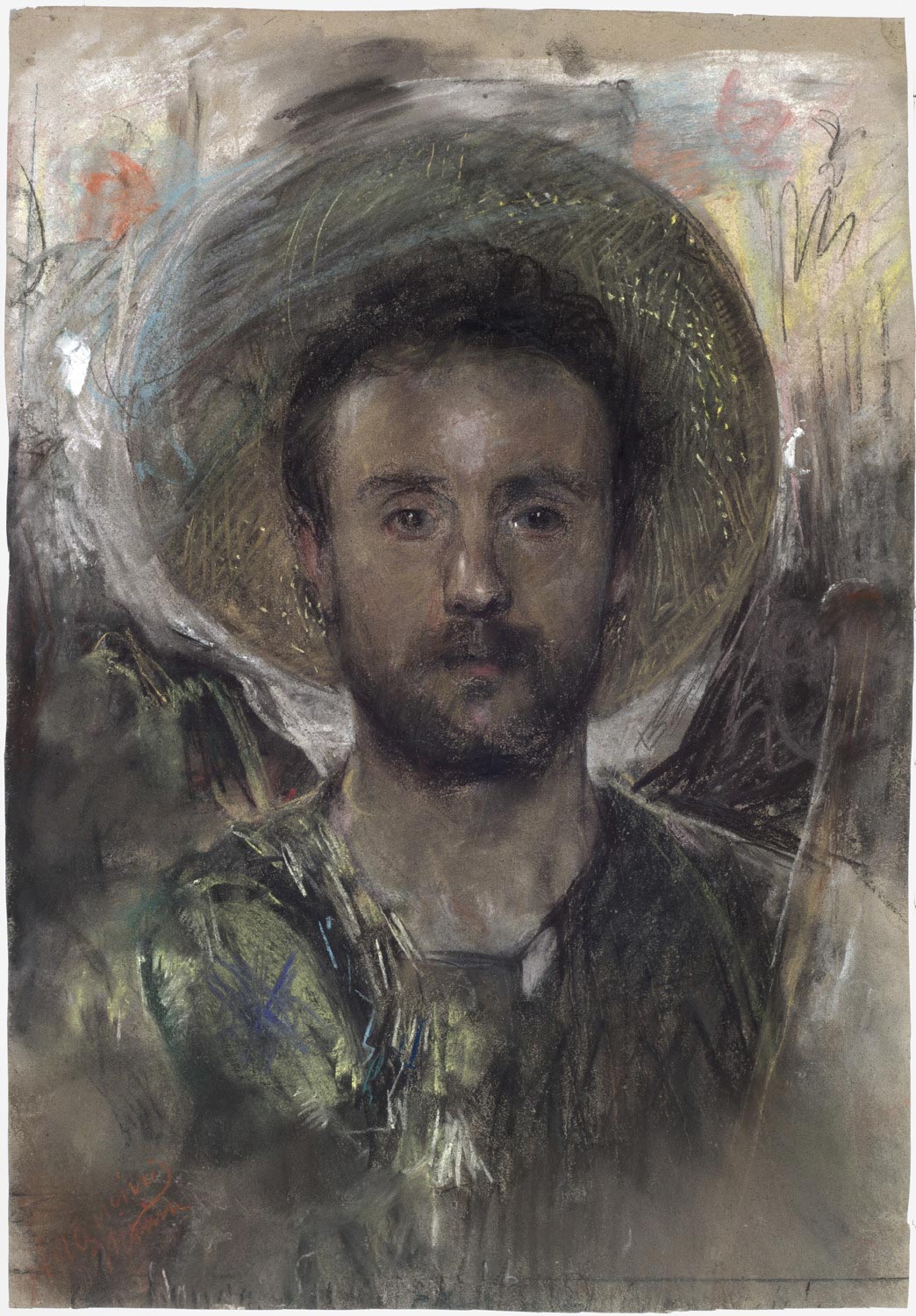
Why Antonio Mancini matters
Antonio Mancini was one of the most technically distinctive Italian painters of the late nineteenth century, known for a thick, encrusted impasto and unflinching genre scenes of children, street performers, and the poor. His work was collected internationally in his lifetime, most notably by the Dutch painter and patron Hendrik Willem Mesdag, whose holdings form the largest single collection of Mancini's work today. For a collector, he represents a historical Italian market with deep museum validation and comparatively thin, infrequent auction turnover.
- Born
- 1852-11-14, Rome, Italy
- Nationality
- Italian
- Media
- Painting
- Movement
- Verismo, Realism
- Education
- Istituto di Belle Arti di Napoli (Institute of Fine Arts, Naples), entered July 1865 at age 12 under Domenico Morelli, Filippo Palizzi, and Stanislao Lista. No formal degree is documented; sources describe completion of academic study rather than a named credential.
- Signature motifs
- Thick impasto portraiture, Genre scenes of street children and beggars
- Representation
- Archivio Antonio Mancini, Galleria Russo (Rome and Venice)
By the numbers
- 15+ editions, 1895 to 1924Venice BiennaleAwarded a dedicated solo gallery at the 1920 Biennale
- GBP 112,500 (about USD 150,649)Auction highPortrait of W. B. Yeats, Sotheby's London, 27 Sept 2017; figure from a secondary compilation of sale data, not independently confirmed from primary auction records
- About 150 worksMesdag CollectionThe Hague, the largest single public holding of Mancini's work
- Archivio Antonio Mancini, Galleria RussoRepresented byRome and Venice, archival and authentication role
Selected works
Click any work to view it full screen.
Biography
Antonio Mancini was born on 14 November 1852 in Rome, though some reference sources place his birth in nearby Albano Laziale. He received early schooling from the Scolopi fathers in Narni and at the Girolamini oratory before, in July 1865 and at age 12, he was enrolled at the Istituto di Belle Arti di Napoli in the figure-drawing school. There he studied under Domenico Morelli, Filippo Palizzi, and Stanislao Lista, and won the first prize in the figure school within about a year of his admission. He completed his academic training after roughly three years and continued to develop his practice in Naples through the 1870s, exhibiting genre subjects such as The Poor Schoolboy at the Paris Salon of 1876.
Mancini worked in Rome, Naples, and Paris over the following decades, opening a studio in Rome by 1883. He maintained a long relationship with the painter and collector Hendrik Willem Mesdag, who acquired roughly 150 of his works, now held at the Mesdag Collection in The Hague. He exhibited at the 1900 Paris Exposition Universelle and the 1904 Louisiana Purchase Exposition in St. Louis, where exhibition-history sources credit him with a gold medal for the Portrait of the Marquis del Grillo, though this specific award was not independently corroborated by dedicated award research. He exhibited at the Venice Biennale in at least fifteen editions between 1895 and 1924, and was given a dedicated solo gallery at the 1920 Biennale, where accounts describe every painting on view as sold. In 1929 he was elected to the Reale Accademia d'Italia. Mancini died in Rome on 28 December 1930 and is buried in the Basilica dei Santi Bonifacio e Alessio on the Aventine Hill.
Critical reception
Mancini has long been described by museums and scholars as one of the most important Italian painters of the nineteenth century, associated with Verismo and prized for a bravura, heavily worked surface that set him apart from more academic contemporaries. His paintings of children and the urban poor, including The Poor Schoolboy, The Little Shepherd, and Little Servant, are treated as central to his reputation for combining technical virtuosity with unsentimental social subject matter. He is frequently said to have influenced and been admired by John Singer Sargent, though no exact, verifiable quotation from Sargent or another named critic in a major outlet can be reproduced with confidence from currently available sources.
Market
Mancini's market is historical rather than active in the sense of a living artist with current gallery representation. The Archivio Antonio Mancini, maintained by Galleria Russo in Rome and Venice, serves as the principal archival and authentication resource for the artist. The highest documented auction result identified in current research is Portrait of W. B. Yeats, a coloured-chalk drawing that sold for GBP 112,500 (about USD 150,649) at Sotheby's London on 27 September 2017. The Little Ballerina sold for USD 112,500 at Sotheby's New York on 31 January 2018, and Una ragazza sold for GBP 63,650 at Sotheby's London on 23 November 2010. These figures come from a secondary compilation of auction-house data rather than primary sale pages, so they should be treated as reported results pending direct confirmation from Sotheby's own records. Milan's Bottegantica Gallery mounted a significant survey of his work, Antonio Mancini: Rebel Genius, in 2016, drawing on private Italian and European lenders, which points to continued dealer and collector interest in the market.
Top auction results
| Work | Price | Sale |
|---|---|---|
| Portrait of W. B. Yeats (2017) | USD 150,649 (GBP 112,500) | Sotheby's, London, 2017-09-27 |
Selected exhibitions
| Years | Exhibition | Venues |
|---|---|---|
| 1895 to 1924 | Venice Biennale (multiple editions) | Venice Biennale, Venice |
| 1920 | XXII Venice Biennale, dedicated solo gallery | Venice Biennale, Venice |
| 1900 | Exposition Universelle | Paris |
| 1904 | Louisiana Purchase Exposition (World's Fair) | St. Louis |
| 1928 | Exhibition at the Castello Sforzesco | Castello Sforzesco, Milan |
| 2007 to 2008 | Antonio Mancini: Nineteenth-Century Italian Master | Philadelphia Museum of Art |
| 2016 | Antonio Mancini, Rebel Genius | Bottegantica Gallery, Milan |
Museum collections
- The Mesdag Collection, The Hague
- Philadelphia Museum of Art
- Galleria Nazionale d'Arte Moderna e Contemporanea, Rome
- National Gallery, London
- Musee d'Orsay, Paris
- Art Institute of Chicago
- Metropolitan Museum of Art, New York
- Tate, London
Awards and honors
- Medal for painting, Exposition Universelle, Paris (award not independently corroborated beyond exhibition-history sources) (1900)
- Gold Medal, Louisiana Purchase Exposition (World's Fair), St. Louis (award not independently corroborated beyond exhibition-history sources) (1904)
- Elected member, Reale Accademia d'Italia (1929)
Authentication and provenance
No catalogue raisonne.
No published catalogue raisonne could be independently confirmed for this profile. A 2019 catalogue by Cinzia Virno is cited by the specialist reference site antoniomancini.com but is not corroborated elsewhere. Works are tracked through the Archivio Antonio Mancini, maintained by Galleria Russo in Rome and Venice, which functions as the main archival and authentication resource for the artist.
Primary reference: https://www.nationalgallery.org.uk/artists/antonio-mancini
What collectors should know
Mancini's auction footprint is comparatively small and unevenly documented. The highest result identified in current research, Portrait of W. B. Yeats at Sotheby's London in 2017, comes from a secondary compilation of auction-house data rather than a primary sale record, so it should be treated as reported rather than fully verified. Because a published catalogue raisonne could not be independently confirmed, provenance research through the Archivio Antonio Mancini in Rome and Venice is the strongest available path to authentication. Collectors should also be aware that reference sources differ slightly on his exact birthplace (Rome versus nearby Albano Laziale), a minor but recurring discrepancy in the literature.
Further reading and resources
Data current as of 2026-07-16.

