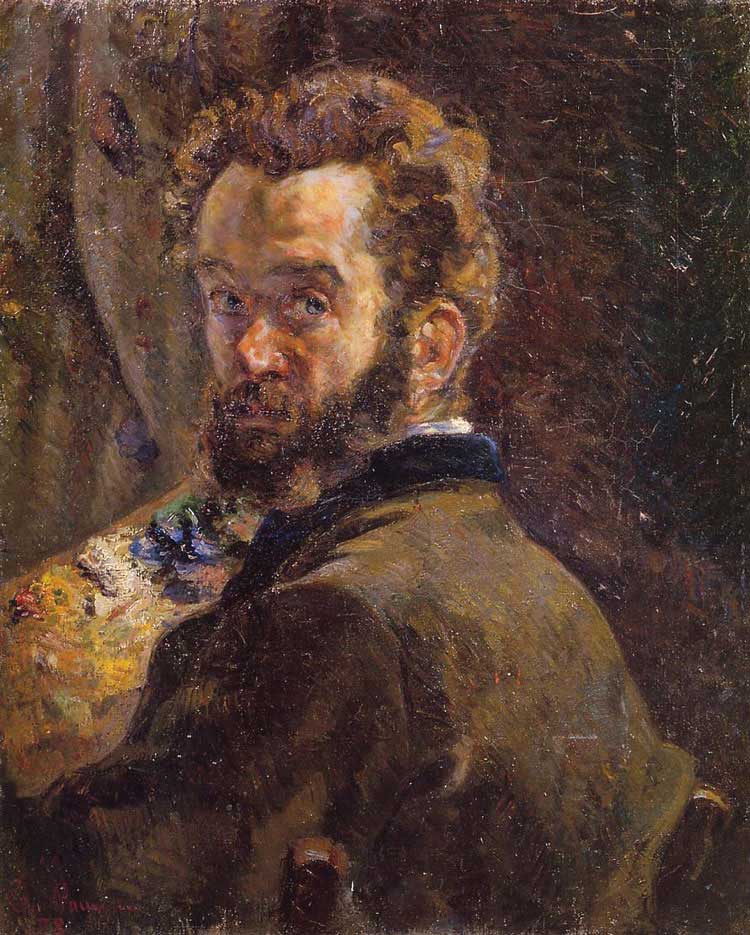
Why Armand Guillaumin matters
Armand Guillaumin was a founding member of the Impressionist group that staged the first independent exhibition in Paris in 1874, and he showed in six of the movement's eight group exhibitions alongside his close friends Paul Cezanne and Camille Pissarro. He is a useful case study for collectors precisely because his art-historical standing, secure and well documented, has not translated into the market recognition given to those same friends: his auction record remains modest for a founding Impressionist, which makes provenance and authentication work more important than headline price when evaluating any individual painting.
- Born
- 1841-02-16, Paris, France
- Nationality
- French
- Media
- Painting
- Movement
- Impressionism
- Education
- No completed art degree. Early schooling in Moulins, business studies in Paris, and informal, evening drawing classes, followed by study at the Academie Suisse, Paris, in the early 1860s, where he met Paul Cezanne and Camille Pissarro.
- Signature motifs
- Crozant and Creuse valley landscapes, Intense, vivid color harmonies
- Representation
- "Findlay Galleries (secondary market)", "Park West Gallery (secondary market)"
By the numbers
- EUR 325,500 (approx.)Auction highBords de la Creuse, cited via Christie's by Artsy; exact sale date unconfirmed. Chemin a Damiette, EUR 270,000, 2014, also cited by market trackers.
- 6 of 8Impressionist exhibitions1874 to 1886, including the first
- 1874 First Impressionist ExhibitionFounding roleFounding member of the independent group
- No exclusive estateRepresented bySecondary market: Findlay Galleries, Park West Gallery
Selected works
Click any work to view it full screen.
Biography
Jean-Baptiste Armand Guillaumin was born in Paris on 16 February 1841 and spent part of his childhood in Moulins, where the surrounding landscape is credited with first drawing him to art. Sent back to Paris around age sixteen at his father's insistence to pursue business, he worked as a clerk while pursuing drawing on the side by attending municipal or public night drawing classes. In the early 1860s he began attending the informal, ungraded Academie Suisse in Paris, where he met Cezanne and Pissarro, friendships that placed him at the center of the emerging Impressionist circle.
Guillaumin exhibited at the 1863 Salon des Refuses alongside Cezanne and Pissarro, and he was a founding participant in the first Impressionist exhibition of 1874, showing landscapes including a view known as Sunset at Ivry. He went on to exhibit in the third exhibition of 1877, the fifth through seventh of 1880 to 1882, and the eighth and final exhibition of 1886. For most of this period he supported himself and his family through a government job, generally described as work connected to roads, bridges, or the railways, painting in the mornings, evenings, and on days off.
His circumstances changed in 1891 when he won 100,000 francs in the French state lottery, a windfall that let him leave paid employment and paint full time. The following decades brought a series of solo exhibitions at leading Paris dealers, including a large retrospective of 106 works in 1894, shows at the Galeries Durand-Ruel in 1895 and the Galerie Ambroise Vollard in 1897, and further exhibitions at the Galerie Bernheim-Jeune in 1901 and 1906 and the Galerie Paul Rosenberg in 1908. He continued painting into his eighties, with a further large retrospective mounted in 1926.
Guillaumin died on 26 June 1927 at the age of 86. Britannica and the Museo Nacional Thyssen-Bornemisza record Paris as the place of death, while Wikipedia and Artnet give Orly, in the Val-de-Marne just south of the city; the date of death is consistent across sources even where the exact location is not.
Critical reception
Contemporaries noted Guillaumin above all for his handling of color rather than his composition, a view echoed in the reception of his major dealer exhibitions, including the large 1894 Paris retrospective. Modern museum writing, including from the Thyssen-Bornemisza, continues to frame him as a secondary figure within Impressionism whose strong, vivid color and landscape and river subjects sit alongside his close friendships with Cezanne and Pissarro. Recent commentary has argued that his reputation has suffered more from thin market visibility than from any real weakness in the work itself.
Market
Market databases point to two candidates for Guillaumin's auction high, and no dossier source could confirm a single result with work, price, house, and exact date all verified together. Artsy cites a Christie's result of EUR 325,500 for Bords de la Creuse as the highest public record it lists, with the exact sale date unconfirmed. A separate tracker cites Chemin a Damiette at EUR 270,000, sold in 2014, with the auction house unconfirmed. More recent, precisely dated sales sit well below either figure: Vergers a Saint Cheron sold for USD 57,900 (GBP 44,500) at Sotheby's London on 6 November 2025, and Bouchardon Lock, Crozant sold for USD 75,300 at Bonhams Paris (Cornette de Saint Cyr) on 2 May 2026. As a founding-era Impressionist whose paintings appear in major museum collections, Guillaumin occupies a mid-market tier: consistently collected and traded, but priced well below Cezanne, Pissarro, Monet, or Renoir.
Top auction results
| Work | Price | Sale |
|---|---|---|
| Bords de la Creuse | EUR 325,500 | Christie's |
| Chemin a Damiette (2014) | EUR 270,000 |
Selected exhibitions
| Years | Exhibition | Venues |
|---|---|---|
| 1863 | Salon des Refuses | Paris (with Cezanne and Pissarro) |
| 1874 | First Impressionist Exhibition | Paris |
| 1877 | Third Impressionist Exhibition | Paris |
| 1880 to 1882 | Fifth, sixth, and seventh Impressionist Exhibitions | Paris |
| 1886 | Eighth and final Impressionist Exhibition | Paris |
| 1894 | Retrospective exhibition, 106 works | Paris, dealer's gallery |
| 1895 | Solo exhibition | Galeries Durand-Ruel, Paris |
| 1901 to 1906 | Solo exhibitions | Galerie Bernheim-Jeune, Paris |
Museum collections
- Musee d'Orsay, Paris
- Art Institute of Chicago
- Metropolitan Museum of Art, New York
- National Gallery of Art, Washington, D.C.
- Tate Britain, London
- Museo Nacional Thyssen-Bornemisza, Madrid
Awards and honors
- French state lottery win of 100,000 francs, enabling him to paint full-time (1891)
Authentication and provenance
No catalogue raisonne.
No catalogue raisonne could be independently confirmed. Some dealer and reference materials cite a 1971 painted-work catalogue by Georges Serret and Dominique Fabiani, but this profile could not verify that publication directly. Market verification relies on exhibition history, provenance, and specialist and auction house expertise.
Primary reference: https://www.britannica.com/biography/Armand-Guillaumin
What collectors should know
There is no single estate or exclusive gallery representing Guillaumin today; his paintings circulate through the secondary market and are handled periodically by galleries such as Findlay Galleries and Park West Gallery as well as major auction houses. Dealer and reference materials sometimes cite a 1971 painted-work catalogue raisonne compiled by Georges Serret and Dominique Fabiani, but that publication could not be independently confirmed here, so it should not be relied upon without direct verification against any work under consideration. Because his auction record rests on modest, unevenly documented results rather than a clear high-water mark, collectors should treat any one price as a data point rather than a trend, and should weight museum exhibition history and documented provenance heavily when assessing value.
Further reading and resources
Data current as of 2026-07-11.

