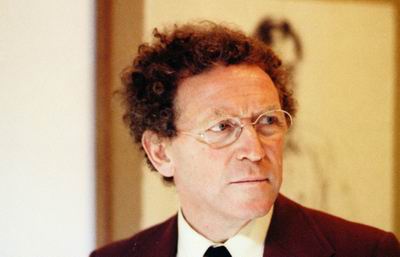
Why Avigdor Arikha matters
Avigdor Arikha is a rare case of an artist whose biography, an escape from the Holocaust, training on two continents, a close friendship with Samuel Beckett, and a mid-career break from abstraction toward painting from life, is matched by deep institutional validation rather than by a large public auction record. For a collector, he represents a museum-grade reputation, held in the British Museum, the Louvre, the Met, and the Tate among others, paired with a market that trades quietly through his estate and specialist galleries rather than through headline salesroom results.
- Born
- 1929-04-28, Radauti, Romania (historic Bukovina)
- Nationality
- Romanian-born, French-Israeli
- Media
- Painting, Drawing, Printmaking
- Movement
- Art Informel, Post-abstract representational painting
- Education
- Bezalel School of Art, Jerusalem, 1946 to 1949; Ecole des Beaux-Arts, Paris, scholarship 1949, studied to 1951
- Signature motifs
- Life studies completed in a single sitting, Still life, Portraiture including Samuel Beckett
- Representation
- "Gordon Gallery, Tel Aviv (Estate)", "Duane Thomas Gallery, New York (Estate)"
By the numbers
- Paris, 1954 to 2010Career centered inSettled permanently in Paris after training in Jerusalem
- Chevalier, Legion d'honneur (2005)Highest honor
- 10+ major institutionsMuseum collectionsIncluding the British Museum, Louvre, Met, and Tate
- Gordon Gallery; Duane Thomas Gallery (Estate)Represented by
Selected works
Click any work to view it full screen.
Biography
Avigdor Arikha was born on 28 April 1929 in Radauti, in the Bukovina region of Romania. As a child he was deported with his family to Nazi camps in Transnistria, in what is now western Ukraine; he survived, and in 1944 the Red Cross brought him to Mandate Palestine, where he settled near Jerusalem. He studied at the Bezalel School of Art from roughly 1946 to 1949, then won a scholarship to the Ecole des Beaux-Arts in Paris, where he studied into 1951.
He settled permanently in Paris in 1954 and worked first as a book illustrator before moving, from about 1957 to 1965, into the gestural abstraction associated with Art Informel. Around the mid-1960s he stepped back from painting almost entirely, devoting nearly a decade, from 1965 to 1973, to drawing and etching. From 1973 onward he painted only from observation, in natural light, insisting on completing each canvas in a single sitting, a method he maintained for the rest of his career. He described himself not as part of any "return to figuration" but as "a post-abstract representational artist."
Arikha was a close friend of the writer Samuel Beckett and painted and drew him repeatedly; Beckett in turn wrote admiringly of Arikha's work. Arikha married Anne Atik in 1961, and the couple had two daughters, Alba Smail and Noga Simonetta. He also worked as an art historian and curator, organizing exhibitions on Poussin at the Louvre and on Ingres at the Musee des Beaux-Arts in Dijon. He died in Paris on 29 April 2010, at age 81; press reports at the time, including the Associated Press, attributed his death to complications of cancer.
Critical reception
Arikha's reputation rests on his standing with major museums as much as on critical writing. Samuel Beckett wrote of "his acuity of vision, sureness of execution, and incomparable grasp of the past," calling him "in a sense heroically alone." The critic Marco Livingstone described him as an artist who "bridged the modernist avant-garde of pure abstraction with traditions of observational drawing and painting stretching back to the Renaissance and beyond," while Arikha himself resisted being folded into any figurative revival, insisting he had found his own way. Marlborough Fine Art has quoted Robert Hughes in Time on the "intensity" of his engagement with the world, and Michael Kimmelman in The New York Times calling his painting "in short supply today and precious." The through line in this writing is Arikha's insistence on painting only what he could see, completed at speed, as a deliberate discipline rather than a stylistic pose.
Market
Arikha's market is thin relative to his institutional standing. No confirmed lot-level auction record, work, price, house, and date together, could be established from available primary auction sources as of this writing. Auction listings from houses including Sotheby's and Tiroche show estimate ranges for individual paintings typically in the low tens of thousands of US dollars, but these are pre-sale estimates rather than a documented top price, and should not be read as a record. His paintings, drawings, and etchings circulate primarily through his estate, represented by Gordon Gallery in Tel Aviv and by Duane Thomas Gallery in New York, which announced a collaboration with the estate in 2022 and mounted a survey of his still lifes from 1975 to 2009. Marlborough Fine Art has presented exhibitions of the estate's work, including a London showing of paintings and works on paper, but current exclusive representation there is not confirmed.
Selected exhibitions
| Years | Exhibition | Venues |
|---|---|---|
| 2022 | Estate survey exhibition (still lifes, 1975 to 2009) | Duane Thomas Gallery, New York |
| 2008 | Retrospective of prints | Bibliotheque nationale de France, Paris |
| Works from the Estate | Marlborough Gallery | |
| Retrospective | Museo Thyssen-Bornemisza, Madrid | |
| Avigdor Arikha: Scenes of War | Israel Museum, Jerusalem | |
| Major one-man exhibition | Tel Aviv Museum of Art | |
| Avigdor Arikha: Paintings and Works on Paper | Marlborough Fine Art, London |
Museum collections
- British Museum, London
- Musee du Louvre, Paris
- Centre Pompidou, Paris
- Metropolitan Museum of Art, New York
- Tate, London
- Israel Museum, Jerusalem
- Los Angeles County Museum of Art
- National Portrait Gallery, London
- Scottish National Portrait Gallery, Edinburgh
- Hirshhorn Museum and Sculpture Garden, Washington, D.C.
Awards and honors
- Chevalier, Legion d'honneur, France (2005)
- Doctor of Philosophy, Honoris Causa, The Hebrew University of Jerusalem (1997)
- Honorary Professor, National Academy of Fine Arts of China, Hangzhou (1995)
- Prix des Arts, des Lettres et des Sciences, Fondation du Judaisme Francais (1989)
- Grand Prix des Arts de la Ville de Paris (1987)
- Chevalier de l'Ordre des Arts et des Lettres, France (1978)
- Gold Medal, Triennale for Applied Art, Milan (1954)
Authentication and provenance
No catalogue raisonne.
No published catalogue raisonne has been confirmed for Arikha. His estate, represented by Gordon Gallery in Tel Aviv and Duane Thomas Gallery in New York, is the primary point of reference for provenance and authentication questions.
Primary reference: https://avigdorarikha.com/about
What collectors should know
Arikha's auction footprint is small and unevenly documented compared with the scale of his museum recognition, so collectors should treat any single sale result with caution and confirm current pricing directly with his estate representatives rather than relying on aggregated price guides. No catalogue raisonne has been confirmed to exist, which places extra weight on provenance research and on verification through Gordon Gallery or Duane Thomas Gallery. His deep presence in institutional collections, from the Louvre to the Tate to the Israel Museum, is the strongest available signal of long-term standing, even where public market data remains sparse.
Further reading and resources
Data current as of 2026-07-16.

