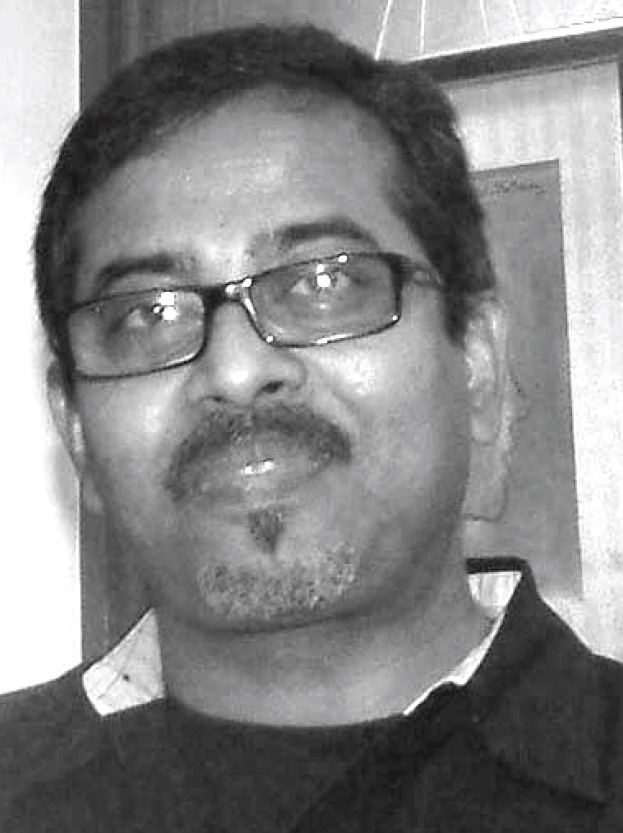
Why Baiju Parthan matters
Baiju Parthan is one of the earliest Indian artists to move deliberately between painting and new media, building a practice that treats botany, mythology, and philosophy as working materials alongside canvas, photography, and digital tools. For collectors, he represents a distinct lane within Indian contemporary art: an intermedia practitioner whose ideas have circulated through international group exhibitions even as his public auction footprint has remained comparatively small and thinly documented.
- Nationality
- Indian
- Media
- Painting, Mixed-media, Digital art
- Movement
- Contemporary Indian art, Intermedia art
- Education
- B.Sc. Botany, Kerala University; B.F.A. Painting, Goa College of Art, University of Bombay, 1978 to 1983; Postgraduate Diploma in Comparative Mythology, University of Mumbai; M.A. Philosophy, University of Mumbai; certification in computer game level design, Pratt Institute, New York, circa 2010
- Signature motifs
- Mythology-technology synthesis, Digital collage and photo-based imagery
- Representation
- The Guild, Palette Art Gallery
By the numbers
- USD 169,000Auction high (reported)Archeology - Arrival at Lancashire, 2008; price per BidtoArt, venue Christie's New York per Art.Salon; neither source independently confirmed
- 1956, Kerala, IndiaBorn
- 1983Practicing sinceB.F.A., Goa College of Art
- The Guild; Palette Art GalleryRepresented by
Biography
Baiju Parthan was born in 1956 in Kerala, India. He earned a B.Sc. in Botany from Kerala University and, by his own account given to the New Indian Express in 2018, began studying civil engineering before leaving after a year to pursue art. He then enrolled at the Goa College of Art, under the University of Bombay, completing a Bachelor of Fine Arts in Painting over 1978 to 1983.
Parthan later returned to formal study several times as his practice expanded. He earned a Postgraduate Diploma in Comparative Mythology and a Master of Arts in Philosophy, both from the University of Mumbai. He also took a certification course in computer game level design at Pratt Institute in Manhattan around 2010, reflecting a sustained interest in digital and interactive media alongside painting.
Early recognition came from the Lalit Kala Akademi, which recorded him receiving its Merit Prize across 1978 to 1981, and from the Goa Lalit Kala Akademi, which named him Artist of the Year in 1981. His work appeared in international group exhibitions including Kapital und Karma at Kunsthalle Wien and Under Construction at the Japan Foundation, Tokyo, both in 2002, Art in Contemporary India at Culturgest, Lisbon, in 2004, and, in 2015, The Eye and The Mind: New Interventions in Contemporary Indian Art, shown at the Minsheng Art Museum in Beijing, the China Art Museum in Shanghai, and the Guangdong Museum of Art in Guangzhou. Solo exhibitions have included Liquid Memory + Rant at Vadehra Art Gallery, New Delhi, in 2007, and two related shows at Aicon Gallery, Milljunction in New York in 2010 and Dislocation: Millijunction Part 2 in London in 2011.
Parthan lives and works in Mumbai. He is regularly associated with several Indian galleries, including The Guild and Palette Art Gallery, alongside historical exhibition relationships with Aicon Gallery, Vadehra Art Gallery, and Gallery Sumukha.
Critical reception
No verbatim critical assessments from named critics in major outlets could be confirmed in the sources reviewed. In general terms, gallery and platform texts consistently describe Parthan as a pioneering figure in Indian intermedia and new media art, noting a practice that draws on his formal training in science, painting, mythology, and philosophy to build a visual language linking myth, technology, and contemporary Indian identity. His exhibition history, spanning European, Asian, and American institutions between the early 2000s and the mid 2010s, reflects an artist whose ideas circulated internationally even as his commercial market remained comparatively contained.
Market
Public auction data for Baiju Parthan is sparse compared with better-documented Indian contemporary painters. The highest figure found in the sources reviewed is a reported USD 169,000 for the painting Archeology - Arrival at Lancashire, cited by the auction-data aggregator BidtoArt as a 2008 result. A separate aggregator, Art.Salon, independently lists the same painting as sold at Christie's, New York, in March 2008, though neither source could be corroborated against a primary auction-house record, so this figure and venue should be read as indicative rather than a fully verified record. More recently, a 2024 lot at AstaGuru, the painting Ethnography - Spectacle And Artifice, sold for approximately Rs 4,71,174 against an estimate of Rs 4,00,000 to Rs 6,00,000, a result well below the reported 2008 high and illustrative of a market with infrequent public sales.
Top auction results
| Work | Price | Sale |
|---|---|---|
| Archeology - Arrival at Lancashire (2008) | USD 169,000 |
Selected exhibitions
| Years | Exhibition | Venues |
|---|---|---|
| 2002 | Kapital und Karma | Kunsthalle Wien, Vienna |
| 2002 | Under Construction | Japan Foundation, Tokyo |
| 2004 | Art in Contemporary India | Culturgest, Lisbon |
| 2007 | Liquid Memory + Rant | Vadehra Art Gallery, New Delhi |
| 2010 | Milljunction: Paintings and Photo Works | Aicon Gallery, New York |
| 2011 | Dislocation: Millijunction Part 2 | Aicon Gallery, London |
| 2012 | INDIA! | Centro Cultural Banco do Brasil, Rio de Janeiro |
| 2015 | The Eye and The Mind: New Interventions in Contemporary Indian Art | Minsheng Art Museum, Beijing; China Art Museum, Shanghai; Guangdong Museum of Art, Guangzhou |
Awards and honors
- Goa Lalit Kala Akademi Award, Artist of the Year (1981)
- Lalit Kala Akademi Merit Prize (recorded 1978 to 1981) (1978)
Authentication and provenance
No catalogue raisonne.
No catalogue raisonne has been identified for this artist. Works are primarily verified through the artist's representing galleries, including The Guild and Palette Art Gallery.
Primary reference: https://en.wikipedia.org/wiki/Baiju_Parthan
What collectors should know
There is no catalogue raisonne for Baiju Parthan, and verification of works relies on his representing galleries rather than a scholarly catalogue. His auction record is thin: the widely cited high of USD 169,000 comes from a single secondary aggregator without a confirmed auction house, location, or exact date, and should be treated with caution rather than as an established benchmark. No major museum collection holdings could be confirmed from the sources reviewed, so institutional presence should not be assumed without further documentation. Collectors should expect limited public price history and should confirm provenance directly with The Guild, Palette Art Gallery, or the artist's studio, before relying on any single reported figure.
Further reading and resources
Data current as of 2026-07-16.

