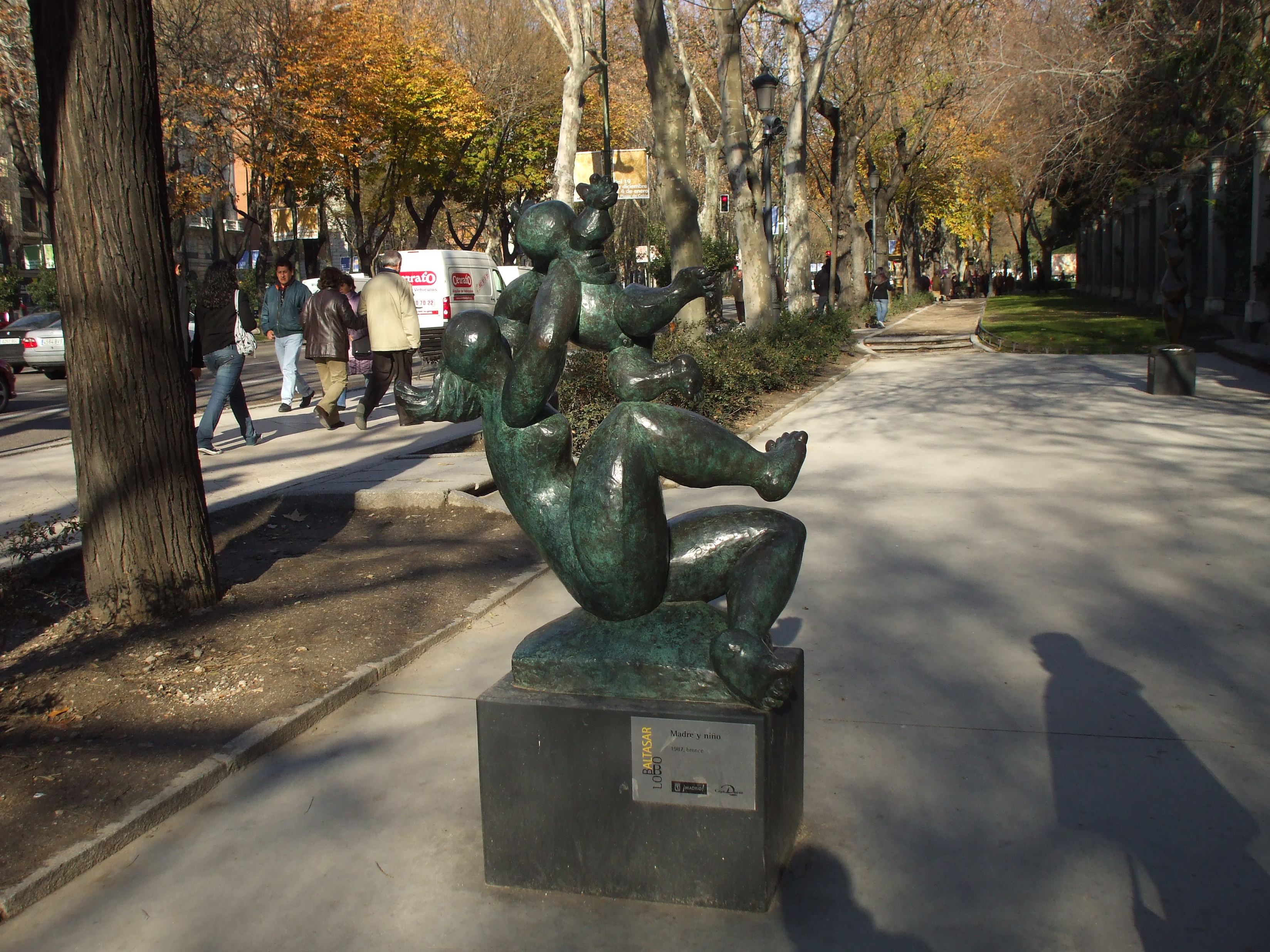
Why Baltasar Lobo matters
Baltasar Lobo is a Spanish sculptor whose mature career unfolded almost entirely in Paris, where he became part of the postwar circle of modernists that included Constantin Brancusi and Jean Arp, and, more loosely, Pablo Picasso, Julio Gonzalez, and Joan Miro. His reputation rests on a body of pared down, organic sculpture built around the female form and the mother and child motif. For a collector, he represents a smaller, museum validated corner of the School of Paris market: broadly held in national collections, honored with Spain's top visual arts award, but transacted at auction only occasionally and at modest scale relative to his better known contemporaries.
- Born
- 1910-02-22, Cerecinos de Campos, Zamora, Spain
- Nationality
- Spanish
- Media
- Sculpture
- Movement
- Modern, School of Paris
- Education
- Apprentice, Ramon Nunez workshop, Valladolid, from 1922, training in religious wood carving; briefly studied at the Escuela de Bellas Artes de San Fernando, Madrid. No completed degree is documented.
- Signature motifs
- Mother-and-child, Female nude, Organic abstraction
- Representation
- Galeria Marc Domenech, Barcelona, David Levy
By the numbers
- USD 620,000Auction highPiece d'eau, Sotheby's. MutualArt cites 2007 as the sale year; exact date not published.
- Deceased, 1993StatusDied in Paris on 4 September 1993, buried at Cimetiere du Montparnasse
- Premio Nacional de Artes Plasticas, 1984National honorSpain's national award for plastic arts
- Museo Baltasar LoboDedicated museumZamora, Spain, near his birthplace
Selected works
Click any work to view it full screen.
Biography
Baltasar Lobo was born on 22 February 1910 in Cerecinos de Campos, a village in the province of Zamora, Spain, the son of a carpenter. In 1922 he entered the workshop of the sculptor Ramon Nunez in Valladolid as an apprentice, training in religious wood carving. He later moved to Madrid, where he studied briefly at the Escuela de Bellas Artes de San Fernando. No source confirms that he completed a formal degree there.
In 1939, fleeing Franco's regime after the Spanish Civil War, Lobo settled in Paris and joined the loose community of artists later called the School of Paris. His sculpture absorbed the abstraction of Brancusi and Arp while retaining a strong figurative core, most often the female nude or the mother and child, rendered in smooth, simplified, rounded forms. Over the following decades he exhibited in Paris, including at the Galerie Vendome. In 1984 Spain awarded him its Premio Nacional de Artes Plasticas, its national award for plastic arts; no other major prizes are documented in the sources reviewed for this profile.
Lobo died in Paris on 4 September 1993, at the age of 83, and was buried at the Cimetiere du Montparnasse. After his death, a large body of his work was gathered into the Museo Baltasar Lobo in Zamora, near his birthplace, which now serves as the principal dedicated repository of his sculpture.
Critical reception
No verbatim critical review could be confirmed in the sources reviewed for this profile, so none is quoted here. What is documented is a consistent institutional framing: gallery and museum texts describe Lobo as a sculptor who absorbed Brancusi's and Arp's abstraction while keeping the female figure and the mother and child at the center of his work, and who moved in the same Paris circles as Picasso, Miro, and Gonzalez without ever being subsumed into their fame. His recognition culminated in Spain's national award for plastic arts in 1984 and in the creation, after his death, of a museum devoted entirely to his work in Zamora, both signs of a settled place in twentieth century Spanish sculpture rather than a rediscovered or contested one.
Market
Lobo's auction market is thin relative to his museum standing. The highest publicly recorded auction price for his work is USD 620,000, for the sculpture Piece d'eau at Sotheby's; MutualArt cites 2007 as the sale year, though the exact sale date and location are not published in the sources reviewed. Other tracked results reach well into six figures at times, including Moment de Bonheur, which sold for about EUR 125,000, and Contemplative, estimated at USD 180,000 to 250,000 at a 2025 Sotheby's sale, but the bulk of recorded results are lower and irregular. The gap between his few strong results and his more typical sale prices is a defining feature of his market, and reflects a sculptor whose institutional reputation outpaces the depth of his auction history.
Top auction results
| Work | Price | Sale |
|---|---|---|
| Piece d'eau (2007) | USD 620,000 (USD 620,000) | Sotheby's |
Selected exhibitions
| Years | Exhibition | Venues |
|---|---|---|
| 2026 | The Figure | Modern Fine Art, New York (online) |
| 2018 | Baltasar Lobo, sculptures | Connaught Brown, London |
| 2004 | Baltasar Lobo | Connaught Brown, London |
| 2001 | Baltasar Lobo | Connaught Brown, London |
| mid-1940s | Masters of Contemporary Art | Galerie Vendome, Paris |
| 1994 to present | Permanent collection | Museo Baltasar Lobo, Zamora |
Museum collections
- Museo Nacional Centro de Arte Reina Sofia, Madrid
- Musee d'Art Moderne de la Ville de Paris
- Museo de Bellas Artes de Bilbao
- National Museum of Norway, Oslo
- Museum of Contemporary Art Sofia Imber, Caracas
- Museo Baltasar Lobo, Zamora
Awards and honors
- Premio Nacional de Artes Plasticas, Spain (1984)
Authentication and provenance
No catalogue raisonne.
No published catalogue raisonne has been identified for Lobo. The Museo Baltasar Lobo in Zamora holds a large body of his work and functions as a reference point, but there is no documented certificate of authenticity program. Provenance is best verified through the galleries that currently handle his work.
Primary reference: https://en.wikipedia.org/wiki/Baltasar_Lobo
What collectors should know
There is no published catalogue raisonne for Baltasar Lobo, and no documented certificate of authenticity program; the Museo Baltasar Lobo in Zamora and the small group of galleries that regularly handle his work, including Galeria Marc Domenech in Barcelona and David Levy, are the most useful points of reference for provenance. His auction record is real but built on a small number of transactions, so any single result, including the USD 620,000 Sotheby's high, should be read as a data point rather than a trend line. His strongest credential for a collector is institutional: holdings at the Reina Sofia, the Musee d'Art Moderne de la Ville de Paris, and several other national museums confirm a settled art historical position, even where the auction market remains comparatively undertested.
Further reading and resources
Data current as of 2026-07-11.

