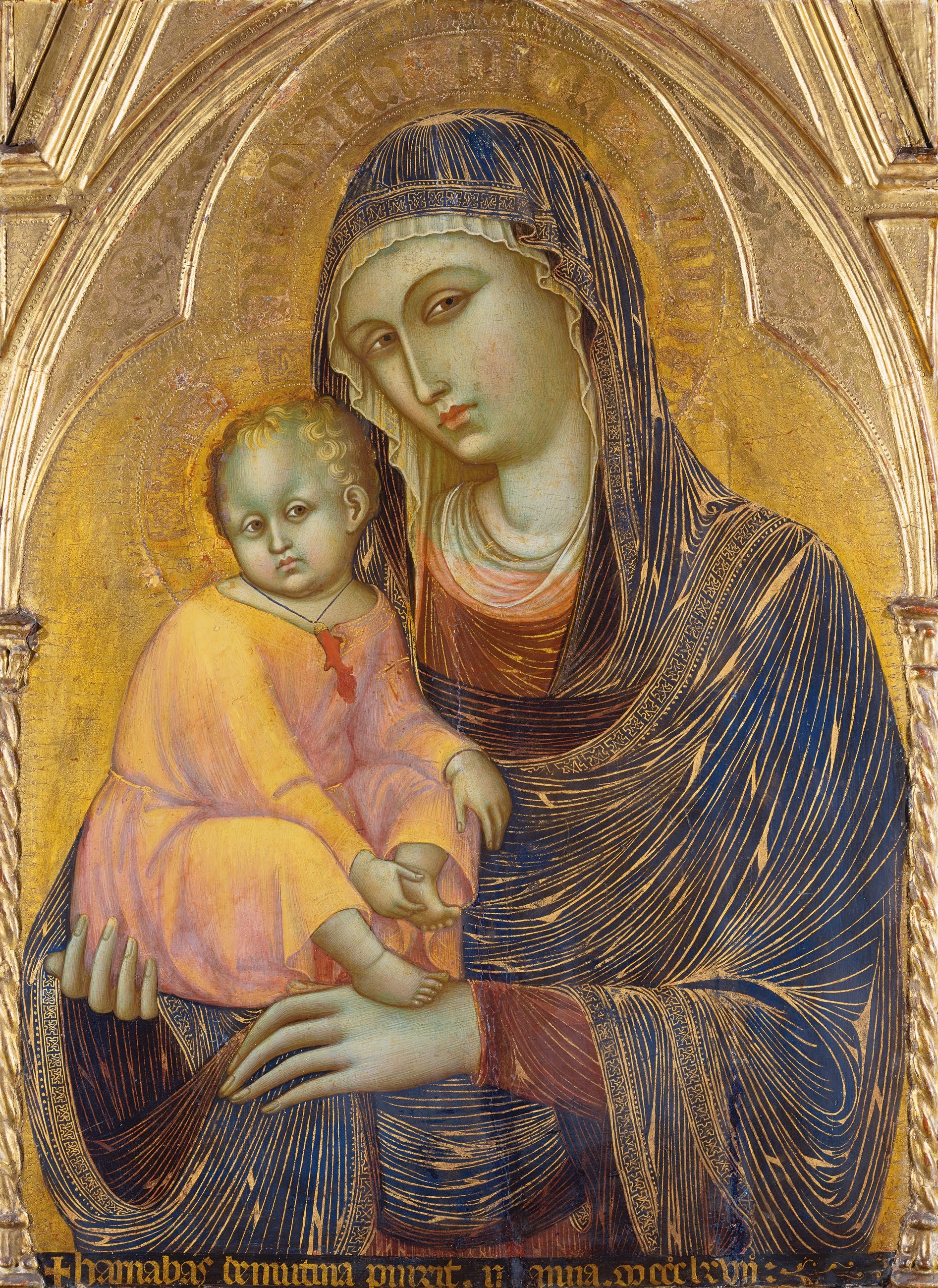
Why Barnaba da Modena matters
Barnaba da Modena, born Barnaba Agocchiari, was one of the most prominent Italian panel painters of the third quarter of the fourteenth century and the artist historians have called the first Lombard painter of note. Working chiefly out of Genoa, he fused a Byzantine-influenced, gold-ground style with an increasingly Gothic sense of line, and his gold-ground Madonnas shaped a generation of Ligurian painters who followed him. He matters to collectors today less as an active market name than as a benchmark of the pre-Renaissance Italian panel market: a documented, museum-held painter whose rare appearances at auction, most recently a 2022 world record at Christie's, illustrate how deep institutional holdings and archival documentation, not gallery promotion, sustain value for artists this old.
- Nationality
- Italian
- Media
- Panel painting, Tempera and gold ground
- Movement
- Italian Gothic (Trecento), Genoese School
- Education
- No school, degree, or apprenticeship record survives. Artistic training is inferred to have occurred in the Emilia region before he settled in Genoa, where he is first documented in 1361.
- Signature motifs
- Gold-ground Madonna and Child panels, Byzantine-influenced Italian Gothic figuration
By the numbers
- GBP 882,000Auction highMadonna and Child with two angels, Christie's London, 8 December 2022, a world auction record for the artist
- 1361 to 1386Documented activityMainly Genoa, with recorded work in Pisa, Alba, and Savona
- 4Museum collectionsStädel Museum, National Gallery London, Courtauld Gallery, and Galleria Sabauda, Turin
- None publishedCatalogue raisonneAttribution relies on signed panels, archival record, and connoisseurship
Selected works
Click any work to view it full screen.
Biography
Barnaba da Modena, whose family name was Agocchiari, was born in or around Modena, in the Emilia region of northern Italy, circa 1328 to 1330. No school, workshop, or apprenticeship record survives to document his training; art historians infer, from stylistic ties and his place of origin, that he trained locally in Emilia before relocating to Genoa. He is first securely documented in Genoa on 13 October 1361, in a contract with the Florentine painter Angelo da Firenze for work in his workshop. His earliest known signed and dated work, a Madonna with Child, is dated 1367 and now hangs in the Städel Museum, Frankfurt am Main.
Barnaba worked across Liguria, Piedmont, and into Tuscany, with commissions recorded for churches in Alba, Piedmont and other towns in the region, though secondary sources do not consistently confirm exact dates for these panels. He is recorded visiting Pisa in 1379. His last securely dated work is a polyptych of 1386, associated with the church of San Dalmazio in Savona, which marks the end of his documented activity rather than a confirmed death date.
No primary record, will, or burial notice fixes the day, month, or place of his death. Reference sources converge on a death sometime after 1386, with many giving "circa 1386" as a rounded approximation; a small number of secondary sources place his death in Modena, while others suggest Genoa, but neither claim is supported by a documentary source strong enough to resolve the question. He should be treated as deceased since the fourteenth century, with the exact date and place of his death unconfirmed.
Critical reception
Later historians treated Barnaba as a pivotal figure in the spread of Italian panel painting beyond Tuscany. Nineteenth-century scholarship, summarized in period reference works, praised the delicacy of his color and the beauty of his heads, with at least one historian said to have preferred him to Giotto, though the original Italian wording of that appraisal is not reliably reproduced in accessible English-language sources and is presented here as paraphrase rather than direct quotation. Modern institutional assessments, including the Städel Museum's, describe his pictorial inventions as influential on subsequent generations of Ligurian painters well into the early fifteenth century. The consistent critical thread across both periods is his role as a transmitter: a painter who carried a Byzantine-inflected, gold-ground vocabulary out of Emilia and into Genoa, Liguria, and Piedmont, where it took root for decades after his death.
Market
Barnaba da Modena rarely appears at auction, and his market is defined almost entirely by museum-quality panel paintings passing between major private collections rather than by a regular trading history. His auction record was set on 8 December 2022, when Madonna and Child with two angels, from the Thyssen-Bornemisza collection, sold at Christie's Old Masters Evening Sale in London for GBP 882,000 (about USD 1,075,158), a price Christie's described as a new world auction record for the artist. By contrast, a panel described only as "circle of Barnaba da Modena," meaning attributed to a follower rather than the artist himself, sold at Koller in Zurich for CHF 162,500, underscoring how much weight a confirmed autograph attribution carries for a painter with such a thin and carefully scrutinized body of surviving work.
Top auction results
| Work | Price | Sale |
|---|---|---|
| Madonna and Child with two angels | USD 1,075,158 (GBP 882,000) | Christie's, London, 2022-12-08 |
Selected exhibitions
| Years | Exhibition | Venues |
|---|---|---|
| 1361 to 1386 | Documented activity as a citizen and painter | Genoa |
| 1367 | Signed and dated Madonna with Child, earliest known signed work | Genoa; now Städel Museum, Frankfurt am Main |
| 1379 | Recorded visit | Pisa |
| 1386 | Polyptych, last securely dated work | San Dalmazio, Savona |
| ongoing | Permanent collection display | National Gallery, London |
| ongoing | Permanent collection display | Städel Museum, Frankfurt am Main |
| ongoing | Permanent collection display | The Courtauld Gallery, London |
Museum collections
- Städel Museum, Frankfurt am Main
- National Gallery, London
- The Courtauld Gallery, London
- Galleria Sabauda, Turin
Authentication and provenance
No catalogue raisonne.
No catalogue raisonne exists for this fourteenth-century painter. Attribution rests on a small number of signed and dated panels, archival contracts, and connoisseurship by institutions such as the Städel Museum and the National Gallery, London, rather than on any certification program.
Primary reference: https://www.nationalgallery.org.uk/artists/barnaba-da-modena
What collectors should know
There is no catalogue raisonne for Barnaba da Modena, and none is likely given the age and dispersal of his surviving output; attribution depends on a handful of signed and dated panels, archival contracts, and expert connoisseurship at institutions such as the Städel Museum and the National Gallery, London. His known body of autograph work is small and concentrated in major museums, so market supply is thin by nature, and any single auction result, including the 2022 Christie's record, should be read against a very limited comparable set rather than as evidence of a broader trend. Provenance carries unusual weight here: the record-setting 2022 sale drew its authority in large part from its documented descent through the Thyssen-Bornemisza collection, and works lacking that kind of chain, or works merely described as "circle of" or "follower of" Barnaba, trade at a steep discount to autograph paintings.
Further reading and resources
Data current as of 2026-07-13.

