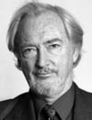
Why Barry Flanagan matters
Barry Flanagan occupies a rare position in postwar British sculpture: he was a founding presence in the late-1960s shift toward process and conceptual art, working with rope, sand, and hessian sacking, and he later became one of the most recognizable figurative sculptors of his generation through a decades-long series of bronze hares. He represented Britain at the 1982 Venice Biennale, was elected to the Royal Academy in 1991, and his work sits in the permanent collections of Tate, the Museum of Modern Art, and the Centre Pompidou, among others. For a collector, he offers a rare combination: art-historical weight from the conceptual art era paired with instantly legible, widely collected bronze editions.
- Born
- 1941-01-11, Prestatyn, Wales, United Kingdom
- Nationality
- British
- Media
- Sculpture, Bronze
- Movement
- Post-war British sculpture, Process art
- Education
- Birmingham College of Art and Crafts, 1957 to 1958 (architecture); St Martin's School of Art, London, Vocational Diploma in Sculpture, graduated 1966
- Signature motifs
- Bronze hare sculptures, Anthropomorphic animal bronzes, Early rope and sand process works
- Representation
- Estate of Barry Flanagan, Kasmin Gallery, Waddington Custot
By the numbers
- GBP 1,448,750Auction highNijinski Hare (1985), Christie's London, 2018; a world auction record for the artist. Exact sale date not independently confirmed.
- British Pavilion, 1982Venice Biennale
- Elected RA, 1991Royal Academy
- Estate of Barry Flanagan; Kasmin Gallery; Waddington CustotRepresented by
Selected works
Click any work to view it full screen.
Biography
Barry Flanagan was born on 11 January 1941 in Prestatyn, North Wales. He studied architecture at Birmingham College of Art and Crafts from 1957 to 1958, then trained as a sculptor at St Martin's School of Art in London, graduating in 1966 with a Vocational Diploma in Sculpture. His first solo exhibition, held at London's Rowan Gallery in 1966, brought him quick recognition within the city's avant-garde, including from the curator and critic Lucy Lippard.
In the late 1960s, Flanagan worked in soft, process-based materials, rope, sand, and canvas sacking, that placed him alongside the leading conceptual and process artists of the period. He was included in three landmark exhibitions in rapid succession: Harald Szeemann's When Attitudes Become Form at Kunsthalle Bern (1969), Op Losse Schroeven at the Stedelijk Museum, Amsterdam (1969), and Information at the Museum of Modern Art, New York (1970). From the late 1970s he turned toward bronze figuration, developing the leaping and boxing hare sculptures for which he later became best known, alongside other anthropomorphized animals. He taught at St Martin's School of Art and the Central School of Arts and Crafts between 1967 and 1971.
Flanagan represented Britain at the 40th Venice Biennale in 1982, was appointed OBE in 1991, and was elected a Royal Academician the same year. Barry Flanagan died on 31 August 2009 in Santa Eulària des Riu, Ibiza, Spain, at the age of 68. The cause, reported by the New York Times and other major sources, was motor neurone disease.
Critical reception
Flanagan is consistently framed by museums and dealers as one of the most important British sculptors of his generation, credited with helping to define process and conceptual sculpture in Britain before pivoting to a widely loved figurative practice. His inclusion in When Attitudes Become Form, Op Losse Schroeven, and Information places him among the artists who set the terms for late-1960s and 1970s sculpture internationally, and his 1966 Rowan Gallery debut is described as having earned him recognition from an influential circle of artists and thinkers, including Lucy Lippard. No verbatim critical assessment from a named critic in a major outlet could be confirmed from the sources available for this profile, so none is quoted here.
Market
Flanagan's bronze hares and related figures are the mainstay of his market, appearing regularly at Christie's, Sotheby's, and Phillips alongside his earlier, rarer conceptual and process works. His auction record is Nijinski Hare (1985), which sold at Christie's London in 2018 for GBP 1,448,750, a world auction record for the artist confirmed by the auction house; the exact calendar date of that sale is not independently documented in public sources. Collectors should treat this 2018 result as the current benchmark until a more recent sale supersedes it.
Top auction results
| Work | Price | Sale |
|---|---|---|
| Nijinski Hare (1985) (2018) | GBP 1,448,750 | Christie's, London |
Selected exhibitions
| Years | Exhibition | Venues |
|---|---|---|
| 1966 | First solo exhibition | Rowan Gallery, London |
| 1969 | When Attitudes Become Form | Kunsthalle Bern |
| 1970 | Information | Museum of Modern Art, New York |
| 1982 | British Pavilion | 40th Venice Biennale |
| 1993 to 1994 | Major retrospective | Fundacion la Caixa, Madrid, traveled to Musee des Beaux Arts, Nantes |
| 2011 | Barry Flanagan: Early Works 1965 to 1982 | Tate Britain, London |
| 2016 | Barry Flanagan: Sand Girl | Tate Britain, London |
| 2026 | Barry Flanagan: On the Other Hand | Galerie Max Hetzler, Berlin |
Museum collections
- Tate, London
- The Museum of Modern Art, New York
- Centre Pompidou, Paris
- Irish Museum of Modern Art, Dublin
- Solomon R. Guggenheim Museum, New York
- Hirshhorn Museum and Sculpture Garden, Washington, D.C.
- Victoria and Albert Museum, London
Awards and honors
- OBE (Officer of the Order of the British Empire) (1991)
- Elected Royal Academician, Royal Academy of Arts (1991)
Authentication and provenance
No catalogue raisonne.
No published catalogue raisonne has been confirmed for Barry Flanagan. Works are verified through the Estate of Barry Flanagan and through dealers including Kasmin Gallery and Waddington Custot, who maintain exhibition history and archival records.
Primary reference: https://www.barryflanagan.com/
What collectors should know
No catalogue raisonne for Barry Flanagan has been confirmed to exist; authentication and provenance research currently run through the Estate of Barry Flanagan and through dealers such as Kasmin Gallery and Waddington Custot, who hold exhibition records and archival material. Because his market spans two very different bodies of work, early process pieces in rope and sand versus later bronze editions, condition, edition number, and casting authority matter more than for many single-medium sculptors. The current auction record, Christie's London 2018 sale of Nijinski Hare for GBP 1,448,750, is confirmed by the auction house itself, though its exact calendar date is not independently documented in public sources.
Further reading and resources
Data current as of 2026-07-10.

