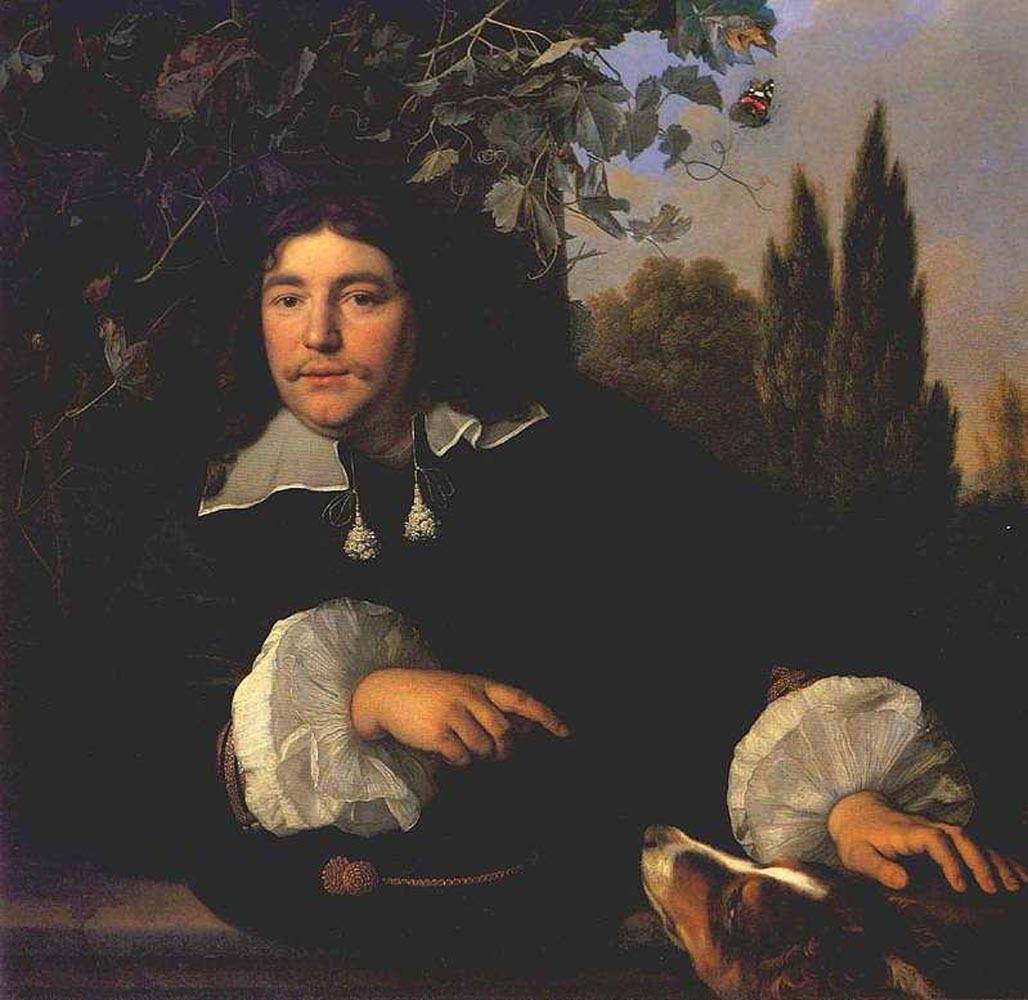
Why Bartholomeus van der Helst matters
Bartholomeus van der Helst was, for much of the 1640s and 1650s, the most sought-after portrait painter in Amsterdam, favored by the city's civic and mercantile elite over his contemporary Rembrandt for his polished, flattering style in the manner of Anthony van Dyck. His large civic guard group portraits, above all The Celebration of the Peace of Munster, are counted among the defining images of the Dutch Golden Age and hang today in the world's leading museums. For collectors, he represents a category distinct from the market's living artists: a canonical Old Master whose value rests on museum-grade provenance, scholarly attribution, and rarity rather than on gallery representation or a living market apparatus.
- Nationality
- Dutch
- Media
- Painting
- Movement
- Dutch Golden Age, Dutch Baroque portraiture
- Education
- No school or apprenticeship record survives. His style, especially his first dated work, suggests training in Amsterdam under Nicolaes Eliaszoon Pickenoy, an attribution reached by art historians through stylistic comparison rather than documentary proof.
- Signature motifs
- Civic guard group portraits, Elegant Van Dyck-influenced society portraiture
- Representation
- "None. A historical Old Master painter; no gallery or estate represents him. Works circulate through museums and the Old Master auction and dealer market."
By the numbers
- GBP 481,250Auction highPortrait of a gentleman, Christie's London, 7 July 2010. USD 760,508 at contemporaneous exchange rates (Artnet Price Database).
- Amsterdam, c.1627 to 1670Active periodLeading portraitist of the Dutch Golden Age, alongside Rembrandt
- The Celebration of the Peace of Munster, 1648 to 1649Major civic commissionRijksmuseum, Amsterdam
- None publishedCatalogue raisonneJudith van Gent monograph and an announced online catalogue are the leading scholarly resources
Selected works
Click any work to view it full screen.
Biography
Bartholomeus van der Helst was born in Haarlem around 1613. His exact birth date is not known because Haarlem's birth and baptismal records from the period have been lost, and scholars note there is no full consensus on the year. He moved to Amsterdam by about 1627, where he spent the rest of his career. No apprenticeship contract or school record survives, but the timing of that move and the style of his first dated painting, Regents of the Walloon Orphanage in Amsterdam of 1637, have led art historians to conclude that he likely trained in Amsterdam under Nicolaes Eliaszoon Pickenoy, an inference based on stylistic comparison rather than documentary proof.
Through the 1640s van der Helst built a reputation among Amsterdam's civic and merchant elite, and by mid-century he had become the city's leading portraitist, more popular with many patrons than Rembrandt because of an elegant, luminous style closer to Van Dyck's. His largest and most celebrated work, The Celebration of the Peace of Munster of 1648 to 1649, a monumental group portrait for the Kloveniersdoelen civic guard headquarters, is now in the Rijksmuseum. In 1667 he painted a self-portrait for Grand Duke Cosimo III de' Medici, now in the Uffizi Gallery, evidence of his international reputation.
Van der Helst died in Amsterdam and was buried there on 16 December 1670. Surviving records document only the burial date with certainty; the exact day of his death itself is not attested. According to later accounts, his wife had to sell much of his collection after his death, though this detail carries only moderate sourcing.
Critical reception
Van der Helst's contemporaries and later critics repeatedly measured him against Rembrandt, and often preferred him. The eighteenth-century English painter and critic Sir Joshua Reynolds, after seeing van der Helst's great civic guard group portrait in Amsterdam, is reported, in an account reproduced by the Historians of Netherlandish Art review, to have rated it above any portrait he had seen and to have judged van der Helst's work for the civic guard headquarters as having surpassed Rembrandt's in the eyes of contemporary critics. Eighteenth-century Amsterdam guidebook writer N. den Hoorn likewise singled out van der Helst's technical command of fabric, gold and silver vessels, and festive ornament as remarkable, praise reproduced in scholarly form by the Leiden Collection. Modern museum scholarship situates him as one of the most important Northern Netherlandish portraitists of the seventeenth century, whose civic and society portraits defined Amsterdam's mid-century visual identity even as later art history gave more sustained attention to Rembrandt's psychological depth.
Market
Van der Helst's market is that of a documented Old Master rather than a living artist: supply is fixed, sales are infrequent, and results depend heavily on the specific work, its condition, and its subject. His standing auction record is GBP 481,250 (USD 760,508 per Artnet's Price Database), paid at Christie's London on 7 July 2010 for Portrait of a gentleman, a three-quarter-length 1655 canvas showing a seated sitter before a balustrade with a distant view of Haarlem. As of mid-2026, no later sale has surpassed this price in major auction databases. Artprice records roughly 85 auction appearances for the artist across the secondary market, with results ranging widely depending on scale, subject, and attribution certainty; simpler or workshop-adjacent works have sold for a small fraction of the 2010 record.
Top auction results
| Work | Price | Sale |
|---|---|---|
| Portrait of a gentleman, three-quarter-length, seated, before a balustrade, a landscape with a country house and a distant view of Haarlem beyond (1655) | USD 760,508 (GBP 481,250) | Christie's, London, 2010-07-07 |
Selected exhibitions
| Years | Exhibition | Venues |
|---|---|---|
| 1637 | Regents of the Walloon Orphanage | Painted for the Walloon Orphanage, Amsterdam; now Amsterdam Museum |
| 1648 to 1649 | The Celebration of the Peace of Munster, 18 June 1648 | Rijksmuseum, Amsterdam |
| 1662 | The Musician | The Metropolitan Museum of Art, New York |
| 1667 | Self-portrait, painted for Cosimo III de' Medici | Uffizi Gallery, Florence |
| 2012 to 2017 | Civic Pride: Dutch Group Portraits from Amsterdam | National Gallery of Art, Washington, D.C. (five-year loan from Amsterdam) |
| Ongoing | Permanent collection display | National Gallery, London |
Museum collections
- Rijksmuseum, Amsterdam
- Amsterdam Museum, Amsterdam
- Museum Boijmans Van Beuningen, Rotterdam
- State Hermitage Museum, Saint Petersburg
- Uffizi Gallery, Florence
- The Metropolitan Museum of Art, New York
- National Gallery, London
Authentication and provenance
No catalogue raisonne.
No published catalogue raisonne exists for van der Helst. Art historian Judith van Gent's scholarly monograph, which surveyed more than 200 works attributed to him (about 95 percent of them portraits), is the leading modern authentication resource, and an online catalogue project has been announced but has not been completed as a published catalogue raisonne. Attribution today relies on museum curatorial departments and scholarly networks such as the Leiden Collection and the RKD, rather than on a certificate program.
Primary reference: https://www.theleidencollection.com/artists/bartholomeus-van-der-helst/
What collectors should know
Van der Helst's market is thin by design: he produced a finite, largely portrait-dominated body of work, there is no published catalogue raisonne, and authentication rests on museum curatorial expertise and scholarly consensus rather than a certificate program. That makes provenance, condition, and clear museum or scholarly attribution history unusually important to value. Prices vary enormously by category, from modest sums for smaller or studio-adjacent portraits to seven-figure-equivalent results for major, well-provenanced civic or society portraits comparable to his 2010 auction record. Because sales are infrequent, any single result should be read in the context of the specific work rather than as evidence of a smooth market trend.
Further reading and resources
Data current as of 2026-07-10.

