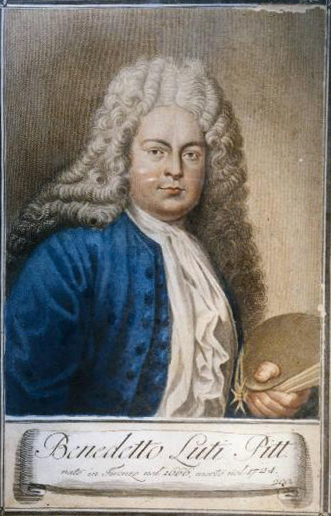
Why Benedetto Luti matters
Benedetto Luti was one of the most influential painters and teachers working in Rome at the turn of the eighteenth century, a bridge figure between the high Baroque manner of Pietro da Cortona and Carlo Maratti and the softer, more classicizing style that carried into the following generation. He was also among the earliest Italian painters to treat pastel as a serious medium, and one of Rome's most important private collectors and connoisseurs of prints and drawings by earlier masters. His election as Principe of the Accademia di San Luca in 1720 placed him at the head of Rome's official artists' institution. For collectors today, he represents a well documented Old Master whose market is thin in volume but anchored by strong museum holdings and a clear archival record of his training, patronage, and institutional standing.
- Born
- 1666-11-17, Florence, Italy
- Nationality
- Italian
- Media
- Painting, Pastel, Drawing
- Movement
- Italian Baroque, Roman late Baroque
- Education
- Trained in Florence under Anton Domenico Gabbiani; joined a Florentine accademia in 1684; moved to Rome in 1690 to 1691, studying Raphael, Annibale Carracci, Domenichino, Guido Reni, and Carlo Maratti; drawing master at the Academie de France in Rome; elected academician of the Accademia di San Luca in 1694 and Principe in 1720
- Signature motifs
- Pastel portrait heads, Religious allegory and biblical narrative
By the numbers
- USD 318,161Auction highBacchus and Ariadne, Bonhams New Bond Street, 2013; exact sale date and currency of the original hammer price not confirmed
- Principe, 1720Accademia di San LucaElected head of Rome's leading academy of artists
- Florence and Rome, 1666 to 1724Active years
- None publishedCatalogue raisonneA 2012 scholarly monograph surveys his oeuvre
Selected works
Click any work to view it full screen.
Biography
Benedetto Luti was born in Florence on 17 November 1666 and trained there in the studio of Anton Domenico Gabbiani, the Medici court painter. He joined a Florentine academy in 1684, and around 1690 to 1691 moved to Rome, where he devoted himself to studying the paintings of Raphael, Annibale Carracci, Domenichino, Guido Reni, and Carlo Maratti rather than formally apprenticing to a single master. His graphic work drew early notice: he began attending the Academie de France in Rome and the Accademia di San Luca soon after his arrival, and in 1691 won first prize in the Concorso Clementino for a drawing of Moses collecting offerings for the temple.
Luti was elected an academician of the Accademia di San Luca in 1694 (some sources give 1695). He went on to serve as a drawing master at the Academie de France in Rome, based at the Palazzo Mancini. His patrons included Cosimo III de' Medici, Grand Duke of Tuscany, who favored his pastel portraits, and the Colonna family, for whom he painted the Apotheosis of Martin V ceiling at Palazzo Colonna. Contemporaries regarded him as one of Rome's leading connoisseurs, and he worked as a dealer and advisor as well as a painter, assembling a large personal collection of prints and drawings by earlier masters.
In 1715, through the intercession of Cosimo III de' Medici, Luti received the cross of Knight of the Holy Roman Empire. In 1720 he was elected Principe of the Accademia di San Luca, its highest office, a step contemporaries reportedly debated given the varied critical assessment of his own painting. Benedetto Luti died in Rome on 17 June 1724.
Critical reception
In his own lifetime, Luti's standing rested as much on his connoisseurship and teaching as on his painting. He was praised for his encyclopedic knowledge of other artists' hands and for the pleasure he took in sharing his large collection of prints and drawings by earlier masters with fellow connoisseurs. His institutional career, moving from prize winner to academician to Principe of the Accademia di San Luca over roughly three decades, tracks a steady rise in Roman artistic authority. Modern museum catalogues situate him within the late Roman Baroque, noting both his fresco and altarpiece commissions in major churches and his role in popularizing pastel portraiture in Italy, following patterns set earlier in France.
Market
Luti's documented auction record is USD 318,161, reported by MutualArt for Bacchus and Ariadne at Bonhams New Bond Street in 2013; the exact sale date and the currency of the original hammer price are not confirmed in the sources available. A separately documented sale, the drawing Allegory of the Elevation of Cardinal Deacon Oddone Colonna to the Papal Chair as Pope Martin V, brought USD 122,500 (GBP 77,723) at Sotheby's New York on 30 January 2013, a price Sotheby's described at the time as a record for the artist, since surpassed. As with most artists of his period, supply at auction is thin and uneven: a Sotheby's oil, Rebecca at the Well, has carried an estimate in the USD 40,000 to 60,000 range, while works catalogued as attributed to or circle of Luti, most often drawings and pastels, have sold for far less, from the tens of thousands of dollars down to a few thousand. Prices depend heavily on medium, attribution confidence, and subject, so any single result should be read alongside comparable, securely attributed lots rather than treated as a stable index.
Top auction results
| Work | Price | Sale |
|---|---|---|
| Bacchus and Ariadne (2013) | USD 318,161 | Bonhams, London (New Bond Street) |
| Allegory of the Elevation of Cardinal Deacon Oddone Colonna to the Papal Chair as Pope Martin V (2013) | USD 122,500 (GBP 77,723) | Sotheby's, New York, 2013-01-30 |
Selected exhibitions
| Years | Exhibition | Venues |
|---|---|---|
| 1691 | Concorso Clementino, first prize for a drawing of Moses Collecting Offerings for the Temple | Accademia di San Luca, Rome |
| 1694 | Elected academician | Accademia di San Luca, Rome |
| 1715 | Knight of the Holy Roman Empire | Conferred through the intercession of Cosimo III de' Medici |
| 1720 | Elected Principe | Accademia di San Luca, Rome |
Museum collections
- Metropolitan Museum of Art, New York
- National Gallery of Art, Washington, D.C.
- Galleria degli Uffizi, Florence
- State Hermitage Museum, Saint Petersburg
- Royal Collection Trust, London
- Accademia Nazionale di San Luca, Rome
Awards and honors
- First prize, Concorso Clementino, Accademia di San Luca (1691)
- Elected academician, Accademia di San Luca (1694)
- Knight of the Holy Roman Empire (1715)
- Elected Principe, Accademia di San Luca (1720)
Authentication and provenance
No catalogue raisonne.
No published catalogue raisonne exists for Luti. A scholarly monograph, R. Maffeis, Benedetto Luti, L'ultimo Maestro (Mandragora, 2012), surveys his output, and attributions rest on connoisseurship, the archival record of the Accademia di San Luca, and museum provenance research. Works are frequently catalogued as attributed to or circle of Luti rather than fully autograph.
Primary reference: https://www.treccani.it/enciclopedia/benedetto-luti_(Dizionario-Biografico)/
What collectors should know
There is no catalogue raisonne for Benedetto Luti, only a 2012 scholarly monograph and the wider art historical literature, so attribution rests heavily on connoisseurship, inscriptions such as the signed and dated example reading "Roma 1712, Benedetto Luti fece," and documented provenance through collections such as the Royal Collection, the Hermitage, and major American and European museums. As an Old Master who died in 1724, he has no living estate or gallery representation; works reach the market through auction houses and Old Master dealers rather than any primary representation structure. Because recorded sales are few and span a wide range of media, from major documented paintings to modest attributed drawings, collectors should weigh medium, attribution strength, and exhibition or publication history carefully rather than relying on a single benchmark price.
Further reading and resources
Data current as of 2026-07-18.

