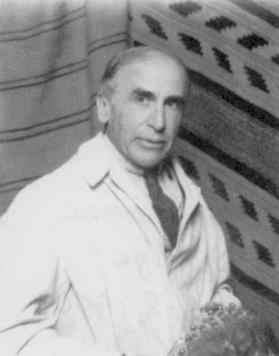
Why Bert Geer Phillips matters
Bert Geer Phillips was a founding member of the Taos Society of Artists, the 1915 cooperative that turned a remote New Mexico village into one of the most consequential art colonies in American history. For collectors, he represents the earliest generation of Taos painting: academically trained, drawn west by chance, and devoted for nearly six decades to romantic realist depictions of Pueblo life and the Southwestern landscape. His market sits outside the mainstream postwar and contemporary channels, in the specialist Western art auction houses that carry the Taos colony's legacy.
- Born
- 1868-07-15, Hudson, New York, USA
- Nationality
- American
- Media
- Painting, Murals
- Movement
- Taos Society of Artists, American Western art
- Education
- Art Students League of New York and National Academy of Design, New York, circa 1883 to 1888; Academie Julian, Paris, 1894. No degrees documented.
- Signature motifs
- Pueblo genre scenes, Taos landscapes
By the numbers
- USD 157,300Auction high'A Taos Pueblo Man and His Pony,' Coeur d'Alene Art Auction; exact sale date not documented in public records; a higher, unverified figure has been reported by a market aggregator
- Founding member, 1915Taos Society of Artists
- 1868 to 1956Career span
- No gallery or estate representative currently documentedEstate representationWork is sold through specialist auction houses and occasional dealer exhibitions
Biography
Bert Geer Phillips was born on July 15, 1868, in Hudson, New York. As a teenager he enrolled in a local studio opened by the painter George McKinstry, then left home around age 16 for New York City, where he trained for roughly five years, from about 1883 to 1888, at the Art Students League and the National Academy of Design. In 1894 he traveled to Europe and studied at the Academie Julian in Paris, where he befriended fellow Americans Ernest Blumenschein and Joseph Henry Sharp.
In 1898 Phillips and Blumenschein set out on a sketching trip through New Mexico Territory. A broken wagon wheel forced them to stop near Taos, and Phillips decided to stay, settling permanently in the town that year. He became one of the founders of the Taos art colony and, in 1915, a founding member of the Taos Society of Artists alongside Sharp, Blumenschein, and others. His paintings, largely of Taos Pueblo people and the surrounding landscape, held to an academic, romantic realist idiom even as some of his colony contemporaries moved toward modernism.
Phillips was also active outside the studio. He is credited with helping establish a forest reserve near Taos and serving as its first, informal forest ranger, a role tied to what later became Carson National Forest. Later in life, eyestrain from painting, in part by firelight, cost him much of his eyesight and eventually forced him to stop painting; he completed several mural commissions beforehand, including one for the Polk County Courthouse in Iowa. He died on June 16, 1956. The National Cowboy & Western Heritage Museum states he died in Taos, New Mexico, where he had lived for nearly six decades, while a Fine Art Connoisseur account notes he remained in Taos "until shortly before his death," so his exact place of death is not fully resolved in the sources available.
Critical reception
No verifiable, exact quotations from named critics writing in major outlets about Phillips could be confirmed from the available sources, so none are reproduced here. What is well documented is institutional recognition of his historical role: he is consistently framed as a co-founder of the Taos Society of Artists and one of the earliest Anglo painters to settle permanently in Taos, and his romantic realist treatment of Pueblo subjects is the recurring thread in museum and gallery writing about him. Recent programming, including the Couse-Sharp Historic Site's 2024 to 2025 exhibition "Vecinos y Amigos: Bert Geer Phillips and His Neighbors" and Blue Rain Gallery's 2025 homage show, indicates sustained institutional and dealer interest in his place within the Taos founding generation.
Watch
Market
Phillips's market runs almost entirely through auction houses that specialize in Western and Taos colony art. The best-documented single-lot price is USD 157,300 for "A Taos Pueblo Man and His Pony," sold through Coeur d'Alene Art Auction, though the auction house's public results page does not give an exact sale date. Coeur d'Alene's page also shows an aggregate figure of USD 168,000 for the artist that is not broken out by lot, and a market-data aggregator has separately cited realized prices of up to USD 378,000 without naming the work, house, or date, so neither figure can be confirmed as a verified single-lot record. Heritage Auctions lists a house record of USD 89,625, from a sale on May 25, 2007. No gallery or estate representative for Phillips is publicly documented; his paintings surface through auctions such as Coeur d'Alene, Scottsdale, Santa Fe, and Heritage, and occasionally through dealer and homage exhibitions.
Top auction results
| Work | Price | Sale |
|---|---|---|
| A Taos Pueblo Man and His Pony | USD 157,300 | Coeur d'Alene Art Auction |
Selected exhibitions
| Years | Exhibition | Venues |
|---|---|---|
| 1915 to 1917 | Panama-California Exposition | San Diego, California |
| 1935 to 1936 | California Pacific International Exposition | San Diego, California |
| 2024 to 2025 | Vecinos y Amigos: Bert Geer Phillips and His Neighbors | Couse-Sharp Historic Site, Taos, New Mexico |
| 2025 | Taos Six Collection: An Homage to Bert Geer Phillips | Blue Rain Gallery, Santa Fe |
| ongoing | Collection display | Gilcrease Museum, Tulsa |
| 2025 to 2026 | The Rabbit Hunt, on view in the Janis and Roy Coffee Gallery | Dallas Museum of Art |
| ongoing | Collection display | National Cowboy & Western Heritage Museum, Oklahoma City |
Museum collections
- Gilcrease Museum, Tulsa
- Dallas Museum of Art
- National Cowboy & Western Heritage Museum, Oklahoma City
- Couse-Sharp Historic Site, Taos
Awards and honors
- Founding member, Taos Society of Artists (1915)
- First forest ranger of the forest reserve near Taos that became Carson National Forest (1906)
Authentication and provenance
No catalogue raisonne.
No catalogue raisonne is documented for Phillips. Works are typically authenticated through provenance history and the specialist Western and Taos art auction houses that regularly handle his market, such as Coeur d'Alene Art Auction.
Primary reference: https://en.wikipedia.org/wiki/Bert_Geer_Phillips
What collectors should know
There is no catalogue raisonne for Phillips and no current estate representation, so provenance and the track record of the specific auction house handling a work carry unusual weight. His auction market is thin and concentrated in a handful of Western art specialists, with results ranging from the low five figures up to the USD 157,300 best-documented high for "A Taos Pueblo Man and His Pony," alongside an unverified higher figure reported by at least one market aggregator, so any single result should be read against that small, imperfectly documented sample rather than as a smooth trend line. Even a basic biographical detail like his exact place of death is unresolved between museum and exhibition sources, a reminder that documentation on early Taos colony figures can be incomplete and should be checked against primary auction and museum records before making claims about condition, subject, or date on a specific work.
Further reading and resources
Data current as of 2026-07-11.

