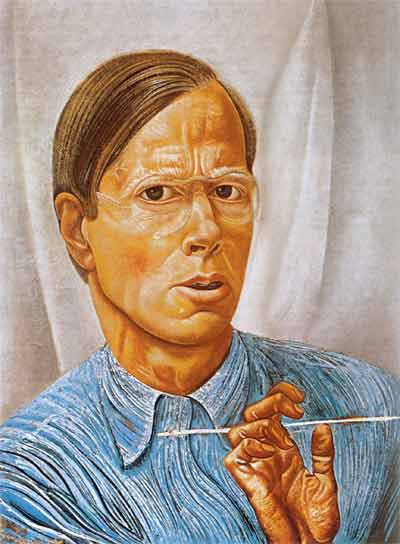
Why Boris Grigoriev matters
Boris Grigoriev is one of the most significant, and least consistently marketed, painters of the Russian avant-garde. His restless portraiture and his peasant-life series Raseya moved between symbolist-inflected realism and expressionist distortion, and his work traveled with him through Petrograd, Berlin, Paris, and New York during the upheavals of revolution and emigration. For collectors, Grigoriev represents a rare combination: real seven-figure auction results and deep museum-level historical standing, in a market thin enough that provenance and connoisseurship, not price charts, still do most of the work.
- Born
- 1886-07-11, Moscow or Rybinsk, Russian Empire (sources disagree)
- Nationality
- Russian
- Media
- Painting, Drawing
- Movement
- Russian avant-garde, Expressionism
- Education
- Stroganov School of Art and Industry, Moscow, 1903 to 1907; Imperial Academy of Arts, St. Petersburg, 1907 to 1912; Academie de la Grande Chaumiere, Paris, 1912 to 1913
- Signature motifs
- Raseya peasant-life series, Expressionist portraiture
By the numbers
- USD 2.09MAuction highSailors at a Café, Sotheby's New York, 2005
- 1908 to 1938Career exhibitionsLeipzig, Venice, Paris, New York, Pittsburgh, Chicago
- State Russian Museum (2011); Faberge Museum (2023 to 2024)RetrospectivesBoth in St. Petersburg
- None confirmedCurrent representationNo known gallery or estate representative as of 2026
Selected works
Click any work to view it full screen.
Biography
Sources disagree on where Boris Grigoriev was born. Several biographical accounts, including Christie's and the Russian Art Gallery, place his birth in Moscow on 11 July 1886 (23 July, New Style); other accounts, including Heritage Auctions and GalleryThane, give Rybinsk, a town on the Volga in the Yaroslavl region, on the same date. Christie's notes he was born in Moscow but raised in Rybinsk, which may explain the split. He is described as the illegitimate son of a banker who later adopted him.
He trained first in commerce at the Moscow Practical Academy of Commercial Sciences, 1899 to 1902, before turning to art at the Stroganov School of Art and Industry in Moscow, 1903 to 1907, then at the Imperial Academy of Arts in St. Petersburg, 1907 to 1912, and finally at the Academie de la Grande Chaumiere in Paris, 1912 to 1913.
Back in Russia, Grigoriev exhibited with the World of Art group and began the Raseya cycle, a series of expressionistic portraits and scenes of Russian peasant life that the critic Alexander Benois is widely reported to have praised for capturing the essence of pre-revolutionary Russia, though no verified exact quotation from Benois could be confirmed for this profile. Grigoriev left Russia after the 1917 revolution and by the early 1920s was showing regularly in Berlin, Paris, and New York, where his work was handled by The New Gallery, Grand Central Art Galleries, and the Scott and Fowles Gallery; pieces sold through those rooms later entered American museum collections. He continued to exhibit internationally through the 1930s, in cities including Venice, Pittsburgh, and Chicago. He settled in the south of France and, according to biographical sources including RusArtNet, died of cancer in Cagnes-sur-Mer on 7 February 1939.
Critical reception
Grigoriev's reputation rests substantially on the Raseya series and on his standing within the World of Art circle before and around the 1917 revolution. Alexander Benois is widely credited, in paraphrase rather than any exact quotation that could be verified here, with praising the series as a portrait of Russia's essence on the eve of revolutionary upheaval. Institutional recognition has followed at intervals rather than continuously: a major retrospective at the State Russian Museum in St. Petersburg in 2011, and another at the Faberge Museum in St. Petersburg running into January 2024, both point to sustained curatorial interest in Russia, even as his American and European exhibition record from the 1920s and 1930s has received comparatively less recent scholarly attention.
Market
Grigoriev's best-documented auction result is Sailors at a Café (1922), from his Marseilles series, which sold for USD 2,088,000 at Sotheby's New York on 15 April 2005, as part of a Russian art sale that totaled more than USD 35 million. Other sources cite higher, less-documented figures, including a reported USD 2,706,640 for an unnamed painting (MutualArt) and EUR 2,555,150 for Shepherd of the Hills, 1920 (Auctie's, 2008), but neither source names an auction house or exact sale date, so neither is treated here as the confirmed record.
No gallery or foundation is known to formally represent Grigoriev's estate today. His work reaches the market almost entirely through auction houses that specialize in Russian art, including Christie's, Sotheby's, and Heritage Auctions, and through the occasional resurfacing of paintings with old New Gallery or Grand Central Art Galleries provenance. Trading volume is modest and uneven year to year, which means headline results can be driven by a single strong lot rather than a broad, continuous market.
Top auction results
| Work | Price | Sale |
|---|---|---|
| Sailors at a Café (2005) | USD 2,088,000 | Sotheby's, New York, 2005-04-15 |
Selected exhibitions
| Years | Exhibition | Venues |
|---|---|---|
| 2023 to 2024 | Boris Grigoriev | Faberge Museum, St. Petersburg |
| 2011 | Boris Grigoriev. Retrospective | State Russian Museum, St. Petersburg |
| 1927 | Paintings by Boris Grigoriev | The Arts Club of Chicago |
| 1921 | Exposition des artistes russes a Paris | Salon d'Automne and Galerie de la Boetie, Paris |
| 1920 | Solo exhibition | Berlin |
| 1913 to 1918 | World of Art (Mir iskusstva) group exhibitions | Russia |
| 1923 | Early American exhibitions | The New Gallery, New York |
| 1925 to 1927 | International exhibitions, Carnegie Institute | Pittsburgh |
Museum collections
- Metropolitan Museum of Art, New York
- State Russian Museum, St. Petersburg
- Faberge Museum, St. Petersburg
Authentication and provenance
No catalogue raisonne.
No catalogue raisonne has been identified for Grigoriev and no artist estate or foundation currently administers authentication. Works reaching the market are typically vetted by Russian-art specialists at major auction houses, with provenance research carrying much of the weight.
Primary reference: https://www.christies.com/en/stories/an-introduction-to-russian-artist-boris-grigoriev-1ad3f82faa0d4a95816e9371ded4fd90
What collectors should know
Basic biographical facts remain unsettled: sources split between Moscow and Rybinsk for Grigoriev's birthplace, and give both an Old Style and New Style birth date twelve days apart. There is no catalogue raisonne and no artist foundation, so buyers should expect authentication to run through auction house Russian art specialists and through provenance research rather than a single certifying authority. Works with a documented chain back to The New Gallery, Grand Central Art Galleries, or Scott and Fowles carry a useful paper trail; anything else warrants closer scrutiny. Because the confirmed auction record rests on one well-documented sale, and higher figures reported elsewhere cannot be independently verified, collectors should treat any single reported price, including the one cited here, as provisional rather than a settled benchmark.
Further reading and resources
Data current as of 2026-07-09.

