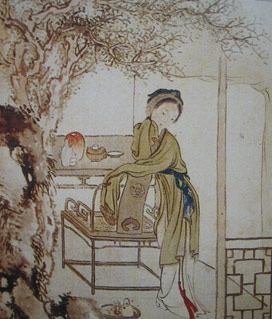
Why Cai Jia matters
Cai Jia is a Qing dynasty Chinese painter, calligrapher, and poet whose landscapes, made in the manner of earlier Ming masters, are held by major museums including the Metropolitan Museum of Art and the Minneapolis Institute of Art. He is not a market-driving name in the way a contemporary blue-chip artist would be, and much of the standard biographical detail expected of a modern artist page, precise life dates, exhibition history, and a verified auction record, is thin or unconfirmed in the available record. For collectors, he is a useful case study in how eighteenth-century Chinese painters are tracked today: through museum curatorial attribution rather than a catalogue raisonne, and through auction databases that split his identity across two different name orders.
- Nationality
- Chinese
- Media
- Painting, Calligraphy
- Movement
- Qing dynasty painting
- Education
- No documented school or degree. Minneapolis Institute of Art notes he trained first as a silversmith before becoming a professional painter, calligrapher, and poet.
- Signature motifs
- Landscapes after Ming masters, Cursive-script calligraphy
By the numbers
- 1686 to 1779Life datesQing dynasty, born in Jiangsu, China
- Jia CaiAlso cataloged asWestern name-order variant used by Invaluable and askART
- Metropolitan Museum of Art; Minneapolis Institute of ArtMuseum collections
Selected works
Click any work to view it full screen.
Biography
Cai Jia, 蔡嘉, was a Chinese painter, calligrapher, and poet active during the Qing dynasty, born in 1686 and died in 1779. Auction-house biographical notes describe him as a native of Jiangsu province. Per the Minneapolis Institute of Art's collection notes, he trained first as a silversmith before turning to painting, calligraphy, and poetry as a professional practice.
His surviving paintings are landscapes worked in the manner of earlier Ming masters. The Metropolitan Museum of Art holds a landscape "in the style of Shen Zhou" that the museum's catalog note describes as painted near the end of his life and as Cai Jia's homage to Shen Zhou (1427 to 1509), which is consistent with a death year in the late 1770s. Museum and market sources also credit him with paintings of flowers, insects, and fish, as well as cursive-script calligraphy. The Minneapolis Institute of Art notes that he is sometimes linked to the Yangzhou eccentrics, a loose circle of individualist Qing painters, though the surviving record does not establish this as a formal affiliation.
No source located in current research gives an exact birth date or death date beyond the years 1686 and 1779, and no place of death is documented. One database listing gives a different death year of 1756, but this figure is not corroborated by the Metropolitan Museum, MutualArt, or Artprice, all of which agree on 1779, and is treated here as an error rather than a live alternative. Those specifics should be treated as unconfirmed rather than assumed.
Critical reception
Cai Jia has not attracted the kind of signed, quotable criticism that accompanies contemporary artists. The descriptions of his work available in current research come from unsigned museum curatorial text rather than named critics writing in general-interest outlets. The Metropolitan Museum's catalog note frames his late landscape as a deliberate homage to Shen Zhou, situating him within the long tradition of Chinese painters reworking Ming-era models. The Minneapolis Institute of Art's framing, that he trained first as a silversmith and only later became a professional painter, calligrapher, and poet, is the closest thing to a critical narrative available and is repeated without much elaboration across the sources reviewed.
Market
Cai Jia's work circulates in the market for classical Chinese painting, listed under two name orders: "Cai Jia," family name first, the Chinese convention used by the Metropolitan Museum, MutualArt, and Artsy, and "Jia Cai," the reversed Western order used by Invaluable and askART. Artprice records 265 public auction appearances for the artist, concentrated in drawing and watercolor works. MutualArt separately reports that his works on paper have realized prices up to USD 3,089,189, the highest figure found in open sources, but does not disclose the corresponding lot title, auction house, or sale date, so this cannot be treated as a confirmed, fully documented record. No source reviewed provides a complete, verifiable all-time auction result, work, price, house, and date together, for this artist; any such figure should be treated as unconfirmed until checked against a paid database.
Museum collections
- Metropolitan Museum of Art, New York
- Minneapolis Institute of Art, Minneapolis
Authentication and provenance
No catalogue raisonne.
No catalogue raisonne has been identified for this painter. Attribution and verification rely on museum curatorial records and connoisseurship, as is typical for Qing dynasty literati painters. Auction and reference databases list the artist under two name orders, Cai Jia and Jia Cai, which collectors should treat as the same person.
Primary reference: https://www.metmuseum.org/art/collection/search/904721
What collectors should know
No catalogue raisonne has been identified for Cai Jia, which is typical for a painter of this period. Attribution rests on museum curatorial judgment and connoisseurship rather than a published research catalogue. Because the market lists him under two different name orders, researchers should search both "Cai Jia" and "Jia Cai" to see the full auction history. MutualArt cites a reported high of USD 3,089,189 for works on paper, but the underlying lot, auction house, and sale date are not disclosed in open sources, so this figure should be treated as an unverified ceiling rather than a confirmed record. Detailed lot-level data sit behind subscription services such as Artprice, askART, and Invaluable. Provenance research is especially important given the long span since the work was made and the informal nature of period attribution.
Further reading and resources
Data current as of 2026-07-09.

