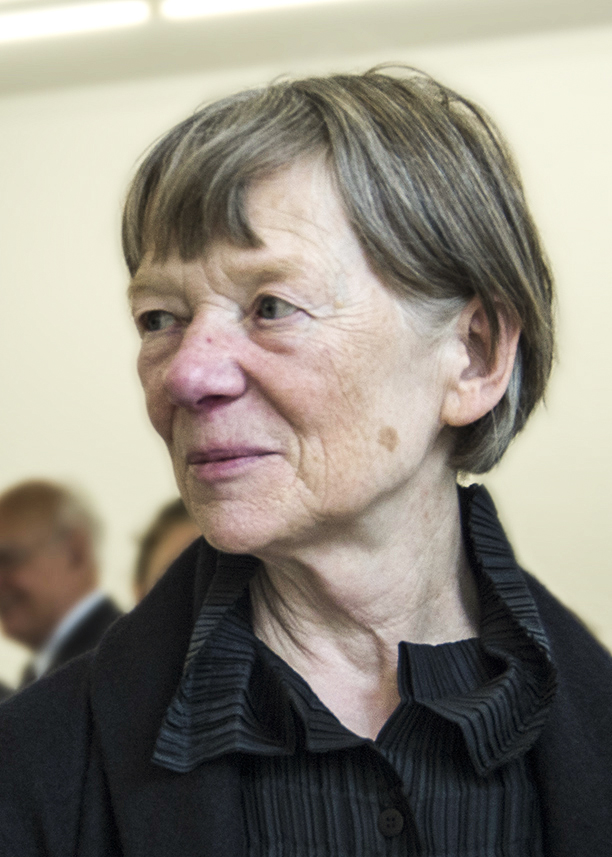
Why Candida Hofer matters
Candida Hofer is one of the most widely collected photographers to emerge from the Dusseldorf Academy under Bernd and Hilla Becher, and she has spent five decades building a singular body of work: large-scale color photographs of libraries, museums, opera houses, and other public interiors, almost always emptied of people. For a collector, she represents a case where museum validation and institutional prestige are unusually strong relative to a comparatively thin and quiet auction market.
- Born
- 1944-02-04, Eberswalde, Germany
- Nationality
- German
- Media
- Photography
- Movement
- Dusseldorf School of Photography
- Education
- Kolner Werkschulen, Cologne, 1964 to 1968 (photography under Arno Jansen); Kunstakademie Dusseldorf, 1973 to 1982 (film under Ole John, then photography under Bernd and Hilla Becher from 1976)
- Signature motifs
- Empty institutional interiors, Libraries and museums, Frontal symmetrical composition
- Representation
- Ben Brown Fine Arts, Sean Kelly Gallery, Spruth Magers, Galerie Barbara Thumm, Galerie Thomas Zander
By the numbers
- EUR 52,080Auction highBibliotheque Sainte-Genevieve Paris II, Lempertz, Cologne; exact sale date not published in available records
- Outstanding Contribution to Photography, 2018Sony World Photography Awards
- 2024Kathe Kollwitz PrizeAkademie der Kunste, Berlin
- German Pavilion, 2003Venice Biennale
Biography
Candida Hofer was born on 4 February 1944 in Eberswalde, Germany. She trained first in artistic photography at the Kolner Werkschulen in Cologne from 1964 to 1968, under Arno Jansen, after an earlier apprenticeship at the Schmolz-Huth photo studio in Cologne. She then studied at the Kunstakademie Dusseldorf from 1973 to 1982, beginning in the film class of Ole John before moving, from 1976, into the photography class of Bernd and Hilla Becher, the teachers whose students became known as the Dusseldorf School of Photography.
Hofer developed a method of photographing public and institutional interiors, libraries, museums, theaters, archives, zoos, and grand halls, using a large-format camera to record their architecture with precise, frontal, often symmetrical framing and an absence of human figures. The approach treats built space itself as a kind of social document, recording how institutions organize knowledge, culture, and public life.
Her profile expanded through major institutional recognition: inclusion in Documenta 11 in Kassel in 2002, and, the following year, representing Germany at the 50th Venice Biennale in 2003, where she designed the German Pavilion together with Martin Kippenberger. She taught as Professor of Photography at the Staatliche Hochschule fur Gestaltung in Karlsruhe from 1997 to 2000. Recent honors include the Sony World Photography Awards' Outstanding Contribution to Photography in 2018, a Lucie Award in 2022, and the Kathe Kollwitz Prize from the Akademie der Kunste in Berlin in 2024. She lives and works in Cologne, Germany.
Critical reception
Hofer is consistently discussed as a central figure of the Dusseldorf School of Photography, the generation of Becher students, alongside artists such as Andreas Gursky and Thomas Struth, who turned the Bechers' typological rigor toward new subjects. Critics and curators frame her recurring subject, the unpeopled public interior, as a study of how institutions shape collective memory and culture, from national libraries to opera houses to natural history museums. In 2018, the World Photography Organisation recognized her with the Sony World Photography Awards' Outstanding Contribution to Photography honor, citing the technical precision and sustained intensity of her practice. Her selection for the 2024 Kathe Kollwitz Prize, one of Germany's most established honors for a living artist, reflects a similar critical consensus around the sustained rigor of her project.
Market
Hofer's confirmed auction high is Bibliotheque Sainte-Genevieve Paris II, which sold for EUR 52,080, price including premium, at Lempertz in Cologne; the exact sale date is not published in available auction records. As with much photography of her generation, works typically circulate as gallery editions rather than unique objects, and public auction volume for her is modest relative to her museum standing, so any single result should be read in that context rather than as a smooth market trend line.
Top auction results
| Work | Price | Sale |
|---|---|---|
| Bibliotheque Sainte-Genevieve Paris II | EUR 52,080 | Lempertz, Cologne |
Selected exhibitions
| Years | Exhibition | Venues |
|---|---|---|
| 2024 | Kathe Kollwitz Prize 2024 exhibition | Akademie der Kunste, Berlin |
| 2024 | RENASCENE | Kukje Gallery, Seoul |
| 2023 | Epic Gaze | Macao Museum of Art, Macao |
| 2014 to 2015 | Memory (Russia works) | State Hermitage Museum, St. Petersburg |
| 2006 to 2007 | Candida Hofer, Le Louvre | Musee du Louvre, Paris |
| 2003 | German Pavilion | 50th Venice Biennale, Venice (with Martin Kippenberger) |
| 2002 | Documenta 11 | Kassel |
| 1999 | Solo exhibition | Kunsthalle Basel, Basel |
Museum collections
- Museum of Modern Art, New York
- Solomon R. Guggenheim Museum, New York
- Tate, London
- Centre Pompidou, Paris
- San Francisco Museum of Modern Art
- Museo Reina Sofia, Madrid
- mumok, Vienna
- J. Paul Getty Museum, Los Angeles
Awards and honors
- Kathe Kollwitz Prize, Akademie der Kunste, Berlin (2024)
- Lucie Award, Achievement in Architecture (2022)
- Sony World Photography Awards, Outstanding Contribution to Photography (2018)
- Federal Cross of Merit, 1st Class (2015)
- Woman Art Award of the State of North Rhine-Westphalia (2002)
- Order of Merit of the Federal Republic of Germany (2000)
Authentication and provenance
No catalogue raisonne.
No published catalogue raisonne has been identified for this artist. Works are generally sold as gallery-editioned photographic prints, and verification runs through her representing galleries (Sean Kelly Gallery, Ben Brown Fine Arts, Spruth Magers, Galerie Barbara Thumm, Galerie Thomas Zander) and the artist's own archive.
Primary reference: https://www.skny.com/artists/candida-hofer
What collectors should know
Hofer's work is best understood as photography sold in editions, so provenance should include edition number, print date, and size, since these variables affect value more than they would for a unique object. There is no confirmed catalogue raisonne, so authentication runs through her representing galleries and her own archive rather than a single reference publication. Her deep museum presence, MoMA, the Guggenheim, Tate, and the Centre Pompidou among them, is the strongest signal of long-term standing, while the relatively small and infrequent set of public auction results is a reason to treat any individual sale price with caution rather than as a fixed benchmark.
Further reading and resources
Data current as of 2026-07-18.

