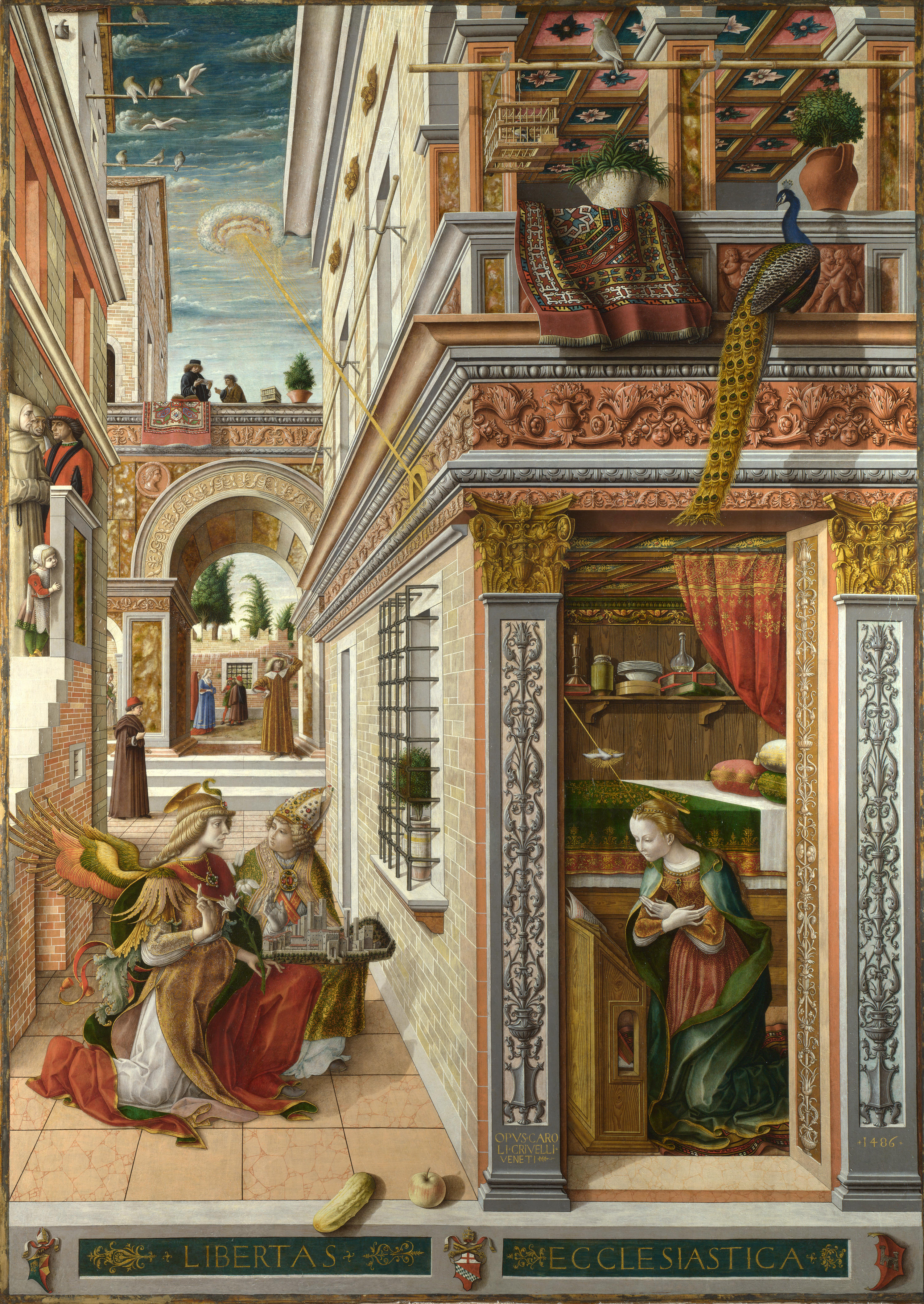
Why Carlo Crivelli matters
Carlo Crivelli is one of the most distinctive painters of the Italian Renaissance, known for intensely ornamented, gold-ground religious panels that combine Byzantine-influenced gilding with an almost obsessive interest in illusionistic detail: trompe-l'oeil fruit, insects, and painted cracks in plaster. He built his career largely outside the dominant art centers of Florence and Rome, working first in Venice and then for decades in the Marche region, which makes him a useful case study in how a major talent can flourish at a remove from the period's best-documented markets.
For collectors, Crivelli matters less as an active auction name than as a benchmark of Old Master connoisseurship. His paintings sit overwhelmingly in museum, church, and long-held private collections, so his relevance rests on institutional validation and scholarly attention rather than on frequent trading.
- Nationality
- Italian
- Media
- Panel painting, Tempera on panel
- Movement
- Italian Renaissance, Venetian School
- Education
- Probably trained in Padua in the circle of Francesco Squarcione; some sources also suggest early training in his father Jacopo's workshop in Venice. No formal degree is documented. First recorded as an independent master in Venice in 1457.
- Signature motifs
- Trompe-l'oeil fruit and insects, Ornate gold-ground panels, Illusionistic cracked-plaster effects
- Representation
- None. Historical Renaissance painter with no gallery or estate representation; works are held in museum, church, and occasional private collections.
By the numbers
- USD 220,000Auction highMadonna and Child, Sotheby's, New York, 1961; best documented result located to date
- 1457 to 1490sDocumented active periodVenice, Zadar, and the Marche region
- Knighted (Miles), 1490HonorBy King Ferdinand II of Naples
- No gallery or estateRepresented byHistorical painter; works held by museums and churches
Selected works
Click any work to view it full screen.
Biography
Carlo Crivelli was born in Venice around 1430 to 1435. He probably trained in Padua in the circle of Francesco Squarcione, a workshop that produced several major Renaissance painters, and some sources also suggest early training in his father Jacopo's workshop in Venice. He is first documented as an independent painter in Venice in 1457, in a court record that also notes a sentence handed down for adultery, a fact preserved because it survives in the same civic archive that establishes his professional activity.
By September 1465 he was documented in Zadar, on the Dalmatian coast, and his earliest signed and dated surviving work is a 1468 polyptych made for the church of San Lorenzo, Silvestro e Rufino in Massa Fermana. From this point Crivelli worked continuously in the Marche region of Italy, producing signed and dated altarpieces for local churches and building a distinctive, conservative style built on gold grounds, sharp linear detail, and elaborate illusionistic ornament. In 1490 he was knighted, given the title of Miles, by King Ferdinand II of Naples.
Crivelli died around 1494 to 1495, most likely in Ascoli Piceno in the Marche, where records place him settled with property in his later years. The exact calendar date of his death is not established in the surviving record; reference sources converge on the year but not the day.
Critical reception
Camp is the paintings of Carlo Crivelli, with their real jewels and trompe-l'oeil insects and cracks in the masonry.
Crivelli's reputation has moved in cycles. Contemporary museum sources note that his intricate, decorative style was "particularly appreciated" during a nineteenth century revival of interest in early Italian painting, which is when institutions such as the National Gallery in London built out their holdings. In the twentieth century, Susan Sontag cited his paintings, "with their real jewels and trompe-l'oeil insects and cracks in the masonry," in her 1964 essay Notes on Camp, using his work as a touchstone for ornate, theatrical excess in visual art.
Institutional attention has continued in the twenty-first century: the Vatican Museums mounted Crivelli's Gold in 2019 to 2020 around three recently restored paintings, the Walters Art Museum in Baltimore presented A Renaissance Original: Carlo Crivelli in 2021 to 2022, and Ikon Gallery in Birmingham staged Carlo Crivelli: Shadows on the Sky in 2022, described by some reviewers as the first UK exhibition devoted to the painter. Together these shows reflect a sustained, ongoing scholarly reassessment of an artist once considered a peripheral, old-fashioned figure next to Florentine and Roman contemporaries.
Market
Crivelli's market context is defined by scarcity rather than by trading volume. The best documented public sale identified in current research is a Madonna and Child that brought USD 220,000 at a Sotheby's sale in New York on 15 November 1961, reported by The New York Times in a survey of record prices from that season. Some contemporary market-tracking sites reference other, more recent Crivelli sale results without publishing full sale details, so those figures cannot currently be verified against a named work, date, and venue and are not treated here as a confirmed record.
The great majority of Crivelli's known output is held by museums and churches, with only occasional appearances in the private and secondary market, so any individual sale result should be read as a data point about a single, often unique panel rather than as a signal about a broader, liquid market.
Top auction results
| Work | Price | Sale |
|---|---|---|
| Madonna and Child (1961) | USD 220,000 (USD 220,000) | Sotheby's, New York, USA, 1961-11-15 |
Selected exhibitions
| Years | Exhibition | Venues |
|---|---|---|
| 2019 to 2020 | Crivelli's Gold | Vatican Museums, Rome |
| 2021 to 2022 | A Renaissance Original: Carlo Crivelli | The Walters Art Museum, Baltimore |
| 2022 | Carlo Crivelli: Shadows on the Sky | Ikon Gallery, Birmingham (reported as the first UK exhibition devoted to the artist) |
| 19th century | Renewed collector and museum interest | National Gallery, London, and other European institutions |
Museum collections
- National Gallery, London
- Victoria and Albert Museum, London
- National Gallery of Art, Washington, D.C.
- Isabella Stewart Gardner Museum, Boston
- Museum of Fine Arts, Boston
- Walters Art Museum, Baltimore
- Pinacoteca Vaticana, Vatican City
- Stadel Museum, Frankfurt
Awards and honors
- Knighted (Miles) by King Ferdinand II of Naples (1490)
Authentication and provenance
No catalogue raisonne.
No published catalogue raisonne has been confirmed for Crivelli. As a fifteenth century Old Master, attribution rests on art historical connoisseurship, provenance research, and museum curatorial review rather than a certificate program.
Primary reference: https://www.nationalgallery.org.uk/artists/carlo-crivelli
What collectors should know
There is no confirmed catalogue raisonne for Crivelli. As with other fifteenth century Old Masters, attribution and authentication rest on art historical connoisseurship, documentary and provenance research, and museum curatorial review rather than on a certificate program, so provenance history carries unusual weight for any work that surfaces.
Public sale data for Crivelli is thin and the exact dates of his birth and death remain approximate in the scholarly record, so collectors should treat any single price point, including the 1961 New York result cited above, as illustrative rather than as evidence of a consistent, active trading pattern.
Further reading and resources
Data current as of 2026-07-10.

