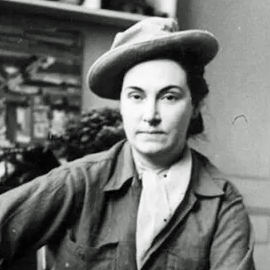
Why Carmen Herrera matters
Carmen Herrera spent nearly seven decades developing a hard-edge geometric style before the market caught up with her, and by the time it did, she had already anticipated the visual language that made Ellsworth Kelly, Kenneth Noland, and Frank Stella famous. For a collector, she is the clearest late-recognition case in postwar abstraction: a fully formed body of work, decades of critical neglect explained largely by gender and ethnicity, and a market that remains thin relative to the scale of her institutional validation.
- Born
- 1915-05-31, Havana, Cuba
- Nationality
- Cuban-American
- Media
- Painting
- Movement
- Minimalism, Hard-edge abstraction, Concrete art
- Education
- Universidad de La Habana, architecture, 1938 to 1939; Art Students League of New York, 1943 to 1947
- Signature motifs
- Hard-edge geometric abstraction, Two-color compositions, Straight-line minimalism
- Representation
- Lisson Gallery, estate
- In the Masterworks collection
- 6 works
By the numbers
- USD 2.9MAuction highBlanco y Verde, Sotheby's New York, 2019
- 2016 to 2018Whitney retrospectivetraveled to Wexner Center and Kunstsammlung Nordrhein-Westfalen
- Age 89First sale2004, after six decades of painting
- Lisson Gallery (estate)Represented by
Selected works
Click any work to view it full screen.
Biography
Carmen Herrera was born on May 31, 1915, in Havana, Cuba, and began formal art instruction at age eight under the painter Federico Edelmann y Pinto. At fourteen she studied in Paris at the Marymount School, spending hours in the city's museums, then returned to Havana in 1931 to study at the Lyceum Women's Club. She was drawn to wood carving early on, and her sculpture Cristo was included in Havana's Primera Exposicion de Pintura y Escultura al Aire Libre. In 1938 she enrolled at the Universidad de La Habana to study architecture, leaving after one year, by her own account, because of the gender discrimination she encountered in the field. The year nonetheless left a permanent mark: architecture's discipline of straight lines and structure would define her painting for the rest of her life.
Herrera moved to New York in 1939 to marry Jesse Loewenthal, an English teacher. She studied painting with Samuel Brecher at the Young Men's Hebrew Association, attended the Art Students League on scholarship from 1943 to 1947 under Jon Corbino, and studied printmaking at the Brooklyn Museum. She and her husband then spent five years in Paris, where she developed her mature geometric style and exhibited five times between 1949 and 1953 in the Salon des Realites Nouvelles at the Musee d'Art Moderne de la Ville de Paris. Returning to New York in 1954, she found gallery doors closed, later attributing the rejection to her gender and her background as a Cuban immigrant. She kept painting regardless, aligning herself with the Latin American Concrete art tradition, and moved into the Manhattan loft in 1967 where she would live and work for the rest of her life.
Herrera did not sell her first painting until 2004, at age 89. Recognition accelerated from there: a major survey, Carmen Herrera: Lines of Sight, opened at the Whitney Museum of American Art in 2016 and traveled through 2018 to the Wexner Center for the Arts in Columbus and the Kunstsammlung Nordrhein-Westfalen in Dusseldorf. She continued to paint into her final years and died on February 12, 2022, at age 106, in the same Manhattan loft where she had worked since 1967. Lisson Gallery, which had represented her since 2010, confirmed her death.
Critical reception
Critics and historians frame Herrera as a case study in delayed recognition rather than delayed achievement: her geometric abstraction predates comparable work by better-known male contemporaries including Ellsworth Kelly, Kenneth Noland, and Frank Stella, but she worked in near-total market obscurity until her eighties. The 2016 Whitney survey was widely read as a corrective, repositioning her within the history of postwar hard-edge painting and Latin American Concrete art rather than treating her as a late-blooming outlier. Writers have consistently connected her training as an architect to the discipline of her compositions, in which color relationships and the tension between two flat planes carry the entire work. Her inclusion in the central pavilion of the 2024 Venice Biennale, two years after her death, reinforced the critical consensus that her historical position had been settled: a foundational rather than peripheral figure in twentieth-century geometric abstraction.
Market
Herrera's auction high is Blanco y Verde (1966 to 1967), which sold for 2.9 million dollars at a Sotheby's benefit auction for Miss Porter's School in New York on March 1, 2019, then a record for the artist and roughly 300,000 dollars above her previous high of 2.6 million dollars, set at Phillips New York with an earlier work from the same series. Auction supply remains low relative to the size of her institutional footprint, a consequence of decades spent almost entirely outside the commercial market before her rediscovery in the 2000s.
Top auction results
| Work | Price | Sale |
|---|---|---|
| Blanco y Verde (1966 to 1967) (1966) | USD 2,900,000 (USD 2,900,000) | Sotheby's, New York, 2019-03-01 |
Selected exhibitions
| Years | Exhibition | Venues |
|---|---|---|
| 2024 | Central Pavilion | 60th Venice Biennale, Foreigners Everywhere |
| 2016 to 2018 | Carmen Herrera: Lines of Sight | Whitney Museum of American Art, New York; traveled to the Wexner Center for the Arts, Columbus; and Kunstsammlung Nordrhein-Westfalen, Dusseldorf |
| 2009 | Carmen Herrera: Five Decades of Painting | El Museo del Barrio, New York |
Museum collections
- Museum of Modern Art, New York
- Whitney Museum of American Art, New York
- Metropolitan Museum of Art, New York
- National Gallery of Art, Washington, D.C.
- Tate, London
- Walker Art Center, Minneapolis
- Museum of Fine Arts, Boston
- El Museo del Barrio, New York
- Smithsonian American Art Museum, Washington, D.C.
- Kunstsammlung Nordrhein-Westfalen, Dusseldorf
- Guggenheim Abu Dhabi
- The White House Collection, Washington, D.C.
Awards and honors
- First painting by a Latin American descent woman artist acquired for the White House Collection (2025)
- Elected Honorary Royal Academician, Royal Academy of Arts, London (2019)
Authentication and provenance
No catalogue raisonne.
No catalogue raisonne exists yet. A catalogue raisonne is in preparation, with an essay by art historian Briony Fer and edited by Monica Espinel. There is no certificate-of-authenticity program; the estate is represented by Lisson Gallery, which serves as the primary point of verification, with estate liaison Grace Leonhart. The 2016 Whitney Museum monograph Lines of Sight documents an extensive body of the artist's work and functions as the closest thing to a reference catalogue currently in print.
Primary reference: https://www.lissongallery.com/artists/carmen-herrera
What collectors should know
Herrera's market sits well below the scale of her museum presence, a gap that is itself the story: decades without gallery representation kept supply extremely limited, and the population of paintings that could ever reach auction is fixed and small since her death in 2022. No catalogue raisonne yet exists, though one is in preparation with an essay by Briony Fer, which should tighten authentication once published; in the interim, the estate at Lisson Gallery is the primary channel for verification. Collectors should also expect volatility from thin trading rather than treat any single auction result as a stable baseline, given how few of her paintings have ever come to market.
Further reading and resources
Data current as of 2026-07-06.

