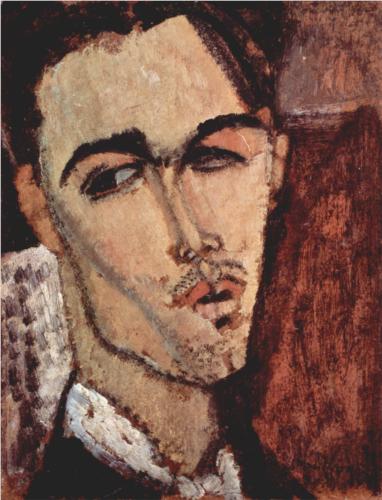
Why Celso Lagar matters
Celso Lagar is a documented but comparatively little-known member of the first generation of the School of Paris, the loose community of foreign-born artists working in Montparnasse alongside Picasso, Modigliani, Derain, and Soutine in the years around the First World War. His circus performers, harbor scenes, and still lifes have been collected steadily by major public institutions in Spain, France, and Switzerland, even though his commercial auction footprint remains thin. For a collector, Lagar is a case study in the gap that can open between real museum validation and a market that has never developed deep, liquid trading history.
- Born
- 1891-02-04, Ciudad Rodrigo, Salamanca, Spain
- Nationality
- Spanish
- Media
- Painting, Sculpture, Lithography
- Movement
- School of Paris
- Education
- Trained in his father's sculpture and woodcarving workshop, Ciudad Rodrigo, from c. 1903; studied sculpture in Madrid from 1907 (accounts vary between the atelier of Miguel Blay and Madrid's School of Arts and Crafts); attended the Escola de la Llotja, Barcelona, 1910 to 1911; moved to Paris in 1911 on a municipal or provincial scholarship to study sculpture. No academic degree is documented in any source.
- Signature motifs
- Circus and performer scenes, Mediterranean and Seine landscapes, Still lifes
- Representation
- "No exclusive gallery or estate representation confirmed; work is handled across multiple secondary-market dealers and auction houses"
By the numbers
- USD 187,380Auction highHommage a Guynemer, Christie's Paris, 2012 (single-source figure, per MutualArt)
- From 1911Active in ParisSchool of Paris circle, alongside Modigliani, Picasso, Derain, and Soutine
- 7+ public institutionsMuseum collectionsIncluding Centre Pompidou and Museo Reina Sofia
- No exclusive representation confirmedRepresented bySecondary market handled by multiple dealers and auction houses
Biography
Celso Lagar Arroyo was born on 4 February 1891 in Ciudad Rodrigo, in the Spanish province of Salamanca. He learned woodcarving and religious sculpture as a boy in the workshop of his father, a cabinetmaker. In 1907 he moved to Madrid to continue his training in sculpture, an episode that sources describe variously as study in the atelier of the sculptor Miguel Blay and attendance at Madrid's School of Arts and Crafts. From 1910 to 1911 he studied at the Escola de la Llotja in Barcelona.
In 1911, on a scholarship funded by the authorities of Ciudad Rodrigo or the province of Salamanca, Lagar moved to Paris to continue his study of sculpture. There he came into contact with Amedeo Modigliani and Jean Metzinger, and over the following years he gradually abandoned sculpture in favor of painting. He returned periodically to Spain and had an active exhibition career in Barcelona between 1915 and 1918, showing at the Galeries Dalmau and Galeries Laietanes and at the Sala Athenea in Girona. During this period he formed a partnership with the French sculptor Hortense Begue, whom he later married.
Back in Paris, Lagar became associated with the wider School of Paris circle; in 1921 he exhibited at the Cafe de Montparnasse alongside Picasso, Derain, Modigliani, and Soutine, handled by the dealers Guillaume and Zborowski. In 1928 the Galerie Zborowski gave him a solo exhibition, for which the poet and critic Max Jacob wrote the catalog essay. Later in his career Lagar suffered a decline in mental health; a 1962 article in Le Monde reported that he was by then confined to the Sainte-Anne psychiatric hospital in Paris. A retrospective at the Crane Kalman Gallery in London in 1959 and a larger exhibition at the Galerie de Paris in 1961 preceded his eventual return to Spain. He went back to Ciudad Rodrigo and then Seville, where he lived with his sister until his death on 6 September 1966.
Critical reception
Lagar's clearest documented critical endorsement dates to 1928, when the poet Max Jacob wrote the catalog text for his solo exhibition at the Galerie Zborowski in Paris. Beyond that essay, his reputation rests less on press criticism than on steady institutional collecting: museums in Spain (the Museo Nacional Centro de Arte Reina Sofia, the Museo Carmen Thyssen, and the Museu Nacional d'Art de Catalunya), France (the Centre Pompidou), and Switzerland (the Petit Palais, Geneva) hold his work. A 2021 to 2022 exhibition at the Museu d'Art de Girona, devoted to Lagar and Hortense Begue's Catalan years of 1915 to 1918, renewed scholarly attention to this early, prolific period of his career. No major state prizes or biennial honors are documented for him in any source reviewed.
Market
Lagar's best documented auction result is Hommage a Guynemer, reported by the commercial database MutualArt as having sold for USD 187,380 at Christie's Paris in 2012; the exact day of that sale is not confirmed in the sources available, and no second independent price database was found to corroborate the figure. Outside that result, realized prices for his circus scenes, still lifes, and landscapes have generally traded at far more modest levels, reflecting a market with limited and inconsistent auction supply rather than a deep, actively traded artist. There is no published catalogue raisonne. No source confirms that any single gallery or estate authority holds exclusive representation of his work today; dealers including Galerie Aurelie Biot-Worms in Paris and various auction houses and online marketplaces continue to handle his work.
Top auction results
| Work | Price | Sale |
|---|---|---|
| Hommage a Guynemer (2012) | USD 187,380 | Christie's, Paris |
Selected exhibitions
| Years | Exhibition | Venues |
|---|---|---|
| 1915 to 1918 | Exhibitions at Galeries Dalmau and Galeries Laietanes | Galeries Dalmau; Galeries Laietanes, Barcelona |
| 1915 to 1918 | Exhibition at Sala Athenea | Sala Athenea, Girona |
| 1916 | First Barcelona exhibition | Barcelona (venue not specified in sources) |
| 1921 | Group exhibition alongside Picasso, Derain, Modigliani, and Soutine | Cafe de Montparnasse, Paris |
| 1928 | Lagar, catalog essay by Max Jacob | Galerie Zborowski, Paris |
| 1959 | Retrospective | Crane Kalman Gallery, London |
| 1961 | Large exhibition | Galerie de Paris |
| 2021 to 2022 | Celso Lagar and Hortense Begue. The Catalan Years, 1915 to 1918 | Museu d'Art de Girona |
Museum collections
- Centre Pompidou, Paris
- Museu Nacional d'Art de Catalunya, Barcelona
- Museo Nacional Centro de Arte Reina Sofia, Madrid
- Museo Carmen Thyssen, Malaga
- Petit Palais, Geneva
- Museo de Art Nouveau y Art Deco Casa Lis, Salamanca
- Museu d'Art de Girona
Authentication and provenance
No catalogue raisonne.
No published catalogue raisonne has been confirmed for this artist. No exclusive gallery or estate authority currently manages authentication; verification in the trade relies on dealer and auction house expertise.
Primary reference: https://www.fundacionmapfre.org/en/art-and-culture/collections/celso-lagar/
What collectors should know
Lagar's public auction record is thin and only partially cross-verified, with the reported USD 187,380 high for Hommage a Guynemer resting on a single commercial database rather than a confirmed primary sale record. There is no catalogue raisonne, and no single gallery is confirmed to hold exclusive representation of his work, so provenance and attribution rely on individual dealer and auction house expertise rather than a centralized estate authority. His museum presence across Spain, France, and Switzerland is real and multi-sourced, which lends the work historical credibility even though pricing sits well below that of his better-known School of Paris peers. Collectors should treat both the exact birth date (4 February 1891, sourced from a single marketplace biography) and the precise date of the auction record as unresolved details pending further primary-source verification.
Further reading and resources
Data current as of 2026-07-13.

