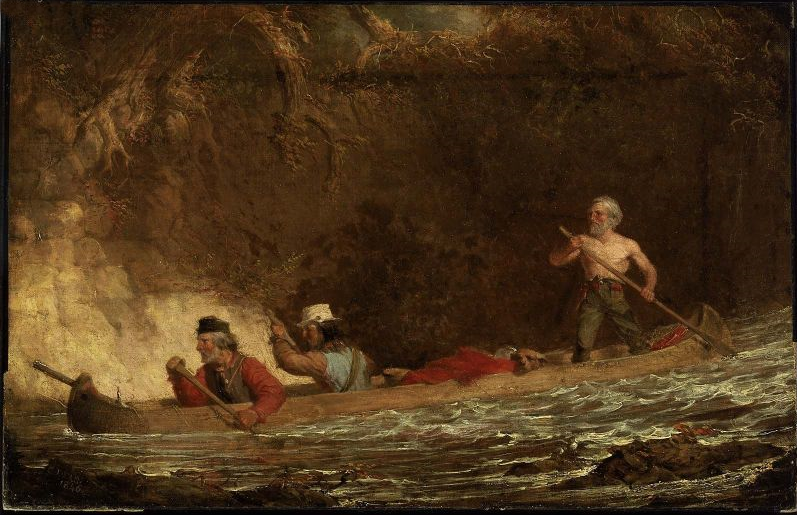
Why Charles Deas matters
Charles Deas was one of the few American painters of the 1840s to depict Native American life and the western frontier from firsthand observation rather than from the studio alone, traveling to forts along the upper Mississippi to paint the Sioux, Winnebago, and Sac and Fox peoples he encountered. His career lasted barely a decade before mental illness ended it, and his reputation faded for more than a century until a 2010 museum retrospective restored him to view. For collectors, he represents a narrow, largely museum-held corner of antebellum American painting rather than an active market.
- Born
- 1818-12-22, Philadelphia, USA
- Nationality
- American
- Media
- Painting
- Movement
- "19th-century American painting", "Western frontier and Native American genre painting"
- Education
- Tutored by John Sanderson in Philadelphia; studied at the National Academy of Design, New York, in the 1830s; elected associate member, 1839. No formal degree is recorded.
- Signature motifs
- Native American subjects, Frontier and fur-trapper scenes
By the numbers
- Thin, unverified top priceAuction marketPublic price databases list scattered results; no single confirmed record price could be established
- 1818 to 1867Active datesBorn Philadelphia, died Bloomingdale Asylum, New York
- 2010First retrospectiveDenver Art Museum, Charles Deas and 1840s America
- None documentedRepresentationNo current gallery or estate; market is auction and museum only
Selected works
Click any work to view it full screen.
Biography
Charles Deas was born December 22, 1818, in Philadelphia, Pennsylvania. As a young man he was tutored by John Sanderson in Philadelphia, then moved to New York City to study at the National Academy of Design, attending life-drawing classes through the 1830s and gaining election as an associate member of the Academy in 1839. He also attempted, unsuccessfully, to gain an appointment to the United States Military Academy at West Point.
Deas settled in St. Louis, Missouri, and used it as a base for repeated trips west to forts including Fort Crawford, Fort Winnebago, Fort Snelling, and Fort Atkinson, observing and sketching Native American life, fur traders, and trappers before completing finished oil paintings in his studio. He exhibited at the National Academy of Design in New York, at the Pennsylvania Academy of the Fine Arts in Philadelphia, at New York's American Art-Union, and, between 1841 and 1848, regularly at the Mechanics' Fairs in St. Louis. His 1844 painting Long Jakes, the Rocky Mountain Man and his 1845 The Death Struggle were among the works that established his reputation, and both were reproduced in the New York Illustrated Magazine of Literature in 1846.
In May 1848 Deas was committed to the Bloomingdale Asylum for the Insane in New York City following a documented mental breakdown, and he remained institutionalized for the rest of his life. He died there on March 23, 1867, at age 48; the recorded cause was "apoplexy," a historical term generally understood today to mean a stroke.
Critical reception
Deas's contemporaries did not always know what to make of his subject matter. An 1839 review of his barroom scene Walking the Chalk objected on moral grounds, arguing that scenes of human degradation were unfit for art unless they conveyed a clear moral lesson, a reflection of the period's expectation that genre painting instruct as much as depict. A later assessment, published in 1947, held that Deas had enjoyed a stronger reputation during his own lifetime than he did in the century that followed, as his work slipped out of general view after his institutionalization and death. That gap closed substantially in 2010, when the Denver Art Museum mounted Charles Deas and 1840s America, the first full retrospective of his work, bringing together roughly forty paintings and works on paper and prompting renewed scholarly attention, including subsequent academic writing on individual paintings such as The Wounded Pawnee.
Market
Deas's work rarely appears at auction, and the public record is too fragmentary to confirm a definitive all-time high with price, currency, house, and date together. Christie's has offered a major work, Indian Warrior on the Edge, but the realized price and exact sale date are not visible in the publicly accessible listing. Secondary price databases such as Invaluable and MutualArt show other Deas paintings, including Figure Group of Sioux and Landscape with Stream and Figures, 1847, selling with estimates in the low five figures to tens of thousands of dollars, but they do not expose a verified, ranked top result. Collectors should treat any specific headline auction figure circulating for this artist with caution absent direct confirmation from the auction house or a paid price database.
Top auction results
| Work | Price | Sale |
|---|---|---|
| Indian Warrior on the Edge | Christie's |
Selected exhibitions
| Years | Exhibition | Venues |
|---|---|---|
| 2010 | Charles Deas and 1840s America | Denver Art Museum, Denver (first retrospective, about 40 works) |
| 1846 | Long Jakes and The Death Struggle reproduced | New York Illustrated Magazine of Literature |
| 1845 | The Death Struggle exhibited | American Art-Union, New York |
| 1844 | Long Jakes, the Rocky Mountain Man exhibited | New York City |
| 1841 to 1848 | Regular exhibitor | Mechanics' Fairs, St. Louis |
| 1840s | Works sent for exhibition and sale | Pennsylvania Academy of the Fine Arts, Philadelphia |
| 1839 | Elected associate member | National Academy of Design, New York |
| 1838 | Annual exhibition | National Academy of Design, New York |
Museum collections
- Denver Art Museum, Denver
- American Museum of Western Art, The Anschutz Collection, Denver
- Gilcrease Museum, Tulsa
- Amon Carter Museum of American Art, Fort Worth
- Metropolitan Museum of Art, New York
Authentication and provenance
No catalogue raisonne.
No catalogue raisonne has been published and no estate or authentication board exists for this artist, who died in 1867. Attribution and dating rely on museum curatorial research and the provenance record built around the 2010 Denver Art Museum retrospective.
Primary reference: https://www.cartermuseum.org/artists/charles-deas
What collectors should know
There is no catalogue raisonne and no estate or gallery managing Deas's work; verification rests on museum curatorial research and the provenance trail reinforced by the 2010 Denver retrospective. His paintings are concentrated in institutional hands, with the Denver Art Museum, the American Museum of Western Art (The Anschutz Collection), the Gilcrease Museum, the Amon Carter Museum of American Art, and the Metropolitan Museum of Art among the confirmed holders, which limits the number of works likely to reach the market at all. Given how few sales exist to benchmark against and how incomplete the public auction record is, prospective buyers should treat any single reported result as illustrative rather than confirmed, and should expect extended diligence on attribution, condition, and price verification for any 19th-century frontier subject offered as his work.
Further reading and resources
Data current as of 2026-07-11.

