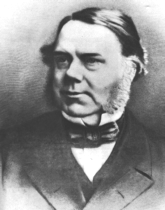
Why Charles Frodsham matters
Charles Frodsham matters to Masterworks Academy readers chiefly as a case study in getting the record right. The name surfaces in art-adjacent databases, but the documented, primary-source history identifies him as one of Victorian Britain's foremost chronometer and watch makers, not a painter or sculptor. His firm's chronometers, clocks, and watches are held by institutions including the Science Museum in London and the Worshipful Company of Clockmakers, and instruments carrying his name continue to trade at auction as important examples of English precision horology. His profile is a reminder that a name-only database entry can misclassify a subject's field entirely, and that verifying primary sources before publishing is essential.
- Born
- 1810-04-15, London, England
- Nationality
- British
- Media
- Chronometers, Watches, Clocks
- Education
- Educated at the Bluecoat School, Newgate, London. Apprenticed to his father, chronometer maker William James Frodsham, circa 1824, for seven years. No documented formal art education.
- Signature motifs
- Marine chronometer escapements, Double impulse chronometer
- Representation
- "Charles Frodsham & Co. Ltd (continuing firm, London)"
By the numbers
- CHF 406,400Auction highMinute Repeating Split-Seconds Chronograph with One-Minute Tourbillon, Phillips Geneva Watch Auction: XXIII, 9 May 2026 (highest confirmed price identified to date)
- First-class medal, 1851Great ExhibitionFor his exhibited timekeepers, Crystal Palace, London
- Chronometer Maker to the Admiralty; Clockmaker to Queen VictoriaRoyal appointments
- Charles Frodsham & Co. Ltd (continuing firm)Represented by
Selected works
Click any work to view it full screen.
Biography
Charles Frodsham (15 April 1810 to 11 January 1871) was an English chronometer maker, watchmaker, and horological author who built one of the most respected precision-timekeeping firms of the Victorian era. He was born in London into a horological family and educated at the Bluecoat School, Newgate, London. His father, William James Frodsham, was a chronometer maker and co-founder of the firm Parkinson and Frodsham. Charles was apprenticed to his father around 1824 for seven years, and by the early 1830s he was submitting chronometers to the Admiralty's premium trials, where he won a second prize. He worked initially from the family firm's address at Change Alley, London.
In 1843, after the death of watchmaker John Roger Arnold, Frodsham purchased Arnold's firm at 84 Strand, London, trading for a time as Arnold and Frodsham before the business took his own name, Charles Frodsham, from 1858. On the advice of Astronomer Royal George Airy, he later acquired the firm of the late clockmaker Benjamin Lewis Vulliamy, and went on to serve as Superintendent and Keeper of Her Majesty's Clocks at Buckingham Palace and as Clockmaker to Queen Victoria. He was twice elected Master of the Worshipful Company of Clockmakers, in 1855 and 1862, and was a founding member, later Vice President, of the British Horological Institute. He also authored The History of the Marine Chronometer, published in 1871.
Frodsham died on 11 January 1871 at his home at 26 Upper Bedford Place, Bloomsbury, London. He was buried in the family vault on the western side of Highgate Cemetery, next to his father. The firm he built, Charles Frodsham & Co., continued after his death and describes itself as the longest continuously trading chronometer manufacturer in the world.
Critical reception
Frodsham's reputation was built through institutional and professional recognition rather than gallery or museum criticism in the fine-art sense. He won the Telford Gold Medal from the Institution of Civil Engineers in 1847 for a paper on the isochronism of the balance spring, and a first-class medal for his timekeepers at the Great Exhibition of 1851 in London. His firm went on to receive fourteen further medals and honour diplomas at major international exhibitions through the rest of the 19th century, and Frodsham served as both exhibitor and juror, writing the horological section report, at the 1862 International Exhibition in London. His own obituary, reproduced by his firm's heritage archive, credited him with advancing the science of horology throughout his career and described his technical writings as authoritative within the trade. No named art or design critic's review of his work in a major outlet has been located. In 2026, the Science Museum's Clockmakers' Museum in London opened a dedicated display, Charles Frodsham, Precise Time: Two Centuries in the Making, marking continued institutional interest in his career two centuries on.
Market
Frodsham's market is a horological one. Collectors bid on chronometers, pocket watches, carriage clocks, and wristwatches carrying his name or his firm's, rather than on paintings or sculpture. The highest confirmed price identified to date is CHF 406,400, paid for a Minute Repeating Split-Seconds Chronograph with One-Minute Tourbillon at Phillips' Geneva Watch Auction: XXIII on 9 May 2026; that price has not been converted to a verified US dollar figure in the available record and is reported here in Swiss francs only. Two other Frodsham lots in the same Phillips sale realized CHF 177,800 and CHF 40,640, and a Charles Frodsham & Co. chronometer sold for USD 76,294 at Bonhams in June 2026, illustrating a wide range of results beneath the current high. Several older, high-estimate Frodsham lots at other houses have undisclosed final prices, so no definitive all-time auction record can be confirmed; CHF 406,400 is simply the highest figure identified in the available record as of this writing. Because both his 19th-century originals and the modern firm's contemporary production circulate under the same name, buyers should distinguish carefully between historical Frodsham pieces and pieces made by the present-day company.
Top auction results
| Work | Price | Sale |
|---|---|---|
| Minute Repeating Split-Seconds Chronograph with One-Minute Tourbillon | CHF 406,400 | Phillips, Geneva, 2026-05-09 |
Selected exhibitions
| Years | Exhibition | Venues |
|---|---|---|
| 1851 | Great Exhibition of the Works of Industry of All Nations | Crystal Palace, Hyde Park, London |
| 1862 | International Exhibition, London | South Kensington, London (exhibitor and juror, wrote the horological section report) |
| 19th century | Major international exhibitions (various) | Firm received fourteen further medals and honour diplomas across international exhibitions after 1851 |
| 2026 | Charles Frodsham, Precise Time: Two Centuries in the Making | Clockmakers' Museum, Science Museum, London |
Museum collections
- Science Museum, London (Clockmakers' Museum)
- Royal Observatory, Royal Museums Greenwich, London
- Worshipful Company of Clockmakers collection, Guildhall Library, City of London
- Lord Harris Collection, Belmont, Faversham, Kent
- British Museum, London
Awards and honors
- Telford Gold Medal, Institution of Civil Engineers (1847)
- First-class medal for timekeepers, Great Exhibition, London (1851)
- Master, Worshipful Company of Clockmakers (1855)
- Founding member, British Horological Institute (later Vice President) (1858)
- Master, Worshipful Company of Clockmakers (second term) (1862)
Authentication and provenance
No catalogue raisonne.
No catalogue raisonne exists. The continuing firm, Charles Frodsham & Co. Ltd, maintains its own archive and heritage records used to date historical pieces, and serial numbers and dial markings are the primary tools of attribution.
Primary reference: https://frodsham.com/heritage/
What collectors should know
Anyone researching "Charles Frodsham" as an artist should first note that the name belongs to a 19th-century chronometer maker, not a painter or sculptor, a distinction that matters for provenance research and comparables. There is no catalogue raisonne; attribution rests on the surviving firm archive, serial numbers, and dial markings. Public auction data for individual pieces is thin, so any single sale price, including the CHF 406,400 result, should be read as one data point in a small and specialized market rather than as a confirmed, permanent record. Because the historic maker and the present-day firm, Charles Frodsham & Co. Ltd, both use his name, collectors should confirm whether a given piece is a 19th-century original or later production before relying on comparable sales.
Further reading and resources
Data current as of 2026-07-11.

