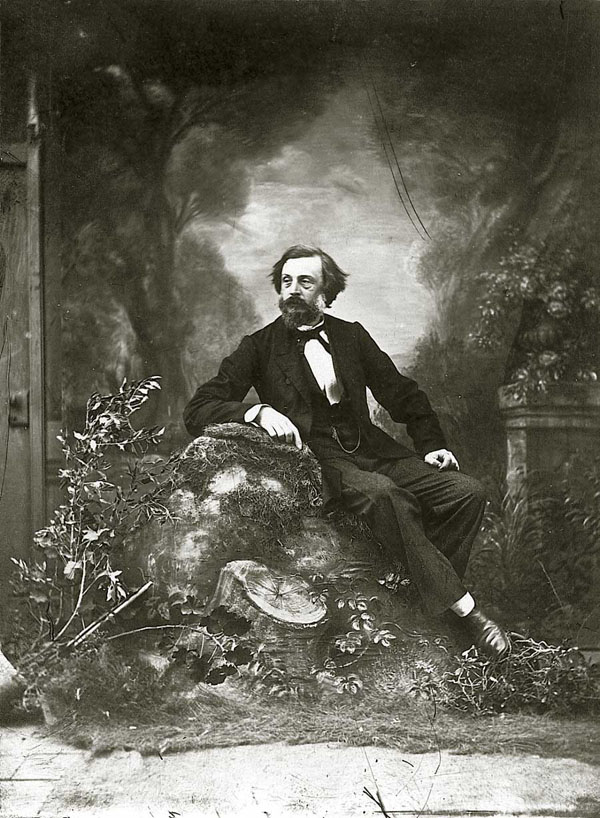
Why Charles Nègre matters
Charles Nègre stands among the small group of photographers who turned a new invention into an art form in the first decades of photography's existence. He is widely credited as one of the earliest street photographers, using faster lenses and shorter exposures to catch figures in motion on Paris streets rather than posing them for the long exposures typical of the 1840s. He also worked to refine the heliogravure process pioneered by Nicephore Niepce, and his photogravures won high honors at the 1855 Exposition Universelle in Paris; in 1856 he patented his own heliogravure process and entered it in the Duc de Luynes competition for the best method of photomechanical reproduction. Trained as a painter under Paul Delaroche, Michel-Martin Drolling, and Jean-Auguste-Dominique Ingres before turning largely to the camera, he represents the hinge point where academic French painting and the new medium of photography met. For collectors, he is a foundational figure of nineteenth-century French photography whose work is concentrated in major museum collections rather than in active commercial trade.
- Born
- 1820-05-09, Grasse, France
- Nationality
- French
- Media
- Photography, Painting
- Movement
- Early French photography, Academic painting
- Education
- Drawing studies, Aix-en-Provence, from 1837; Ecole des Beaux-Arts, Paris, from 1839 (admitted 1841), studios of Paul Delaroche, Michel-Martin Drolling, and Jean-Auguste-Dominique Ingres
- Signature motifs
- Parisian street scenes, Architectural photography of French cathedrals, Heliogravure printmaking
By the numbers
- USD 149,000Auction highLes Ramoneurs en marche, Sotheby's New York, 2014
- 1843 to 1864Active periodRegular exhibitor, Paris Salon
- 1855Exposition Universelle honorsHigh honors for heliogravures, Paris
- Musee d'Orsay; Met; National Gallery of ArtMajor holdings
Selected works
Click any work to view it full screen.
Biography
Charles Nègre was born on 9 May 1820 in Grasse, France. He began drawing lessons in Aix-en-Provence around 1837 before moving to Paris in 1839 to study painting, entering the Ecole des Beaux-Arts by 1841. He trained successively in the studios of Paul Delaroche, Michel-Martin Drolling, and Jean-Auguste-Dominique Ingres. He exhibited paintings at the Paris Salon from 1843 to 1864 and received a third-class medal there in 1850, though he was unsuccessful in the Prix de Rome competition of 1845.
Through his circle of painter friends, Nègre took up photography in the late 1840s, working first with daguerreotypes and then with paper negatives and calotypes. He became known for photographing everyday Parisian street life, chimney sweeps, organ grinders, and market scenes, as well as the architectural monuments of Notre-Dame and Chartres Cathedral. He also undertook a photographic survey of the Midi region of France and worked to refine heliogravure printing. His photogravures won high honors at the Exposition Universelle in Paris in 1855, and in 1856 he patented a heliogravure process that he entered in the Duc de Luynes competition for the best method of photomechanical reproduction.
As his health declined, Nègre gradually withdrew from active photographic and painting work and returned to the south of France, settling in Grasse by the late 1870s. He died there on 16 January 1880, at around 59 or 60 years of age. His reputation faded after his death until a series of retrospective exhibitions in Paris, New York, and Canada in 1936, and further recognition during France's Year of Cultural Heritage in 1980, restored him to his current standing as a pioneer of early photography.
Critical reception
Institutions rather than individual critics have shaped Nègre's reputation. The Metropolitan Museum of Art has described him as one of the era's most skilled photographers, known for his elegant views of France's architectural patrimony, and the Fitzwilliam Museum notes he was a regular exhibitor at the Paris Salon through the 1840s and 1850s. Museum scholarship, including that of the Musee d'Orsay and the Musee de la Photographie in Nice, consistently frames him as a technical innovator whose heliogravure work addressed a central problem of the period, printing photographic images with the permanence of an engraving, and as an early adopter of instantaneous exposure who helped make street photography possible. No verbatim quotation from a named critic in a major outlet could be confirmed from the available sources, so none is reproduced here.
Market
Charles Nègre's market is a specialist one built almost entirely around vintage photographic prints rather than paintings. His documented auction high is USD 149,000 for Les Ramoneurs en marche, sold at Sotheby's New York in 2014, a price cited as his record by MutualArt's auction database, which also notes his work has traded across a wide range, from under USD 100 to that six-figure high. Individual photographs and photogravures by Nègre have appeared periodically at Sotheby's and Phillips, generally in specialist photography sales, with recorded results in the tens of thousands of dollars for cathedral and street-scene studies. There is no gallery or estate currently representing his work; instead, it circulates through the secondary market and is heavily concentrated in institutional hands, which limits the volume of comparable sales available to price against.
Top auction results
| Work | Price | Sale |
|---|---|---|
| Les Ramoneurs en marche (2014) | USD 149,000 | Sotheby's, New York |
Selected exhibitions
| Years | Exhibition | Venues |
|---|---|---|
| 1843 to 1864 | Paris Salon | Paris Salon (painting) |
| 1855 | Exposition Universelle | Paris |
| 1936 | Rediscovery retrospectives | Paris; New York; Canada |
| 1980 | Year of Cultural Heritage exhibitions | France, various venues |
| date unconfirmed | Charles Nègre, photographe 1820 to 1880 | Musee Reattu, Arles, and Musee du Luxembourg, Paris |
| circa 2020 | Charles Nègre, un artiste proteiforme | Musee d'art et d'histoire de Provence, Grasse |
| 2020 to 2021 | True to Nature: Open-Air Painting in Europe 1780 to 1870 | Fitzwilliam Museum, Cambridge, and touring venues |
Museum collections
- Musee d'Orsay, Paris
- Bibliotheque nationale de France, Paris
- Musee d'art et d'histoire de Provence, Grasse
- Musee Ingres Bourdelle, Montauban
- Metropolitan Museum of Art, New York
- National Gallery of Art, Washington, D.C.
Awards and honors
- Third-class medal, Paris Salon (1850)
- High honors for heliogravures, Exposition Universelle, Paris (1855)
Authentication and provenance
No catalogue raisonne.
No published catalogue raisonne has been identified for Charles Nègre. His photographic and painted work is documented mainly through museum archives, notably the Musee d'Orsay and the Bibliotheque nationale de France, together with family-preserved papers cited by scholars. There is no gallery or estate authentication board; attributions rest on institutional provenance and archival records.
Primary reference: https://www.musee-orsay.fr/fr/ressources/repertoire-artistes-personnalites/charles-negre-19159
What collectors should know
Nègre's market is thin and specialized: most of his surviving photographs and paintings sit in major museum collections such as the Musee d'Orsay, the Bibliotheque nationale de France, the Musee d'art et d'histoire de Provence in Grasse, the Musee Ingres Bourdelle in Montauban, the Metropolitan Museum of Art, and the National Gallery of Art, leaving relatively few works to trade. There is no catalogue raisonne and no gallery or estate to authenticate new-to-market pieces, so provenance and prior institutional or auction history carry unusual weight when evaluating a work. Buyers should also be careful with naming: auction databases sometimes list him under the unaccented spelling "Charles Negre," and that spelling is also used by an unrelated contemporary photographer active today, so date and medium should always be checked to confirm which artist a listing refers to.
Further reading and resources
Data current as of 2026-07-16.

