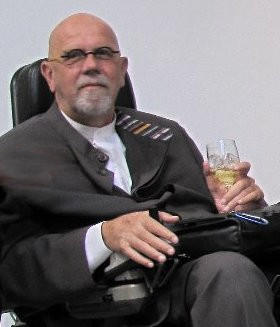
Why Chuck Close matters
Chuck Close was one of the artists most closely identified with American Photorealism, known for monumental portraits built up, square by square, from a gridded photographic source. His grid method became one of the most recognizable working processes in postwar American art, and he kept refining it after a 1988 medical event left him largely paralyzed. For a collector, he represents a career anchored in deep museum validation and a body of work whose market was largely established two decades ago, which puts a premium on studio and gallery-verified provenance rather than a frequently refreshed price history.
- Born
- 1940-07-05, Monroe, Washington, USA
- Nationality
- American
- Media
- Painting, Photography, Printmaking
- Movement
- Photorealism
- Education
- Everett Community College, attended 1958 to 1960, no degree; BA, University of Washington, Seattle, 1962; BFA, Yale University School of Art and Architecture, 1963; MFA, Yale University School of Art and Architecture, 1964; Fulbright fellowship study, Academy of Fine Arts Vienna, 1964 to 1965
- Signature motifs
- Grid-based portrait construction, Large-scale photorealist self-portraits
- Representation
- Pace Gallery
By the numbers
- USD 4.8MAuction highJohn (1971 to 1972), Sotheby's, 2005; reported price varies USD 4.3M to 4.8M across sources
- 2000National Medal of ArtsAwarded by President Bill Clinton
- MoMA, Whitney, Tate, Centre PompidouMuseum collectionsAmong institutions holding his work
- Pace GalleryRepresented byActive gallery for the artist's work; formal estate representation is not separately confirmed
Selected works
Click any work to view it full screen.
Biography
Chuck Close was born on July 5, 1940, in Monroe, Washington. Accounts of his schooling describe significant learning difficulties that he worked around through art, and he attended Everett Community College from about 1958 to 1960 before transferring to the University of Washington in Seattle, where he earned a BA in 1962. He went on to Yale University's School of Art and Architecture, earning a BFA in 1963 and an MFA in 1964, and is also reported to have studied afterward on a Fulbright fellowship at the Academy of Fine Arts in Vienna, circa 1964 to 1965.
Close had his first solo exhibition in 1967 at the University of Massachusetts Art Gallery. By the early 1970s he had developed the signature approach for which he became known: enormous portraits, often of himself, family, and fellow artists, built from a photographic source divided into a grid and reconstructed square by square, first in tightly controlled black and white and later in vivid color and varied media. In 1988, Close experienced a spinal artery collapse that left him largely paralyzed and confined mainly to a wheelchair. He adapted his process, working with a brush strapped to his hand and wrist, and continued to produce grid-based portraits, later moving into pixelated, mosaic-like compositions, tapestries, and prints, for more than three decades afterward.
His career brought sustained institutional recognition, including election as an Associate of the National Academy of Design in 1990 and a full Academician in 1992, the National Medal of Arts from President Bill Clinton in 2000, and more than twenty honorary degrees. Close died on August 19, 2021, at a hospital in Oceanside, New York, at the age of 81. His death has been attributed to congestive heart failure, with some reporting describing the cause as cardiopulmonary failure.
Critical reception
Close is widely treated as a central figure in the history of American Photorealism, credited with turning a mechanical, grid-based process into a vehicle for psychologically charged, large-scale portraiture. His standing was reinforced by early recognition, including inclusion in major museum programming, and by sustained institutional honors: election to the National Academy of Design, the National Medal of Arts in 2000, and a large traveling survey, Chuck Close: Self-Portraits 1967 to 2005, that toured the Walker Art Center, SFMOMA, the High Museum of Art, and the Albright-Knox Art Gallery. A recurring theme in commentary on his career is resilience: critics and curators consistently frame his continued, evolving output after the 1988 spinal artery collapse as central to how his work is read, not as a footnote to it. No verbatim critic quotations from named writers at major outlets could be confirmed for this profile.
Market
Close's auction record is John (1971 to 1972), sold at Sotheby's in 2005. Sources disagree on the exact figure: Wikipedia's auction table lists USD 4.3 million for a sale dated May 10, 2005, while Sotheby's own artist page and market trackers including Artnet and MutualArt cite USD 4.8 million without giving a specific date, and it is not confirmed whether these refer to the same transaction. No source through mid-2026 documents a higher price for any Close work, so this remains his standing auction high. His secondary market is comparatively thin relative to his institutional stature: most documented top results at major houses date from the mid-2000s, and his current gallery presence centers on Pace Gallery, which continued to mount and sell exhibitions of his work into 2026, though a formal estate representation arrangement is not independently confirmed in public sources.
Top auction results
| Work | Price | Sale |
|---|---|---|
| John (1971 to 1972) (2005) | USD 4,800,000 (USD 4,800,000) | Sotheby's, New York |
Selected exhibitions
| Years | Exhibition | Venues |
|---|---|---|
| 1967 | Debut solo exhibition | University of Massachusetts Art Gallery, Amherst |
| 2005 to 2006 | Chuck Close: Self-Portraits 1967 to 2005 | Walker Art Center, Minneapolis; SFMOMA; High Museum of Art, Atlanta; Albright-Knox Art Gallery, Buffalo |
| 2015 | Chuck Close: Red Yellow Blue | Pace Gallery, New York |
| 2017 to 2018 | Monochrome: Painting in Black and White | National Gallery, London |
| 2017 | Photorealism: 50 Years of Hyperrealistic Painting | Tampa Museum of Art |
| 2018 to 2019 | Eye to I: Self-Portraits from 1900 to Today | National Portrait Gallery, Washington, D.C. |
| 2019 to 2020 | Photo Revolution: Andy Warhol to Cindy Sherman | Worcester Art Museum, Massachusetts |
| 2026 | Chuck Close: On Paper | Pace Gallery, New York (540 West 25th Street) |
Museum collections
- Museum of Modern Art, New York
- Whitney Museum of American Art, New York
- Walker Art Center, Minneapolis
- Tate, London
- Centre Pompidou, Paris
- San Francisco Museum of Modern Art
Awards and honors
- National Medal of Arts (2000)
- University of Washington, Alumnus Summa Laude Dignatus (1997)
- National Academy of Design, elected Academician (Associate, 1990) (1992)
- Skowhegan Medal
- New York State Governor's Arts Award
Authentication and provenance
No catalogue raisonne.
No published catalogue raisonne has been confirmed for Close in the available research. Works are verified through gallery and estate records.
Primary reference: https://www.pacegallery.com/artists/chuck-close/
What collectors should know
Close's market rests on a strong institutional foundation but a relatively old and thin public auction record, with the standing high set in 2005 and few comparably documented results since. There is no confirmed catalogue raisonne, so provenance and studio or estate verification carry extra weight, and collectors should treat gallery representation of the estate as an evolving, not fully documented, arrangement centered on Pace Gallery. Given the gap between his art-historical stature and the limited recent public sales data, any single auction comparison should be read cautiously and checked against current gallery and museum activity.
Further reading and resources
Data current as of 2026-07-09.

