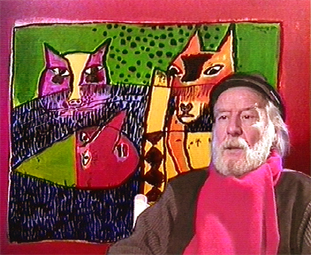
Why Corneille Guillaume Beverloo matters
Corneille, born Cornelis Guillaume van Beverloo and often catalogued under the fuller name Corneille Guillaume Beverloo, was a Dutch painter and printmaker who came of age with CoBrA, the loose group of Dutch, Belgian, and Danish artists who pushed European painting toward spontaneous, expressive figuration after the Second World War. His work sits in major museum collections, including the Museum of Modern Art and the Cobra Museum of Modern Art, and he was recognized early with a Guggenheim International Award. For collectors, he represents an entry point into the CoBrA movement at auction levels that remain modest relative to his historical standing, in a market handled by a small network of specialist dealers rather than a single estate gallery.
- Born
- 1922-07-03, Liege, Belgium
- Nationality
- Dutch
- Media
- Painting, Printmaking, Sculpture
- Movement
- CoBrA, Post-war European Expressionism
- Education
- Studied drawing at the Rijksakademie (Academy of Art), Amsterdam, 1940 to 1943; widely described in dealer and reference sources as a self-taught painter
- Signature motifs
- Vivid, expressive color, CoBrA-style figuration
- Representation
- "Kahan Art Gallery", "Simonis & Buunk (Netherlands)"
By the numbers
- USD 465,806Auction highL'Orchestre de Jazz Be Bop (Hommage a Charlie Parker), 1950; also reported as EUR 443,860 by Aucties for a 2022 sale of the same work; sale house and exact date not documented in public price databases
- 1956Guggenheim International AwardAwarded for the Netherlands, the year of his first solo show at the Stedelijk Museum
- CoBrAMovementCo-founder, with Karel Appel and Constant, among others
- Kahan Art Gallery; Simonis & BuunkRepresented byNo single exclusive estate gallery confirmed
Selected works
Click any work to view it full screen.
Biography
Corneille was born Cornelis Guillaume van Beverloo on 3 July 1922 in Liege, Belgium, to Dutch parents, and grew up using the pseudonym by which he became known internationally. He studied drawing at the Rijksakademie, the Academy of Art in Amsterdam, from around 1940 to 1943, but reference sources consistently describe him as a largely self-taught painter rather than a formally credentialed one.
His first solo exhibition was held in 1946 at Het Beerenhuis in Groningen. By the late 1940s he was part of the circle, alongside artists such as Karel Appel and Constant, that became known as CoBrA, and his work appeared in the 1949 group exhibition International Experimental Art at the Stedelijk Museum in Amsterdam. In 1956 he received the Guggenheim International Award for the Netherlands, the same year he held his first solo exhibition at the Stedelijk. His international profile grew through the following decade, with his first New York solo show at the Lefebre Gallery in 1962 and a retrospective at the Musee d'Antibes in France in 1963. He was later named Ridder in de Orde van Oranje-Nassau in 1969 and Commandeur in de Orde van de Nederlandse Leeuw in 1997.
Corneille continued to exhibit widely across Europe, the Americas, and elsewhere through the 1970s and beyond, and later relocated to France. He died on 5 September 2010 at age 88. Most auction-house and reference sources, including Wikipedia, Wikidata, and Simonis & Buunk, place his death in Auvers-sur-Oise, France, where Simonis & Buunk notes he is buried; French and Spanish Wikipedia instead give the nearby town of L'Isle-Adam, and one gallery biography describes a hospital near Paris. All sources agree on the date and his age at death.
Critical reception
Corneille is treated in museum and dealer literature as a central figure of CoBrA, valued for a body of work described in Artnet's biographical entry as imaginative and poetic, marked by an eccentric and vivid use of color. No verbatim assessment from a named critic, or from the artist himself, could be confirmed in the available research, so this profile relies on institutional biographical framing rather than attributing critical opinion or direct quotation to a specific source.
Market
Corneille's documented auction record is L'Orchestre de Jazz Be Bop (Hommage a Charlie Parker), a 1950 painting that Artnet lists as having sold for USD 465,806, the highest price recorded for his work in the major price databases consulted. A separate market-data source, Aucties, reports the same work selling for EUR 443,860 in 2022, consistent with the Artnet figure, though it likewise does not identify the auction house or exact date. The auction house, sale location, and exact sale date for that result remain unconfirmed. Below that top result, typical prices for his paintings, watercolors, drawings, and prints at auction run considerably lower, generally in the low thousands of dollars, reflecting a market that is active in volume but modest in scale compared with his CoBrA-era peers.
Top auction results
| Work | Price | Sale |
|---|---|---|
| L'Orchestre de Jazz Be Bop (Hommage a Charlie Parker) | USD 465,806 |
Selected exhibitions
| Years | Exhibition | Venues |
|---|---|---|
| 1946 | First solo exhibition | Het Beerenhuis, Groningen |
| 1949 | International Experimental Art | Stedelijk Museum, Amsterdam |
| 1956 | First solo exhibition at the Stedelijk | Stedelijk Museum, Amsterdam |
| 1957 | Salon des Realites Nouvelles | Paris |
| 1962 | First solo exhibition in New York | Lefebre Gallery, New York |
| 1963 | Retrospective | Musee d'Antibes, France |
| 1998 to 1999 | Face of the Moon, Face of the Earth | Museum of Modern Art, New York |
| 2007 | Solo exhibition | Cobra Museum of Modern Art, Amstelveen |
Museum collections
- Museum of Modern Art, New York
- Cobra Museum of Modern Art, Amstelveen
- Art Institute of Chicago
- Fine Arts Museums of San Francisco
Awards and honors
- Guggenheim International Award (Netherlands) (1956)
- Ridder in de Orde van Oranje-Nassau (1969)
- Commandeur in de Orde van de Nederlandse Leeuw (1997)
Authentication and provenance
No catalogue raisonne.
No catalogue raisonne has been confirmed. The estate does not appear to have a single exclusive representative; multiple specialist dealers, including Kahan Art Gallery and Simonis & Buunk, offer paintings, works on paper, and sculpture. Collectors should rely on documented provenance and established dealers rather than any certification program.
Primary reference: https://en.wikipedia.org/wiki/Corneille_Guillaume_Beverloo
What collectors should know
There is no confirmed catalogue raisonne for Corneille, and his estate does not appear to be handled by one exclusive gallery; instead, works move through a small set of specialist dealers, including Kahan Art Gallery and Simonis & Buunk in the Netherlands, alongside routine turnover at general auction houses. That fragmentation, combined with a headline auction result whose venue and date are not publicly documented, means collectors should lean on provenance and established dealer relationships when evaluating a work rather than assuming a uniform authentication process. Prices for his paintings and works on paper vary widely by medium, period, and subject, so any single result, including the record price, should be read as one data point rather than a stable benchmark.
Further reading and resources
Data current as of 2026-07-13.

