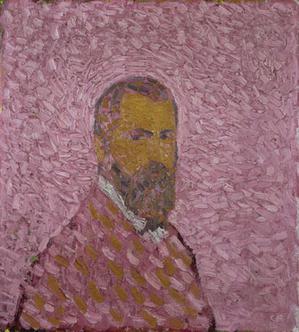
Why Cuno Amiet matters
Cuno Amiet is one of the two artists, alongside Ferdinand Hodler, most often credited with founding modern Swiss painting, and he was the only Swiss painter admitted into Die Brucke, the German Expressionist circle. For a collector, he represents a specific kind of art-historical importance: deep in major museum collections, structurally connected to the birth of Expressionism, but comparatively thin and quiet as an auction-market presence, which makes museum and archival context more important than price history when assessing any single work.
- Born
- 1868-03-28, Solothurn, Switzerland
- Nationality
- Swiss
- Media
- Painting, Printmaking, Sculpture
- Movement
- Swiss Post-Impressionism, Expressionism, Die Brucke
- Education
- Academy of Fine Arts, Munich, 1886 to 1888; Academie Julian, Paris, 1888 to 1892; honorary doctorate, University of Bern, 1919
- Signature motifs
- Color-forward Alpine landscapes, Self-portraits, Harvest and garden scenes
By the numbers
- CHF 4,058,000 (about USD 3.4M)Auction highDer Auszug der hl. Ursula, Christie's Zurich, May 12, 2008
- 4,000+ paintingsDocumented oeuvreincluding more than 1,000 self-portraits, per Wikipedia
- 1934Venice Biennale
- 5+ major institutionsMuseum collectionsNational Gallery of Art, Musee d'Orsay, MoMA, Tate, Kunstmuseum Basel
Biography
Cuno Amiet was born in 1868 in Solothurn, Switzerland. After finishing his secondary schooling there, he studied briefly with the painter Frank Buchser before enrolling at the Academy of Fine Arts in Munich from 1886 to 1888, where he formed a lasting friendship with fellow artist Giovanni Giacometti. The two continued their training together in Paris at the Academie Julian from 1888 to 1892, and in 1892 Amiet joined the circle of artists working around Pont-Aven in France, absorbing the flat color and decorative line associated with Gauguin and his followers.
Back in Switzerland, Amiet settled in Oschwand and developed a distinctive colorist style that broke with the tonal naturalism common among his Swiss contemporaries. He won a silver medal at the 1900 Exposition Universelle in Paris for his painting Richesse du soir, his first major international recognition. In 1904 he exhibited at the Vienna Secession alongside Ferdinand Hodler, Edvard Munch, Akseli Gallen-Kallela, and Jan Thorn-Prikker, a moment art historians treat as the start of his own expressionist period. Around 1906 he became the only Swiss member of Die Brucke, the Dresden-based group that included Ernst Ludwig Kirchner, Erich Heckel, and Karl Schmidt-Rottluff.
Amiet mounted major solo exhibitions in Zurich in 1914 and in Bern in 1918, and in 1919 the University of Bern awarded him an honorary doctorate for his contribution to Swiss art. He went on to serve in a series of official cultural roles, including membership on Switzerland's Federal Fine Arts Commission (1911 to 1915 and 1931 to 1932), the Moderner Bund artists' association from 1912, and later commissions tied to the Gottfried Keller Foundation and the Bern Art Museum. He represented this standing internationally at the 1934 Venice Biennale. Amiet worked prolifically into old age, producing more than 4,000 paintings over his career, including over 1,000 self-portraits. He died on July 6, 1961, in Oschwand, Seeberg, Canton of Bern, Switzerland, at the age of 93.
Critical reception
Standard art-historical reference sources place Amiet, together with Hodler, at the center of the emergence of Swiss modernism, crediting him as the first Swiss painter to make color, rather than tone or line, the primary structural element of a composition. His trajectory from the Munich academy and the Pont-Aven circle to the Vienna Secession and Die Brucke is generally read as tracing the transmission of French Post-Impressionist and German Expressionist ideas into Swiss painting. Later writers have noted that, despite this pivotal role, Amiet has not been absorbed into the international canon at the same level as some of his German Expressionist peers, a gap more often attributed to the relative isolation of Swiss modern art from the larger market narratives around Die Brucke than to any dispute about his historical importance.
Market
Amiet's all-time auction high is Der Auszug der hl. Ursula (The Departure of St Ursula), which sold for CHF 3,350,000 hammer, CHF 4,058,000 including premium (about USD 3.4 million), at Christie's Zurich on May 12, 2008. That result remains, as of this writing, the highest price documented for his work at auction. His more recent secondary market activity has run considerably lower and has been concentrated at Swiss auction houses: a 1925 portrait, Portrait of a Young Woman, sold for roughly CHF 24,000 (about USD 29,600) at Koller Auktionen in Zurich in June 2026, a figure typical of the range in which most of his works now trade. No gallery or estate representation for Amiet could be confirmed as of mid-2026; his market today functions primarily through auction houses and dealers handling historical Swiss and German Expressionist material rather than through a single representing gallery.
Top auction results
| Work | Price | Sale |
|---|---|---|
| Der Auszug der hl. Ursula (The Departure of St Ursula) | USD 3,424,315 (CHF 4,058,000 including premium; CHF 3,350,000 hammer) | Christie's, Zurich, 2008-05-12 |
Selected exhibitions
| Years | Exhibition | Venues |
|---|---|---|
| 1900 | Exposition Universelle | Paris (silver medal awarded for Richesse du soir) |
| 1904 | Vienna Secession exhibition | Vienna (with Ferdinand Hodler, Edvard Munch, Akseli Gallen-Kallela, Jan Thorn-Prikker) |
| 1906 | Die Brucke | Dresden (only Swiss member of the group) |
| 1914 | Solo exhibition | Zurich |
| 1918 | Solo exhibition | Bern |
| 1934 | Venice Biennale | Venice |
| 2018 | Cuno Amiet | bromer kunst, Roggwil, Switzerland (150th birthday retrospective) |
| 2026 to 2027 | Cuno Amiet, The Four Seasons | Musee d'art de Pully, Switzerland |
Museum collections
- National Gallery of Art, Washington, D.C.
- Musee d'Orsay, Paris
- Museum of Modern Art, New York
- Tate, London
- Kunstmuseum Basel
Awards and honors
- Silver medal, Exposition Universelle, Paris (1900)
- Honorary doctorate, University of Bern (1919)
- Member, Moderner Bund (1912)
- Member, Federal Fine Arts Commission of Switzerland (1911 to 1915, 1931 to 1932) (1911)
Authentication and provenance
No catalogue raisonne.
No published catalogue raisonne has been confirmed for Cuno Amiet. The Fondation Cuno Amiet in Oschwand holds biographical and archival material on the artist, but no certificate-of-authenticity program or catalogue raisonne could be verified. Works are generally assessed through exhibition history, auction provenance, and institutional records.
Primary reference: https://www.fondation-cunoamiet.ch/english-1/cuno-amiet/biography/
What collectors should know
No catalogue raisonne for Amiet has been confirmed, so provenance, exhibition history, and the Fondation Cuno Amiet's archival records carry more weight than they would for an artist with an established scholarly catalogue. His market is thin: aside from the 2008 Christie's Zurich result for Der Auszug der hl. Ursula, most documented sales fall well below six figures and cluster at Swiss houses such as Koller and Germann. There is currently no confirmed gallery or estate representation to anchor primary-market pricing, so collectors should treat any single auction result as a data point within a shallow record rather than as a stable benchmark, and should pay particular attention to which body of work a piece belongs to, since his self-portraits, Alpine landscapes, and harvest scenes have not historically traded in the same range.
Further reading and resources
Data current as of 2026-07-10.

