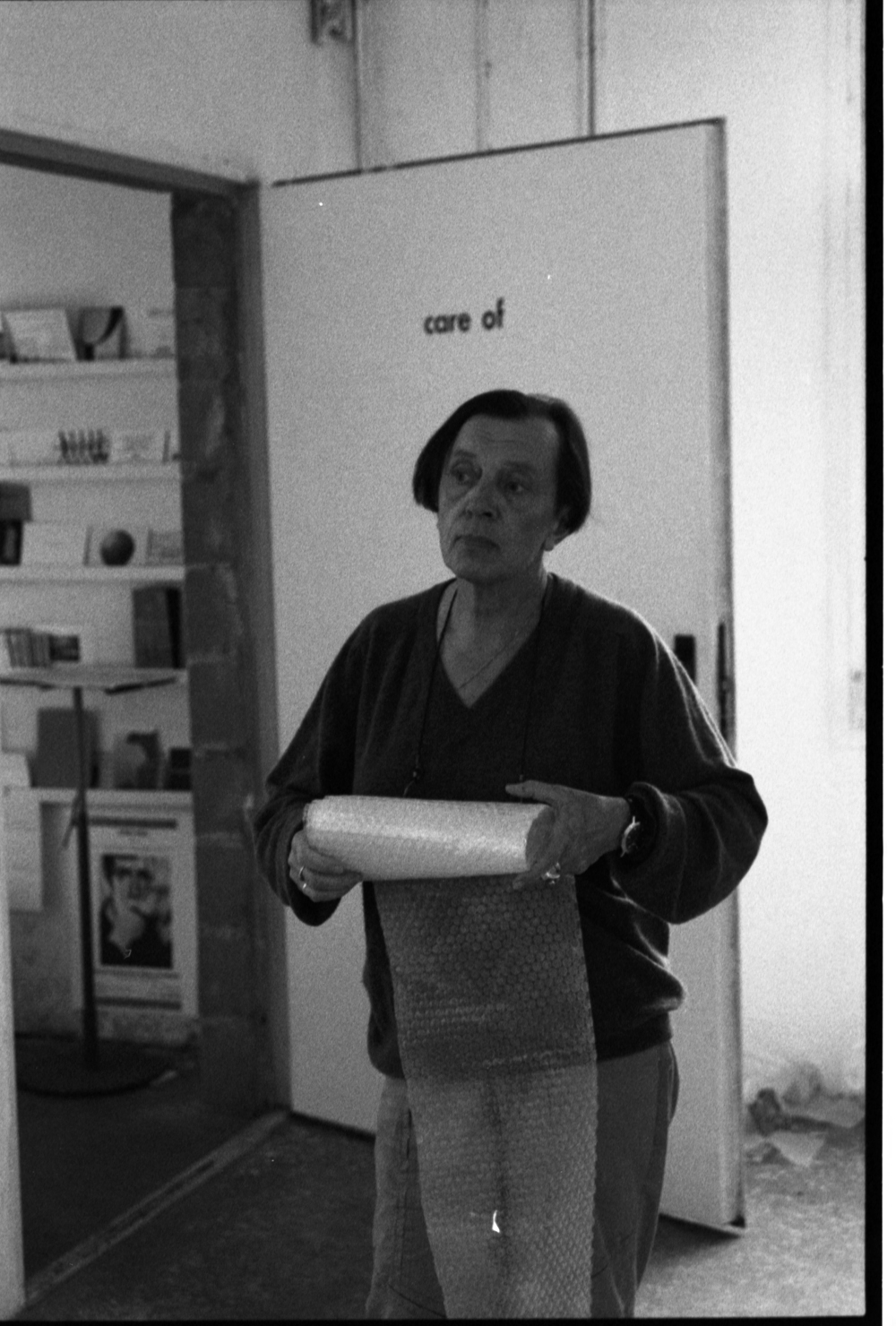
Why Dadamaino matters
Dadamaino was one of the few women at the center of the Milanese avant-garde of the 1960s, exhibiting alongside Piero Manzoni, Enrico Castellani, and Agostino Bonalumi at the Azimuth gallery and later placed within the international Zero network. Her Volumi series, monochrome surfaces cut and perforated to turn flat canvas into shifting relief, and her later Oggetti Ottico-Dinamici, kinetic optical objects, made her a key figure in postwar Italy's move away from traditional painting toward surface, light, and structure. For a collector, she represents a case where institutional standing, two Venice Biennale appearances and steady museum retrospectives, runs well ahead of a thin and still-developing auction market.
- Born
- 1930-10-02, Milan, Italy
- Nationality
- Italian
- Media
- Painting, Cut-canvas relief, Kinetic and optical objects
- Movement
- Milanese avant-garde, Zero movement
- Education
- Undertook university studies in medicine in Milan in the 1950s; sources disagree on whether she completed the degree. Earlier attended a classical lyceum and the School of Applied Art for Industry at Castello Sforzesco, Milan, though exact years are undocumented. Her artistic training is described as self-taught, formed through contact with the Milanese avant-garde.
- Signature motifs
- "Volumi (cut and perforated monochrome surfaces)", "Oggetti Ottico-Dinamici (optical-kinetic objects)"
- Representation
- "Archivio Dadamaino (estate archive and authentication body)", "Tornabuoni Art", "The Mayor Gallery"
By the numbers
- GBP 173,000Auction highVolume (1960), Phillips London, 8 March 2018
- 1980 (solo room), 1990Venice Biennale
- Azimuth, Milan, 1960Avant-garde circleExhibited alongside Piero Manzoni, Enrico Castellani, and Agostino Bonalumi
- Archivio DadamainoAuthenticationNo published catalogue raisonne; archive issues certificates of authenticity
Biography
Dadamaino was born Eduarda Emilia Maino in Milan on 2 October 1930. She attended a classical lyceum and, afterward, the School of Applied Art for Industry at Castello Sforzesco in Milan, though the exact years of that schooling are not documented. She then undertook university studies in medicine in Milan; sources disagree on whether she completed the degree, and no source names the university or gives precise dates. By the late 1950s she had turned to painting, largely self-taught, developing her practice through direct contact with Milan's avant-garde circle rather than through formal art training. Her artist name, Dadamaino, is said to have originated from a cataloguing error in a 1961 Dutch exhibition catalogue that turned into a nickname she kept.
In 1960 she exhibited at the Azimuth gallery in Milan alongside Manzoni, Castellani, and Bonalumi, showing early works from her Volumi series, monochrome sheets cut and perforated to create depth and shadow without color or brushwork. Through the 1960s she extended this research into kinetic and optical works, including the Oggetti Ottico-Dinamici. She had a solo room at the Venice Biennale in 1980 for I fatti della vita and returned to the Biennale in 1990. A large retrospective was organized at the Padiglione d'Arte Contemporanea in Milan in 1983, and Museum Bochum mounted a full retrospective of her work in 2000. She continued to work and exhibit until her death in Milan on 13 April 2004, following a period of illness, as recorded by her archive and multiple institutional sources.
Critical reception
Dadamaino is recognized as one of the few women placed at the center of the Milanese avant-garde, first through her 1960 inclusion at the Azimuth gallery alongside Manzoni, Castellani, and Bonalumi, and later through her presence in the Solomon R. Guggenheim Museum's 2014 exhibition Zero: Countdown to Tomorrow, 1950s to 60s, which reaffirmed her place within the broader international Zero network. Piero Manzoni wrote about her work in a 1961 exhibition text associated with a show in Padua. More recent scholarship, including the AWARE (Archives of Women Artists) project, has worked to raise her profile relative to the male peers with whom she is most often exhibited, and museum retrospectives at PAC Milan (1983), Museum Bochum (2000), Le Consortium in Dijon (2013), and MA*GA in Gallarate (2023 to 2024) have steadily reinforced her institutional standing.
Market
Dadamaino's auction market is small relative to her institutional standing. The best documented result is Volume (1960), which sold for GBP 173,000 at Phillips, London, on 8 March 2018. Earlier sales from the Volumi series reportedly reached GBP 105,000 in 2013 and GBP 122,500 in 2014, each described as a record at the time, and a Dorotheum lot realized EUR 59,325 on 23 November 2016. Works entering the market at Sotheby's, Christie's, and Phillips are typically registered with the Archivio Dadamaino, which functions as the primary authentication body in the absence of a published catalogue raisonne.
Top auction results
| Work | Price | Sale |
|---|---|---|
| Volume (1960) (1960) | GBP 173,000 | Phillips, London, 2018-03-08 |
Selected exhibitions
| Years | Exhibition | Venues |
|---|---|---|
| 1960 | Azimuth | Galleria Azimuth, Milan (with Piero Manzoni, Enrico Castellani, Agostino Bonalumi) |
| 1980 | I fatti della vita | Venice Biennale (solo room), Venice |
| 1983 | Retrospective | Padiglione d'Arte Contemporanea (PAC), Milan |
| 1990 | Venice Biennale | Venice Biennale, Venice |
| 2000 | Retrospective | Museum Bochum, Bochum |
| 2013 | Retrospective | Le Consortium, Dijon |
| 2014 | Zero: Countdown to Tomorrow, 1950s to 60s | Solomon R. Guggenheim Museum, New York |
| 2023 to 2024 | Retrospective | MA*GA, Museo Arte Gallarate, Gallarate (with Archivio Dadamaino) |
Museum collections
- Tate, London
- Peggy Guggenheim Collection, Venice
- Centre Pompidou, Paris
- Philadelphia Museum of Art, Philadelphia
- MA*GA, Museo Arte Gallarate, Gallarate
- MAMbo, Museo d'Arte Moderna di Bologna, Bologna
- GAM, Galleria d'Arte Moderna, Turin
Authentication and provenance
No catalogue raisonne.
No published catalogue raisonne has been identified for Dadamaino. Works are registered and authenticated through the Archivio Dadamaino (Archivio Generale Opera Dadamaino), which issues certificates of authenticity cited in recent lot listings at Sotheby's, Christie's, and Phillips.
Primary reference: https://www.tate.org.uk/art/artists/dadamaino-14983
What collectors should know
There is no published catalogue raisonne for Dadamaino; verification runs through the Archivio Dadamaino, which registers works and issues certificates of authenticity that major auction houses cite directly in their listings. Her auction record is thin: the confirmed high of GBP 173,000 for Volume (1960) at Phillips, London, in 2018 is one of relatively few six-figure results, so any single data point should be treated with caution rather than as a stable benchmark. Collectors should also be aware that some secondary market databases list her birth year as 1935 rather than 1930; the 1930 date is confirmed by Tate, the Peggy Guggenheim Collection, and other primary institutional sources and should be treated as authoritative. Given the disputed completion of her medical studies and the general scarcity of dated biographical detail before 1958, provenance and archive registration carry unusually heavy weight for this artist.
Further reading and resources
Data current as of 2026-07-13.

