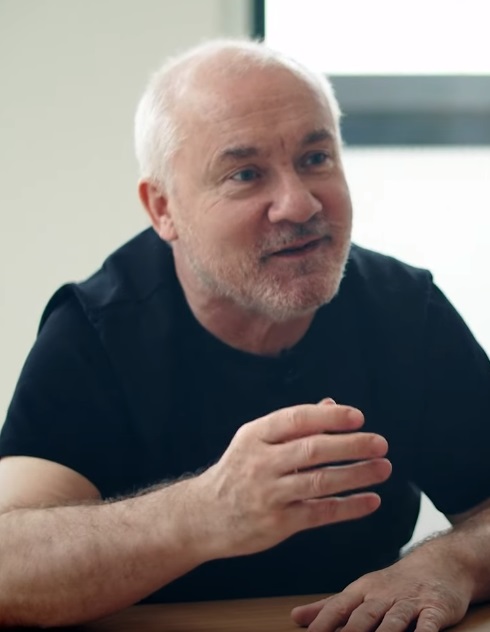
Why Damien Hirst matters
Damien Hirst is the central figure of the Young British Artists and one of the most commercially powerful living artists of the past three decades. For a collector, he is the textbook case of how spectacle, primary-market innovation, and sheer volume interact: a market that has produced enormous headline prices and a deep, liquid secondary supply, but one where value depends heavily on series, period, and edition. Understanding Hirst means understanding the difference between an iconic singular work and a mass-produced multiple bearing the same name.
- Born
- 1965-06-07, Bristol, England
- Nationality
- British
- Media
- Painting, Sculpture, Installation, Printmaking
- Movement
- Young British Artists, Contemporary
- Education
- Goldsmiths, University of London, BA Fine Art, 1986 to 1989 (preceded by a foundation diploma at Jacob Kramer College, Leeds)
- Signature motifs
- Formaldehyde animal vitrines, Spot paintings, Spin paintings, Butterfly and medicine-cabinet works
- Representation
- Gagosian, White Cube, Science Ltd
By the numbers
- USD 19.2MAuction highLullaby Spring, Sotheby's London, 2007
- 1995Turner Prize
- Bristol, 1965Born
- Gagosian; White Cube; Science LtdRepresented by
Selected works
Click any work to view it full screen.
Biography
Damien Steven Hirst was born on 7 June 1965 in Bristol and grew up in Leeds. After a foundation diploma at Jacob Kramer College, he studied for a BA in Fine Art at Goldsmiths, University of London, from 1986 to 1989. While still a student, in 1988, he conceived and organized Freeze, a warehouse exhibition in London's Docklands that is widely credited as the launch point for the Young British Artists generation.
His early career was bound up with the collector Charles Saatchi, who funded and exhibited the work that made Hirst famous, including The Physical Impossibility of Death in the Mind of Someone Living, a tiger shark suspended in formaldehyde, first shown in 1991. Recurring bodies of work followed: the formaldehyde vitrines, the spot paintings, the spin paintings, the butterfly canvases, and the medicine-cabinet pieces. He won the Turner Prize in 1995. In 2007 he produced For the Love of God, a platinum cast of a human skull set with more than 8,000 diamonds.
Hirst has repeatedly tested the boundary between artist and market. In 2008 he bypassed his dealers and sold a new body of work directly through Sotheby's in the Beautiful Inside My Head Forever sale. In 2021 he launched The Currency, a project of 10,000 artworks paired with NFTs. He remains active, represented by Gagosian and White Cube and supported by his own company, Science Ltd. He continues to live and work in the United Kingdom, with a major retrospective scheduled at the MMCA in Seoul in 2026.
Critical reception
Critical opinion on Hirst is sharply divided, and that division is itself part of his significance. Supporters credit him with reanimating the memento mori for a media age and with collapsing the distance between art, science, and commerce; the formaldehyde works in particular have been read, including in Tate scholarship, as confrontations with mortality and the sublime. Detractors have been blunt. The New York magazine critic Jerry Saltz once wrote that Hirst had brought forth so much bad art and blatant moneymaking that it was hard to remember he was not merely a huckster, and many reviewers have treated the spot and spin paintings, largely executed by assistants, as evidence of a practice that prizes brand over hand. Roberta Smith of The New York Times has written more measuredly about the formal mechanics of the spot paintings. The persistent critical question is not whether Hirst is influential but whether the late, high-volume output dilutes the early work that earned him his place.
Watch
Market
Hirst's auction high is Lullaby Spring, a steel and glass cabinet of 6,136 hand-painted pills, which sold for GBP 9,600,000 hammer (about USD 19.2 million) at Sotheby's London on 21 June 2007. The result made him, at the time, the most expensive living European artist at auction, and the work entered the collection of Qatar's ruling family. The Golden Calf, a bullock in formaldehyde with gold horns and hooves, was the standout of the 2008 Beautiful Inside My Head Forever sale at Sotheby's, achieving GBP 10.3 million with premium, though at a lower headline figure than Lullaby Spring.
His secondary market is unusually deep for a living artist, spanning unique vitrines at one extreme and large editions of prints and spot paintings at the other, so prices vary enormously by category.
Top auction results
| Work | Price | Sale |
|---|---|---|
| Lullaby Spring (2002) | USD 19,200,000 (GBP 9,600,000 (hammer)) | Sotheby's, London, 2007-06-21 |
Selected exhibitions
| Years | Exhibition | Venues |
|---|---|---|
| 2012 | Damien Hirst | Tate Modern, London |
| 2017 | Treasures from the Wreck of the Unbelievable | Palazzo Grassi and Punta della Dogana, Venice (Pinault Collection) |
| 2026 | Damien Hirst retrospective | MMCA, Seoul |
| 1991 | The Physical Impossibility of Death in the Mind of Someone Living (first shown) | Saatchi Gallery, London |
| 1988 | Freeze | Surrey Docks, London (organized by Hirst) |
Museum collections
- Tate, London
- Museum of Modern Art, New York
- The Metropolitan Museum of Art, New York
- British Museum, London
- Victoria and Albert Museum, London
- Hirshhorn Museum and Sculpture Garden, Washington, D.C.
- Stedelijk Museum, Amsterdam
- The Broad, Los Angeles
Awards and honors
- Turner Prize (1995)
- DAAD fellowship, Berlin (1994)
Authentication and provenance
Catalogue raisonne published.
Works are authenticated through the artist's company, Science Ltd, which administers his archive and certificate program. A formal authentication request process and certificates of authenticity support secondary-market verification.
Primary reference: https://gagosian.com/artists/damien-hirst/
What collectors should know
With Hirst, category is everything. A unique formaldehyde vitrine, a major medicine cabinet, and a standard spot-painting edition share an artist but not a market. Provenance and series matter more than the name alone, and the sheer volume of editions means buyers should distinguish carefully between scarce, museum-grade works and the much larger pool of multiples. The depth of his secondary market is a genuine advantage for liquidity, but it also means headline records reflect specific iconic objects rather than a uniform price level across the catalogue. The existence of a Science Ltd certificate program makes authentication relatively well structured compared with many living artists.
Further reading and resources
Data current as of 2026-06-19.

