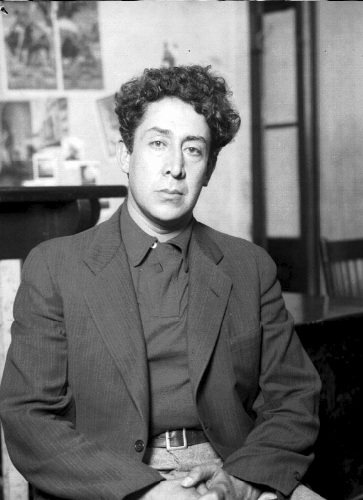
Why David Alfaro Siqueiros matters
David Alfaro Siqueiros was one of the three founding figures of Mexican Muralism, alongside Diego Rivera and Jose Clemente Orozco, and one of the most politically engaged painters of the twentieth century. His large-scale public murals fused revolutionary politics with an experimental, often industrial, approach to materials and technique, and his influence carried directly into the 2020 Whitney Museum exhibition "Vida Americana," which traced Mexican muralism's impact on American art of the 1920s to 1940s. For collectors, he represents an artist whose reputation rests overwhelmingly on public, largely non-transactable murals, with a comparatively small and thinly traded body of portable paintings, drawings, and prints on the secondary market.
- Born
- 1896-12-29, Chihuahua, Mexico (sources vary between Chihuahua City and the nearby town of Santa Rosalia de Camargo)
- Nationality
- Mexican
- Media
- Painting, Muralism, Fresco
- Movement
- Mexican Muralism, Social Realism
- Education
- Academia de San Carlos, Mexico City, art and architecture study, circa 1910 to 1911, no degree documented; further study in France, Spain, and Italy from 1919 on a Mexican government grant. Some secondary sources also cite an Open Air Painting School in Santa Anita, Mexico City, after 1911, though this is not corroborated by major encyclopedic sources.
- Signature motifs
- Monumental public murals, Political and social allegory, Dynamic foreshortened perspective
- Representation
- No formal estate representation identified as of 2026. Because Siqueiros died in 1974, galleries and auction houses handle and sell his work in the secondary market rather than formally representing him; no specific current dealer network is confirmed in available sources.
By the numbers
- USD 529,000Auction highNino Tarahumara, 2007, auction house and exact date not publicly confirmed
- Mexican MuralismLos Tres GrandesGrouped with Diego Rivera and Jose Clemente Orozco
- 1911 to 1974Career spanFrom the San Carlos Academy strike to his death
- None confirmedCatalogue raisonne
Biography
David Alfaro Siqueiros was born Jose de Jesus Alfaro Siqueiros on December 29, 1896. Sources place his birth in Chihuahua state, Mexico, though they differ on the exact locality, with some citing Chihuahua City and others the town of Santa Rosalia de Camargo. He began his formal art training in Mexico City at the Academia de San Carlos around 1910, and in 1911, at age fifteen, took part in a student strike against the academy's teaching methods. Some secondary sources state that strike led to the founding of an Open Air Painting School in Santa Anita, Mexico City, where Siqueiros was among the first students to enroll, though this claim is not corroborated by major encyclopedic sources. In 1919 he traveled to Europe on a Mexican government grant, studying in France, Spain, and Italy and absorbing the influence of Cubism, Futurism, and Renaissance fresco painting.
Through the 1920s and 1930s Siqueiros emerged, with Rivera and Orozco, as one of "Los Tres Grandes" of Mexican Muralism, producing large public murals that carried explicit Marxist and social themes. During a period of political exile in Los Angeles in 1932 he painted two major outdoor murals, "Portrait of Mexico Today" and "America Tropical." "Portrait of Mexico Today" was later removed intact and is now installed at the Santa Barbara Museum of Art, while "America Tropical" remains at its original site at El Pueblo de Los Angeles, with reproduction rights administered by the Artists Rights Society and SOMAAP. His political activism, which included lifelong Communist Party involvement and, according to some accounts, service connected to the Spanish Civil War, repeatedly intersected with his art and led to periods of imprisonment and exile in Mexico.
Late in life he was honored with retrospectives at the Museo Universitario de Ciencias y Arte in Mexico City in 1967 and at the Tokyo National Museum in 1972. David Alfaro Siqueiros died on January 6, 1974, in Cuernavaca, Morelos, Mexico, at age 77, after a documented struggle with cancer, as reported in his New York Times obituary. He was interred at the Rotunda of Illustrious Men in Mexico City.
Critical reception
Siqueiros is consistently described in museum and auction-house literature as the most technically experimental and politically radical of the three great Mexican muralists, known for his use of industrial materials, dynamic perspective, and monumental scale in service of explicit social and revolutionary content. In 1966 he received the Lenin Peace Prize, and he was also reported to have won first prize for his submissions to a 1950 exhibition in Venice, commonly associated with the Venice Biennale, though the precise title and awarding body of that prize are not fully documented in available sources. His inclusion in the Museum of Modern Art's 1993 survey "Latin American Artists of the Twentieth Century" and in the Whitney Museum's 2020 exhibition "Vida Americana" reflects a critical consensus that treats Mexican muralism, and Siqueiros in particular, as a direct forerunner of politically engaged public art in the United States.
Market
The all-time auction high for Siqueiros is "Nino Tarahumara," which sold for USD 529,000 in 2007. The auction house and exact calendar date of that sale are not confirmed in publicly available records. Market databases reviewed through mid-2026 show no later sale exceeding that figure. Siqueiros's secondary market consists largely of easel paintings, works on paper, and prints, since most of his best-known works are fixed public murals held in institutional or civic settings rather than in private hands. There is no formal estate managing his market; secondary-market activity runs through ordinary auction-house channels and specialist dealers in Latin American art, and no single gallery holds exclusive representation.
Top auction results
| Work | Price | Sale |
|---|---|---|
| Nino Tarahumara (2007) | USD 529,000 (USD 529,000) |
Selected exhibitions
| Years | Exhibition | Venues |
|---|---|---|
| 1932 | Siqueiros | Casino Espanol, Mexico City |
| 1932 | Portrait of Mexico Today | Los Angeles, painted during political exile; now installed at the Santa Barbara Museum of Art |
| 1947 | 70 Recent Works from David Alfaro Siqueiros | Museo Nacional de Artes Plasticas, Mexico City |
| 1953 | Siqueiros | Galeria de Arte Mexicano, Mexico City |
| 1967 | Siqueiros: Retrospective Exhibition 1911 to 1967 | Museo Universitario de Ciencias y Arte, Mexico City |
| 1972 | Siqueiros, Exposicion Retrospectiva | Tokyo National Museum, Tokyo |
| 1993 | Latin American Artists of the Twentieth Century | Museum of Modern Art, New York |
| 2020 | Vida Americana: Mexican Muralists Remake American Art, 1925 to 1945 | Whitney Museum of American Art, New York |
Museum collections
- Museum of Modern Art, New York
- Museo de Arte Carrillo Gil, Mexico City
- Hirshhorn Museum and Sculpture Garden, Washington, D.C.
- Philadelphia Museum of Art
- Santa Barbara Museum of Art (site-specific mural, Portrait of Mexico Today, 1932)
Awards and honors
- Lenin Peace Prize (1966)
- Reported first prize, Venice exhibition (often associated with the Venice Biennale, though the exact title and awarding body are not fully confirmed in available sources) (1950)
Authentication and provenance
No catalogue raisonne.
No published catalogue raisonne has been confirmed for Siqueiros. Works on the secondary market are typically vetted through provenance research and specialist dealers or auction houses. Reproduction rights for public murals such as America Tropical are administered by the Artists Rights Society (ARS) and SOMAAP.
Primary reference: https://www.sothebys.com/en/artists/david-alfaro-siqueiros
What collectors should know
Siqueiros has no confirmed published catalogue raisonne, and there is no formal estate or exclusive representing gallery, so provenance and authentication rest on specialist dealers, auction house expertise, and documentary research rather than a single centralized authority. His auction market is thin, anchored by a single confirmed record sale from 2007 whose house and exact date remain unconfirmed, which means new results can move the picture significantly and should be weighed against the small number of comparable transactions. Because so much of his most important work exists as fixed public murals rather than transferable objects, collectors should be careful to distinguish between his broad institutional and historical stature and the narrower, more fragile market for his portable paintings, drawings, and prints.
Further reading and resources
Data current as of 2026-07-11.

