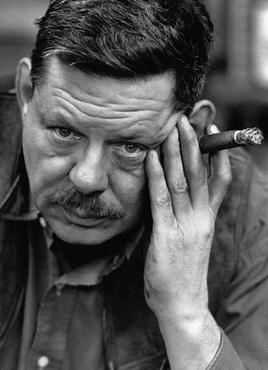
Why David Smith matters
David Smith is widely credited as the artist who established welded steel as a serious medium for American sculpture, and his work sits at the foundation of postwar American abstraction. For a collector, he represents a rare case of a mid-twentieth-century sculptor with both deep museum validation and a documented auction record in the tens of millions, though supply at that level is extremely limited.
- Born
- 1906-03-09, Decatur, Indiana, USA
- Nationality
- American
- Media
- Sculpture, Painting
- Movement
- Abstract Expressionism, Modernism
- Education
- No degree completed. Ohio University, 1924 to 1925 (left after one year); brief study at the University of Notre Dame and George Washington University, mid-1920s; Art Students League of New York, c. 1926 to 1932, under John Sloan, Kimon Nicolaides, and Jan Matulka.
- Signature motifs
- Welded steel sculpture, Cubi series, Geometric abstraction
- Representation
- Gagosian, Hauser & Wirth, Estate of David Smith
By the numbers
- USD 23.8MAuction highCubi XXVIII, Sotheby's New York, 2005
- 1957MoMA retrospectiveFull retrospective, Museum of Modern Art, New York
- US representation, 1954 and 1958Venice Biennale
- Gagosian; Hauser & WirthRepresented by
Biography
David Smith, born Roland David Smith on March 9, 1906, in Decatur, Indiana, did not complete a university degree. He attended Ohio University from 1924 to 1925 before leaving after a year, spent about two weeks at the University of Notre Dame, and briefly studied art and poetry at George Washington University. His formal artistic training came instead from the Art Students League of New York, where he studied from roughly 1926 to 1932 under painters including John Sloan, Kimon Nicolaides, and Jan Matulka. Around 1933, Smith began welding steel sculpture, a technique he adapted from industrial fabrication, becoming one of the first artists in the United States to build sculpture this way rather than carving or casting it.
He had his first solo exhibition in 1938 at Marian Willard's East River Gallery in New York. Through the 1940s and 1950s he developed an increasingly abstract, geometric vocabulary in series such as Agricola and later Cubi, working for much of his career from his home and studio at Bolton Landing in upstate New York. He received John Simon Guggenheim Memorial Fellowships in both 1950 and 1951, and represented the United States at the Venice Biennale in 1954 and 1958. The Museum of Modern Art gave him a full retrospective in 1957 and organized a nationwide traveling exhibition of about fifty of his sculptures in 1961. In 1965, President Lyndon B. Johnson appointed him to the newly formed National Council on the Arts.
Smith died on May 23, 1965, at age 59, in an automobile accident near Bennington and South Shaftsbury, Vermont, cutting short a career then at its critical and commercial peak.
Critical reception
Smith was recognized during his lifetime, and increasingly after his death, as a central figure in the transition from European modernist sculpture to a distinctly American postwar idiom. Critics writing in Arts Magazine in the mid-twentieth century described him as the American sculptor whose body of work had produced a lasting change in the medium itself, a view echoed by later museum retrospectives, including the Museum of Modern Art's 1957 show and the Solomon R. Guggenheim Museum's 2006 centennial retrospective, which traveled to the Centre Pompidou and Tate Modern. When a major survey of his sculpture traveled to the Yorkshire Sculpture Park in the United Kingdom in 2019, reviewers in the British press framed him as a foundational figure for welded sculpture whose influence extended well beyond the American Abstract Expressionist painters he is often grouped with. The recurring critical thread across six decades is that Smith treated welding and torch-cutting not as a technical shortcut but as a sculptural language in its own right.
Market
Smith's market high point is Cubi XXVIII, sold at Sotheby's New York on November 9, 2005, for USD 23,816,000 (widely reported at the time as USD 23.8 million) to collector Eli Broad. The sale was reported as a record for the most expensive work of contemporary art sold at auction up to that date. Below that level, results for smaller sculptures, drawings, and paintings trade at a much wider range, from the tens of thousands to low millions, reflecting a market with relatively few top-tier public sales. His estate and market presence are currently associated with Gagosian and Hauser & Wirth, both of which have organized major monographic exhibitions in coordination with the Estate of David Smith.
Top auction results
| Work | Price | Sale |
|---|---|---|
| Cubi XXVIII (1965) | USD 23,816,000 (USD 23,816,000) | Sotheby's, New York, 2005-11-09 |
Selected exhibitions
| Years | Exhibition | Venues |
|---|---|---|
| 1938 | First solo exhibition | Marian Willard's East River Gallery, New York |
| 1954 | Venice Biennale | United States representation, Venice Biennale |
| 1957 | David Smith retrospective | Museum of Modern Art, New York |
| 1958 | Venice Biennale | United States representation, Venice Biennale |
| 2006 to 2007 | David Smith: A Centennial | Solomon R. Guggenheim Museum, New York, traveled to Centre Pompidou, Paris, and Tate Modern, London |
| 2017 | David Smith: The White Sculptures | Storm King Art Center, Mountainville, New York |
| 2019 | David Smith: Sculpture 1932 to 1965 | Yorkshire Sculpture Park, Wakefield, UK |
| 2024 | No One Thing. David Smith: Late Sculptures | Hauser & Wirth, New York |
Museum collections
- Museum of Modern Art, New York
- Whitney Museum of American Art, New York
- National Gallery of Art, Washington, D.C.
- Hirshhorn Museum and Sculpture Garden, Washington, D.C.
- Peggy Guggenheim Collection, Venice
- Harvard Art Museums, Fogg Museum, Cambridge
- Tate, London
- Centre Pompidou, Paris
Awards and honors
- John Simon Guggenheim Memorial Fellowship (1950)
- John Simon Guggenheim Memorial Fellowship (second year) (1951)
- Appointed to the National Council on the Arts by President Lyndon B. Johnson (1965)
Authentication and provenance
No catalogue raisonne.
No published catalogue raisonne could be confirmed from the primary sources reviewed for this profile. The Estate of David Smith, in coordination with Gagosian and Hauser & Wirth, functions as the primary body for questions of attribution and provenance.
Primary reference: https://www.davidsmithestate.org/
What collectors should know
Because Smith died in 1965, his market is fixed in supply, and the exceptional Cubi and Agricola sculptures that anchor his auction record surface only rarely, so any single result should be read against the specific work rather than treated as a market-wide indicator. No catalogue raisonne has been confirmed for his sculpture; provenance research instead relies on the Estate of David Smith's own records and its coordination with his current galleries. Authentication and scholarly questions are generally directed to the Estate, which works closely with Gagosian and Hauser & Wirth on exhibitions and placements. Note also that "David Smith" is a common name in the art market, including an unrelated living British landscape painter born in 1949, so provenance and attribution should always be checked against the 1906 to 1965 dates specific to this artist.
Further reading and resources
Data current as of 2026-07-09.

