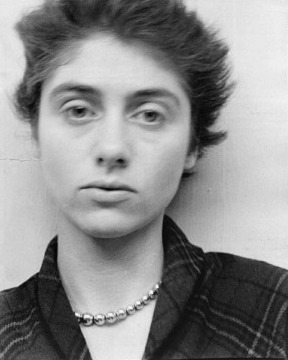
Why Diane Arbus matters
Diane Arbus is the rare photographer whose work commands seven figures at auction, and for a collector that fact carries a specific structure: her market is built almost entirely on prints rather than unique objects, and supply is governed by an estate that has kept tight control over who may print her negatives. She is a study in how photography prices, which usually trail painting by an order of magnitude, can reach the top of the medium when name recognition, museum saturation, and scarce authorized printing combine. The result is a market where the headline number is large for a photographer, the underlying assets are editions and vintage prints rather than singular paintings, and provenance and printing history do much of the work in setting value.
- Born
- 1923-03-14, New York City, USA
- Nationality
- American
- Media
- Photography
- Movement
- Documentary photography, New York School of photography
- Education
- Ethical Culture Fieldston School, New York; studied under Berenice Abbott, Alexey Brodovitch, and Lisette Model
- Signature motifs
- Square-format frontal portraits, Flash in daylight, Subjects on the social margins
- Representation
- David Zwirner, Fraenkel Gallery
By the numbers
- USD 1.2MAuction highIdentical Twins, Roselle, New Jersey, Christie's New York, 2024
- PhotographyPrimary medium
- David Zwirner and Fraenkel GalleryEstate
- 1972, posthumousMoMA retrospective
Selected works
Click any work to view it full screen.
Biography
Diane Arbus made direct, square-format portraits of people, often photographing those on the margins of mid-century American life: circus and sideshow performers, nudists, residents of institutions, and the eccentric, the famous, and the ordinary alike. Her use of flash in daylight isolated her subjects from their surroundings and gave the pictures a frontal, confrontational clarity that became one of the most influential styles in postwar photography.
She was born in New York City in 1923 into the family that owned Russeks, a Fifth Avenue department store, and attended the Ethical Culture Fieldston School. With her husband Allan Arbus she ran a commercial fashion photography studio before turning to her own work in the late 1950s. She studied with Berenice Abbott early on, briefly with the art director Alexey Brodovitch, and most decisively with Lisette Model beginning in 1956, whose teaching helped her find the unsparing portrait style she became known for. She won Guggenheim Fellowships in 1963 and 1966 and published in magazines including Esquire and Harper's Bazaar.
Arbus died in New York City in 1971, at the age of 48, by suicide. Her reputation grew rapidly after her death. In 1972 the Museum of Modern Art mounted a posthumous retrospective curated by John Szarkowski that traveled across the United States and Canada through 1975 and drew enormous audiences, and the same year she became the first photographer to represent the United States at the Venice Biennale. The accompanying Aperture monograph, edited by her daughter Doon Arbus and the designer Marvin Israel, became one of the most widely circulated photography books of the period and remains a touchstone for the field.
Critical reception
A photograph is a secret about a secret. The more it tells you the less you know.
Diane Arbus
Critical opinion on Arbus has been intense and divided in a way that, over time, has only deepened her standing. The 1972 MoMA retrospective was a landmark event for photography as a museum medium, and John Szarkowski's championing placed her at the center of the New York School of documentary photography alongside figures such as Robert Frank, Lee Friedlander, and Garry Winogrand. At the same time, critics including Susan Sontag argued that her photographs of marginalized subjects raised difficult questions about the gaze and about the ethics of looking, a debate that has accompanied the work ever since. The recurring critical theme is the directness of the encounter: the frontal pose, the flash, and the square frame are read not as neutral documentation but as a deliberate confrontation between photographer, subject, and viewer. Reassessment has generally treated her as one of the defining American photographers of the twentieth century, with large surveys such as the 2025 Diane Arbus: Constellation at the Park Avenue Armory reaffirming the scale and ambition of the body of work rather than revising her place in it.
Watch
Market
Arbus has the strongest auction market of almost any photographer, anchored by a small group of iconic images that recur at the top of her results. Her auction record is Identical Twins, (Cathleen and Colleen), Roselle, New Jersey, 1966, a gelatin silver print that sold for USD 1,197,000 at Christie's New York on 14 May 2024 in the 21st Century Evening Sale, a price reported as a record for the artist. The previous benchmark was a complete portfolio of A box of ten photographs, which sold for USD 1,008,000 at Christie's New York in May 2023; an earlier example of the same portfolio had reached USD 792,500 at Christie's in 2018. Below the very top, the strongest and most liquid demand concentrates on a handful of signature images, including Identical Twins, Child with a Toy Hand Grenade in Central Park, and A Jewish Giant at Home with His Parents in the Bronx, which appear repeatedly across the price record.
Because the work is photographic, the market trades in prints rather than unique objects, and value turns heavily on whether a print is a vintage print made in Arbus's lifetime or a posthumous print, on edition and portfolio context, and on provenance. Supply of new authorized prints is constrained: Neil Selkirk is the only person authorized to make prints from her negatives, which keeps the estate's printing under unusually tight control. For a collector, that combination of a few much-wanted images, a print-based market, and a closely governed supply is the defining feature of how her work prices.
Top auction results
| Work | Price | Sale |
|---|---|---|
| Identical Twins, (Cathleen and Colleen), Roselle, New Jersey, 1966 (1966) | USD 1,197,000 (USD 1,197,000) | Christie's, New York, 2024-05-14 |
Selected exhibitions
| Years | Exhibition | Venues |
|---|---|---|
| 2025 | Diane Arbus: Constellation | Park Avenue Armory, New York (North American premiere) |
| 2025 to 2026 | Diane Arbus: Sanctum Sanctorum | David Zwirner, London |
| 2022 to 2023 | Cataclysm: The 1972 Diane Arbus Retrospective Revisited | David Zwirner, New York |
| 2018 | Diane Arbus: A box of ten photographs | Smithsonian American Art Museum, Washington, D.C. |
| 1972 | Diane Arbus (posthumous retrospective) | The Museum of Modern Art, New York (traveled across the United States and Canada through 1975) |
| 1972 | Venice Biennale, American Pavilion | First photographer to represent the United States at the Biennale |
Museum collections
- The Museum of Modern Art, New York
- The Metropolitan Museum of Art, New York
- Whitney Museum of American Art, New York
- J. Paul Getty Museum, Los Angeles
- San Francisco Museum of Modern Art
- Smithsonian American Art Museum, Washington, D.C.
- Tate, London
Awards and honors
- Guggenheim Fellowship (1963)
- Guggenheim Fellowship (renewal) (1966)
Authentication and provenance
No catalogue raisonne.
There is no published catalogue raisonne. The Estate of Diane Arbus, overseen by her daughter Doon Arbus, controls reproduction and exhibition rights, and Neil Selkirk is the only person authorized to make prints from her negatives. The estate is co-represented by David Zwirner and Fraenkel Gallery.
Primary reference: https://www.davidzwirner.com/artists/diane-arbus
What collectors should know
The first thing to understand about Arbus is that her market is a print market, not a market in unique works, so the same image can appear at auction many times at very different prices depending on whether it is a vintage or posthumous print, its size, its edition or portfolio context, and its provenance. The seven-figure results belong to a narrow set of celebrated images in strong print form, while many other prints trade at far lower levels. The absence of a published catalogue raisonne places more weight on the estate and on print authorization: the Estate of Diane Arbus, overseen by her daughter Doon Arbus and co-represented by David Zwirner and Fraenkel Gallery, controls reproduction and printing, and Neil Selkirk is the sole authorized printer of her negatives. That control is the main reason supply of new authorized prints is limited. For a collector, the durability signals are the deep museum representation, including the Metropolitan Museum of Art's acquisition of her complete archive, and the continued institutional programming around the work; the central discipline is matching the specific print, its date, and its provenance to the price being paid.
Further reading and resources
Data current as of 2026-06-29.

