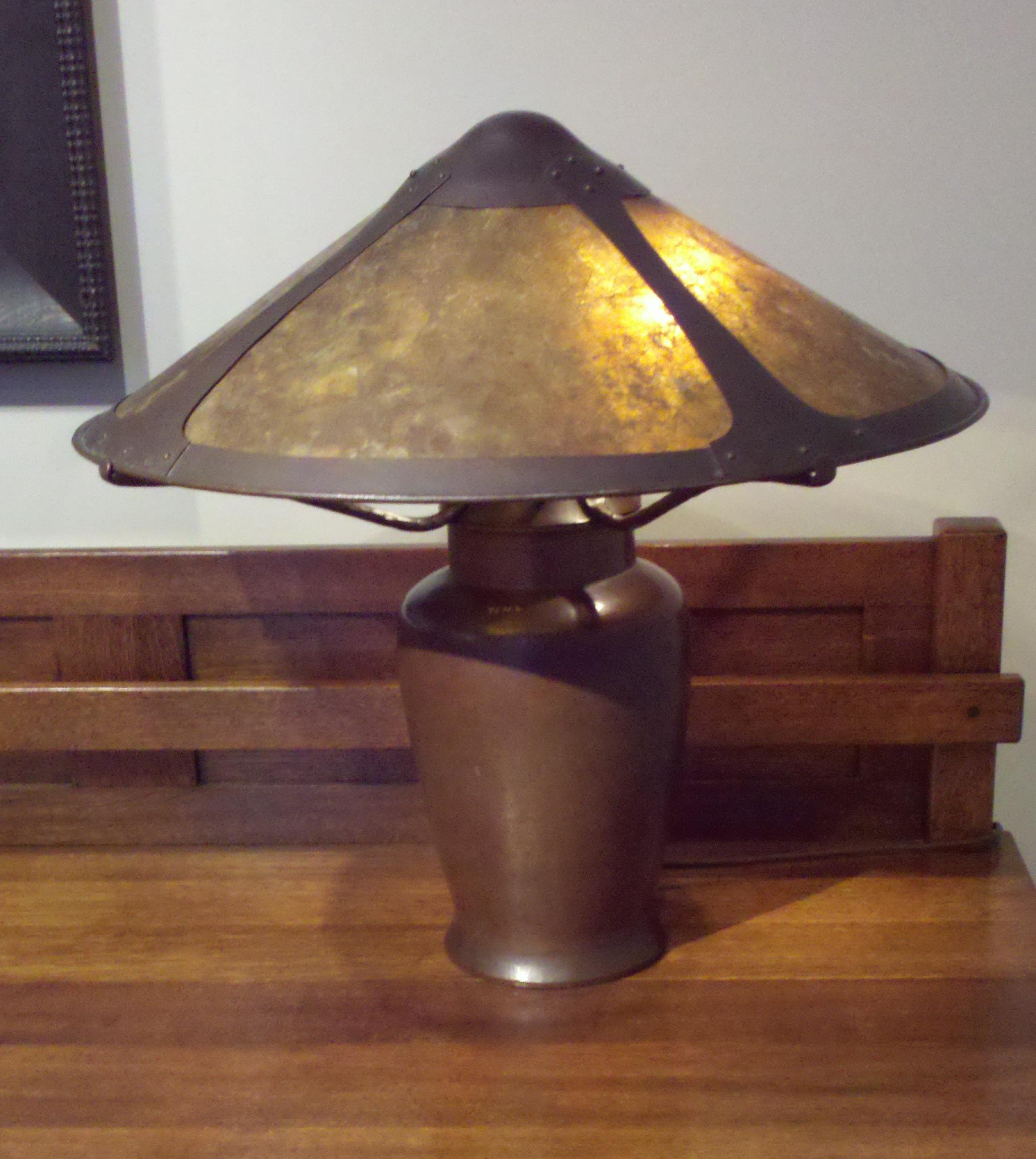
Why Dirk van Erp matters
Dirk van Erp is one of the defining metalsmiths of the American Arts and Crafts movement, best known for hammered copper lamps fitted with warm, glowing mica shades. His pieces sit in major museum decorative arts collections and command some of the strongest prices in the market for early twentieth century American design. For a collector, he is a case study in how a small, hand-built studio output, made without any catalogue raisonne, can still command deep institutional respect and a genuine, if thin, auction market a century later.
- Born
- 1862-01-04, Leeuwarden, Netherlands
- Nationality
- Dutch-American
- Media
- Metalwork, Hammered copper
- Movement
- Arts and Crafts Movement
- Education
- No formal art school documented. Trained informally in metalwork, likely within a family workshop tradition in the Netherlands, before immigrating to the United States.
- Signature motifs
- Hammered copper surfaces, Mica-shade lamps, Windmill mark signature
- Representation
- "Isak Lindenauer Arts and Crafts Antiques (specialist dealer)", "Dirk van Erp Museum and Workshop, Alameda, California (adjacent to ACStickley Gallery)"
By the numbers
- USD 180,000Auction highTable lamp designed by D'Arcy Gaw, made by Dirk van Erp; Craftsman Auctions, Lambertville, New Jersey, June 2002
- Deceased, 1933StatusDutch-American coppersmith of the Arts and Crafts movement
- San Francisco, circa 1910 to 1929Studio activeStudio continued under his son William van Erp until 1977
- Specialist Arts and Crafts dealers and an estate-affiliated museum and workshopRepresented by
Biography
Dirk van Erp was born in Leeuwarden, Netherlands, on January 4, 1862, according to Wikipedia's biographical entry and consistent with the Metropolitan Museum of Art's bracket dates of 1862 to 1933; some reference and dealer sources instead give a birth year of 1860, so the exact year carries a documented discrepancy. He is generally described as trained informally in metalwork rather than through a named school, in keeping with the artisanal, workshop-based training common to Dutch metalsmithing families of the period.
Van Erp immigrated to the United States, arriving in California in the mid-1880s, with sources giving 1885 or 1886. He became active as a coppersmith in Oakland and San Francisco, opening his own studio around 1908 to 1910, accounts differ on the exact year and city of the first shop. Between roughly 1909 and 1911 he partnered with designer Elizabeth Eleanor D'Arcy Gaw, whose formal training at the Art Institute of Chicago and at C.R. Ashbee's Guild and School of Handicraft in London shaped the refined lamp forms that now carry both their names. Van Erp retired in 1929 and turned the studio over to his son, William van Erp, who kept it running in San Francisco until 1977.
Van Erp died on July 18, 1933. Wikipedia's account, drawing on biographical sources, states that he died in Fairfax, California, and that his wife, Mary van Erp, died four hours later; the Getty Research Institute's ULAN record instead gives San Francisco as the death location. Both are documented in credible reference sources and the discrepancy is noted here rather than resolved by guesswork.
Critical reception
Institutional and specialist opinion treats van Erp as the central figure of Bay Area Arts and Crafts metalwork. The Metropolitan Museum of Art's curatorial text describes him as an "iconic Arts and Crafts metalsmith" who apprenticed in the Netherlands before immigrating to America, and its collection entries identify him as one of the most important metalworkers in California during the period. Kenneth Trapp, curator of decorative arts at the Oakland Museum of California, has been quoted describing van Erp as widely considered the most important metalsmith of the Arts and Crafts movement, and as a maker whose lamps and other copper pieces stand largely unrivaled in American metalwork of the era. The recurring critical theme is craftsmanship and material honesty: hand-hammered copper surfaces and mica shades treated as expressive ends in themselves, not merely functional lighting.
Market
Van Erp's market is built almost entirely on the secondary, auction and specialist-dealer market for early American Arts and Crafts metalwork. The highest price documented for his work is USD 180,000, paid at Craftsman Auctions in Lambertville, New Jersey, in June 2002, for a copper and mica table lamp designed by D'Arcy Gaw and made by Dirk van Erp; the exact day of sale within that month is not confirmed in available sources. An earlier "Warty" hammered copper and mica lamp had set what was reported at the time as a world record of USD 104,750 at Butterfields. Since then, prices at auction for van Erp lamps, vases, and desk accessories have varied widely, from a few thousand dollars for smaller, later pieces to sums in the tens of thousands for large, early, or design-collaboration examples, reflecting a market driven by size, form, mica condition, and rarity rather than a smooth price curve.
Top auction results
| Work | Price | Sale |
|---|---|---|
| Table lamp (design attributed to D'Arcy Gaw, made by Dirk van Erp) (2002) | USD 180,000 | Craftsman Auctions, Lambertville, New Jersey |
Selected exhibitions
| Years | Exhibition | Venues |
|---|---|---|
| n.d. | Dirk van Erp Leeuwarder Copper Artist, Made in America (1862 to 1933) | Pier Pander Museum, Leeuwarden, Netherlands |
| n.d. | Dirk van Erp Copper Shop | Isak Lindenauer Arts and Crafts Antiques, San Francisco Bay Area |
| Ongoing | American Wing, permanent collection display | Metropolitan Museum of Art, New York |
| Ongoing | Metalwork gallery | Museum of the American Arts and Crafts Movement, St. Petersburg, Florida |
| Reopened 2020s | Dirk van Erp Museum and Workshop | Alameda, California, adjacent to ACStickley Gallery |
Museum collections
- Metropolitan Museum of Art, New York
- Museum of the American Arts and Crafts Movement, St. Petersburg, Florida
- Pier Pander Museum, Leeuwarden, Netherlands (exhibited)
Authentication and provenance
No catalogue raisonne.
No catalogue raisonne has been published for Dirk van Erp. Works are typically authenticated through the maker's stamped windmill mark and studio marks, cross-checked by specialist Arts and Crafts dealers and auction house department experts.
Primary reference: https://en.wikipedia.org/wiki/Dirk_van_Erp
What collectors should know
There is no catalogue raisonne for Dirk van Erp, so provenance, the stamped windmill mark, and confirmation by specialist Arts and Crafts dealers or auction house departments carry real weight in establishing authenticity. The auction record is concentrated in a handful of well-documented, high-value sales rather than a deep, continuous trading history, which means published price benchmarks should be read as data points tied to specific, often unusual pieces rather than a smooth market trend. Because early and design-collaboration pieces, particularly those associated with D'Arcy Gaw, trade at a substantial premium over later or smaller studio output, collectors should treat form, date, and attribution detail as the main drivers of value.
Further reading and resources
Data current as of 2026-07-16.

